Band Members

Bernie Leadon
Randy Meisner
Glenn Frey
Don Henley
Don Felder
Joe Walsh
Timothy B.Schmit
Bernie Leadon
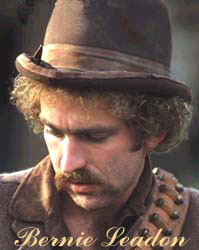
 Vocals, Guitar, Steel Guitar Banjo, Mandolin
Born on July 19, 1947
Minneapolis, Minnesota,USA
Original member of the Eagles
Left the band in 1975
Replaced by Joe Walsh
Best Work : My Man, Bitter Creek, Train Leaves here morning, Witchy Woman
Bernie Leadon was with the Eagles from 1972-1975..all of the albums included on Greatest Hits. He arrived in L.A. in 1967 as a member of Hearts and Flowers before joining Dillard and Clark and then the Flying Burrito Brothers. He had the best voice: smooth, soft, and clear. He could play guitar and banjo when he was six! Bernie was a great country guitarist and an awesome banjo player.
His songs were some of the best but unnoticed Eagles tunes: My Man, I Wish You Peace, and Train Leaves Here This Morning. It was very unfortunate that Bernie left, because he was a great force in early Eagles music, and you can definitely sense his absence in the Eagles last two albums.He represented, like Glenn, the country side of the Eagles.When he left the group and Joe Walsh entered Glenn was the only country person left and it was out of balance and I believe that led to the breakup. He was an important member in the early Eagle days.
Bernie in 1979, on why he left the band:
"I kept asking 'Are we going to rest next month?' and we never did. I wanted to get in shape before the age of thirty so I could have a chance at the rest of my life. I was afraid something inside me was dying. Leaving was an act of survival."
 Back to Top
Randy Meisner

Vocals, Bass, Guitarone
Born on March 8, 1946
Scottsbluff, Nebraska,USA
Original member of the Eagles
Left the band in 1977
Replaced by Timothy Schmit
Best Work : Take it to the Limit, Certain Kind of Fool, Saturday Night
For most of his professional life, Randy Meisner has been one of America's highest-reputed and least-known musicians. His work, with bands ranging from Poco through Rick Nelson's Stone Canyon Band, to his years as a founding member of the Eagles, has remained first-rate. But Randy, a quiet person, has preferred to relinquish the spotlight to others.
Randy's from Scottsbluff, Nebraska, and the grandson of a Russian classical violinist. turned on to music when he first heard Elvis Presley, he took up guitar, then bass. He joined a local group, the Dynamics. The group still exists back home; one of Randy's fellow members, Donny Ullstrom, sings background on Randy's album and has joined his new band.
At 20, Randy headed for Denver, joined a band called The Soul Survivors ( not the "Expressway to Your Heart" Soul Survivors), stayed with them while they grew relatively rich and relatively famous in Denver, and headed with them to the Big City -- Los Angeles. There, prevailing conditions resulted in a change of name to The Poor. "There were five people living in a one bedroom place," Randy recalls, "sleeping on the floor. We used to sell the Los Angeles Free Presson corners so that we could eat. No one had a car, so we couldn't get our equipment to auditions."
The Poor's management also handled Sonny and Cher and the Buffalo Springfield. But the group, while pioneering complex vocal harmonies along with their excellent instrumental work, never got beyond the good-reputation stage. One single, Tom Shipley's "She's Got The Time," was released on Loma Records and passed in obscurity.
When the Buffalo Springfield broke up, Richie Furay and Jim Messina promptly formed their own, new group, eventually named Poco. Randy was the first musician they called in; others were Randy's Denver friends, Rusty Young and George Grantham.
Randy soon became dissatisfied with Poco -- a dispute over the mixing is said to have been the last straw -- and when Rick Nelson asked him to join his new band, Randy was quick to say "yes." The first edition of the Stone Canyon Band was The Poor, regrouped by Randy, plus Steel guitarist and Buck Owens alumnus Tom Brumley.After two albums and a European tour with Nelson, Randy moved back to Nebraska with his family, worked briefly for the John Deere tractor company, met Stephan Love, and formed another band Goldrush. They moved back to Los Angeles, where Randy worked on and off with Nelson while trying to build Goldrush. He also played on recording sessions for acts including Waylon Jennings, John Stewart, and Linda Ronstadt.
Following a series of accidental encounters with Glenn Frey, Randy was asked to join him in the Linda Ronstadt band -- a group also including drummer Don Henley. The three, plus guitarist Bernie Leadon, formed the first-edition Eagles in 1972; Randy left the band in 1977. His replacement, Timothy B. Schmit, had followed Randy into the bass-player's chair in Poco (eventually becoming the band's co-leader, lead singer and on-stage spokesman), rounding the story out nicely.Having decided to work with expert, though unknown, musicians and producer Alan Brackett, Randy worked on the selection of material, arrangements, and overall musical direction of this crucial "first" album. "Making the record was the most fun I've had in years," he states, "the band came together so naturally most of the guys have been playing together since high school!"
While with The Eagles, Randy's best-known vehicle was the song "Take It To The Limit," which he co-composed and which became his spotlighted solo in the band's show. Throughout his career as a professional musician, Randy's pursuit for excellence has been well known. Now, with his first chance for group leadership Randy can be counted on to "take it to the limit one more time."
Back to Top
Glenn Frey
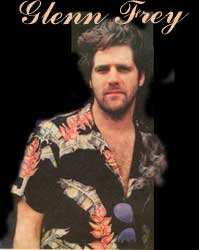
Vocals, Guitar, Slide Guitar, Harmonium, Keyboards
Born on November 6, 1948
Detroit, Michigan,USA
Original member of the Eagles
Very good solo career
Good Country Writer
Best Work : Tequila Sunrise, Lyin' Eyes, New Kid in Town
While remaining best known for his tenure in the Eagles, Glenn Frey also enjoyed considerable success as a solo performer, with a career dating back to the glory days of the Detroit rock scene of the mid-1960s. Born in the Motor City on November 6, 1948, Frey formed his first band the Mushrooms in 1966, soon appearing live on the local TV program Robin Seymour's Swinging Time and becoming a staple at the area teen club the Hideout; for the club's Hideout Records label, the group cut their debut single "Such a Lovely Child," a session produced by another aspiring Detroit rocker, Bob Seger.The Mushrooms split soon after, and Frey joined the folk-rock group the Four of Us; he subsequently formed two more Detroit teen bands, the Subterraneans and the Heavy Metal Kids, before relocating to California in the early 1970s.
After co-founding the Eagles a year later, Frey enjoyed a remarkable run as a member of one of the decade's most successful bands, assuming lead vocals on smashes including "Take It Easy," "Tequila Sunrise," "New Kid in Town," "Lyin' Eyes" and "Heartache Tonight." When the Eagles disbanded in the wake of 1979's The Long Run, he began a solo career in 1982 with No Fun Aloud, notching a pair of Top 40 hits with "I Found Somebody" and "The One You Love." 1984's ...
Here's a quote from Glenn back in 1975, showing a bit of an attitude about the band:
"I mean we got the songs. We got the best country guitarist in Bernie Leadon, and the best rock'n'roll player in the world in Felder, and the best high-singin' bass player, and the best singin' drummer and I know I'm the grease and we are going. I know we're on, there's nobody better. And that's all I know."
Back to Top
Don Henley
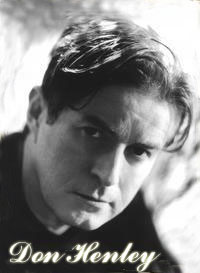
Vocals, Drums, Percussion Keyboards
Born on July 22, 1947
Gilmer, Texas, USA
Original member of the Eagles
Very good solo career
Best song Writer
Best Work : Last Resort, Hotel California, Desperado
Don Henley is obviously the most recognized Eagles member. His voice stood out as "the" lead vocalist for the later Eagles. Henley was probably the best songwriter, and perhaps the best singer, even though he didn't have the best voice. He is a great drummer, with Take it Easy, Hotel California, and Victim of Love standing out in my mind
Out of all of the Eagles, Don Henley had the most successful solo career. After the group broke up in 1982, Henley released his first solo album, I Can't Stand Still. Although it wasn't as successful as an Eagles record, the album performed respectably, launching the number three single "Dirty Laundry" and going gold. Building the Perfect Beast followed two years later and established Henley as a solo star in his own right. Featuring the Top Ten hits "Boys of Summer" and "All She Wants to Do Is Dance," as well as the Top 40 singles "Not Enough Love in the World" and "Sunset Grill," the album sold over two million copies and stayed on the charts for over a year.
Henley's third album, 1989's The End of the Innocence, was his most ambitious record yet, as well as his most commercially successful. The album sold over three million copies and stayed on the charts for nearly three years, launching the hit singles "The End of the Innocence," "Heart of the Matter," "New York Minute," "How Bad Do You Want It?," and "The Last Worthless Evening." Henley reunited with the Eagles in 1994, embarking on a worldwide tour. The group released a live album culled from an appearance on MTV Unplugged called Hell Freezes Over; the record also featured a handful of new studio tracks. Hell Freezes Over was a major success, selling over five million copies by the summer of 1995. However, the group decided not to pursue any more projects together and Henley continued working on his fourth solo album, finally issued in mid-2000 under the title Inside Job.
Back to Top
Don Felder
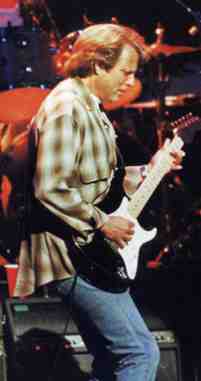
Vocals, Guitar, Slide Guitar, Steel Guitar, Mandolin
Born on September 21, 1947
Gainesville, Florida, USA
Joined the Eagles in 1975
Fired on April, 2001
Guitar God
Best Work : Too many hands, Hotel California, Getover it
While growing up in Gainesville, Florida Don saw Elvis on TV and it changed his life. " I can remember seeing him (Elvis) on the Ed Sullivan Show Live and just going wild over the music I heard and how "COOL" he was. Shortly after that there came a flood of music and "Rock & Roll" seemed to be at every of my life. 1 Soon Felder would be learning the guitar. "I traded a handful of cherry bombs to the kid across the street for a horrible acoustic that was full of holes, I was around 11, and everybody on the block was playing the guitar. I conned another kid out of his guitar somehow. I had a lot of different guitars when I was a kid." At 15 Felder joined a band called the Continentals, which also included Stephen Stills. "We played junior high schools, the usual stuff," says Felder "We were pretty successful, considering that we were all teenagers lying about our ages." After Stills left the group, he was replaced by Bernie Leadon, who specialized in bluegrass & country. "I wanted to learn his country stuff, and Bernie had never played electric guitar, So we traded lessons." The band would become the Maundy Quintet They would play on the same circuit with Mudcrutch. Mudcrunch would become Tom Petty & the Heartbreakers. Interesting sides note, Felder taught guitar to Tom Petty and did arrangements for Mudcrutch.
"The Cyrkle came through town when they had their single, 'Red Rubber Ball' and we opened for them. Their manager took us to New York to play club gigs. Our drummer took the exam to leave ninth grade before the end of the school year and we went, but he got homesick pretty quick. We went back to Florida and broke up." Leadon moved to California and Don headed right back to New York with a new band called Flow. They would record one album, but soon after broke up. While in New York Felder learned various styles of playing to support himself. "Frat-rock, jazz, Top 40, country--and I picked up a little pedal steel, classical guitar and so on." "Then I moved to Boston and got a job in a recording studio, learning how to make records and be an engineer. Bernie kept calling me and saying, 'Come to LA--there's tons of work out here!" But I had contact with West Coast acts that came through town, and I was writing, playing and learning. It was two solid years of woodshedding. I made practically no money, but I stayed busy all day and all night. I worked at the studio all day, then I'd play rhythm and blues from 9 to 2. I played and played and played."
The Eagles came to Boston on their first tour and Felder met the rest of the band and jammed with Leadon backstage. "I played slide guitar and Glenn Frey freaked out and invited me to LA to work on sessions." Felder made it to California in 1972. Soon he was hired as guitar player for David Blue's album. When the record was completed, Felder was asked to stay on and help Blue put together the tour. "We opened for Crosby and Nash for about nine months," Graham Nash asked Don to play guitar on his solo tour. "I was getting ready to out with Graham when the Eagles called me to come in and add some slide guitar to 'Good Day in Hell.' I did the session and the next day they asked me to join the band." Felder didn't hesitate to join the band. "I felt as though I'd joined a band that was breaking up," he says. "Bernie was going to quit, Randy was quitting, and everybody was really pissed off. Those were hostile times," he says. "We argue about things sometimes even now, but there's a lot more respect for the individuals." (Remember that he made this statement in '80) Felder was hired to bring a more solid Rock & Roll sound to the band's already established country rock sound. "They wanted the record to be a little more rock and roll," says Felder. Donn began a friendship with Joe Walsh. Who was another client of producer Bill Szymczyk. "Joe came around to smoke joints and jam after sessions," says Don. " He told me, 'If Bernie ever quits, I'd join you guys in a second." The band started rehearsing with Walsh when Leadon didn't show up for a flight to a gig. Before he was asked to join, Walsh worked with Felder on Walsh's 'You Can't Argue With A Sick Mind' LP and did a TV show with him. "That was Joe's audition, in a way," says Felder. "It turned out that not only is he a great player, but he's a positive, humorous, great guy. People said it'd never work, that Walsh was too heavy metal, but he backed way off and let me write and arrange. It just worked out great--we gave each other plenty of room."
From that moment on the Eagles became a full - fledged Rock & Roll outfit. The fist album to be released with the new lineup with the legendary 'Hotel California'. The title track is one of the most beloved songs in R&R history. It was written by Don Henley, Glenn Frey & of course Don Felder. Felder wrote ALL the music and submitted copies to each member of the band. Though originally he wrote it in the wrong key:) "We actually recorded the basic three times. I wrote it at home on my Teac four-track, and I did all the guitar lines and the melody and presented it to the band. I was written in e-minor, but as Don and Glenn and I worked on the lyrics and the vocal arrangement, it turned out we needed it to be in B-minor. We re-cut the basic twice in B-minor, which is a terrible key to play guitar in. It took us ten or twelve days just to get the basic tracks together." After the amazing success of Hotel California and the tour that was to follow. The band was presented with a huge problem. How do they follow up the success of Hotel California? For three years they recorded and recorded tracks for The Long Run (or the band called it 'The Long One') Stress among the members developed and by the end of the Long Run tour things weren't looking good for the band. Creative and personal differences led to the break up of the band. "We were big-too big. There were so many restrictions within the band as far as making records. There was such high pressure to do high-quality work. We had to come up with an album that measured up to incredibly high standards. That restricted us. We had to play it safe. We didn't want to make any mistakes. The stress in that situation was heavy. The pressure was often unbearable." Recalling the news of the bands demise Felder says, "We were shocked, emotionally upset. . . . I still remember how devastated we all were. . . . It was like getting hit in the face from out of nowhere. . . . The bottom dropped out of everything." "Glenn told everyone in the band that he wasn't going to work with the Eagles anymore, that he was going solo. At that point we were in the middle of the Eagles' live album. He refused to participate as a group member. Everyone else wanted to finish the album, so the four of us went ahead and finished it.
Glenn. was in L.A. and we were in Miami. We flew tapes back to L.A and Glenn went into the studio with his own engineer. He did his part and mailed the tape back. It was like phoning in his part. He was tired of the group. He didn't want any more to do with us. The rest of the band assumed that Frey's departure is only temporary. "We all were clinging to the hope of changing Glenn's mind," Felder said. "We figured he would do his solo record and get it out of his system and then reconsider reforming the band." Felder recalls that after Glenn refused to reconsider everyone got solo crazy. "Henley said if Frey is going to do an album, then me too. Then Joe (Walsh) shortly after that said, 'Me too.' Then I said, 'Me too" By 1982 Henley & Frey was releasing their first solo album and Felder was in his home 24 track recording studio working on his. Airborne was released in 1983 and unlike his former band mates Felder's LP was pure R&R. Nothing like what was featured on any Eagles LP. Even though he was proud of his first LP he was unsure if he was ready to make a solo album. "I really wasn't anxious to assume the responsibility for a whole record," he said. "I was afraid. I said to myself, 'I have to do this all alone now.' That was scary after having those guys to work with and rely on all those years. I wasn't sure I was ready. Irving (Azoff, the Eagles' manager) had to coax me into doing my own record. "I did the album because I missed recording and I had some songs I wanted to record. I didn't do it for the money. I don't need the money. Financially, I did very well in the Eagles." Airborne was mostly done is a former guesthouse turned studio at Felder's house. "Basically what I did was sit down by myself with the 24-track and a drum machine and make a demo of each song -- rough guitars, keyboards and vocals and a Linn Drum Machine," he explains. "Then I'd take the tape into town (to Rumbo, the San Fernando Valley studio owned by the Captain and Tennille) and mix it down to about three tracks on another 24-track machine." In 1993 Don Henley organized a LP featuring today's top country singers singing classic Eagles songs to benefit his organization The Walden Woods Project. One track, recorded by Travis Tritt was 'Take It Easy'. And by some miracle all the members of the Eagles last line up Don Henley, Glenn Frey , Don Felder, Timothy B. Schmit & Joe Walsh were all assembled for the video. Something happened and the magic was back. In 1994 the Eagles recorded a LP of live material from a special concert for MTV and added 4 new Tracks. The result was the hit album Hell Freezes Over. The tour that followed was the biggest tour of 1994. Things began to work out for a possible permanent regrouping. In 1999 the Eagles did a couple warm up shows in Las Vegas and then on December 31, 1999 played a Millennium show in Los Angeles. Fans were thrilled at the prospect of having the band together again.
"But on Feburary 6th of 2001, Don was fired from the Eagles. The band is moving on without him and is touring this summer in Europe. Many fans are disappointed that Felder after giving so much to the success of the band would be fired and believe that if he didn't join they would have never received the boost from country rock/bluegrass band to the R&R legends that they became. The final chapter of this bio is yet to be written. Only time will tell how it will end.
Back to Top
Joe Walsh
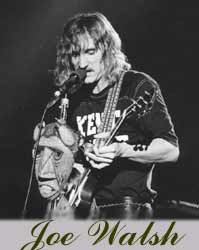
Vocals, Guitar, Slide Guitar, Keyboards
Born on November 20, 1947
Wichita, Kansas, USA
Joined the Eagles in 1976
Replaced for Bernie Leadon
Very good rock guitarist
Best Work : Guitar solo in Hotel California , Life in fast lane
Joe Walsh was born November 20th, 1947, in Wichita, Kansas. Joe first became interested in music at an early age due to the influence of his mother's playing of classical piano. His first instruments were the oboe and the clarinet. The first stringed instrument that Joe picked up was not the guitar as some might assume, but the bass. As a teenager, Joe played in the local New Jersey bands, the G-Clefs and the Nomads. In 1965 Joe enrolled at Kent State University in Cleveland Ohio, where he became known as the "phantom of Kent State" due to his propensity for playing guitar in the stairwells during class.This is where he picked up the electric guitar. While attending Kent State, Joe took courses like welding, electronics, and music theory. Shortly after enrolling at Kent, Joe joined up with the band, the Measles. Joe remained a member of the Measles until 1969, when he was asked to join the Cleveland based power trio the James Gang. In October of 1969, the James Gang released their debut album, Yer Album, which eventually rose to #83 on the Billboard charts. In July of 1970, Rides Again was released which reached #20 on the charts and subsequently went gold. Thirds was released in the fall of the same year and gave the James Gang their second gold album.
In 1971, Live in Concert was released again breaking the top 30 on the charts. Joe left the James Gang in November that same year and moved to Colorado. Once in Colorado Joe formed a new trio, Barnstorm which released their self titled album in 1972. In 1973 Joe's first solo album, The Smoker You Drink, The Player You Get, was released and climbed to #6 on the charts, turning Joe into a "legitimate" solo act. Joe's follow-up album, So What, was released in 1974 and reached # 11. In 1976, Joe joined the California based band The Eagles as a replacement for guitarist Bernie Leadon. The first album released by the new incarnation of the band was Hotel California, which reached #1 on the Billboard charts, and went gold. The Eagles, with Joe on guitar, also released The Long Run, as well as Eagles Live, which reached #1 and #6 on the charts respectively. While a member of the Eagles, Joe released two solo albums, You Can't Argue With A Sick Mind, a live album, as well as But Seriously Folks, which contained the hit single Life's Been Good. After the break up of The Eagles in 1980, Joe was once again a solo artist. Joe continued to release solo albums, starting in 1981 with There Goes the Neighborhood, followed by You Bought it You Name It, The Confessor, Got Any Gum?, Ordinary Average Guy, and his most recent studio album, Songs For A Dying Planet which was released in 1992.
In 1995 the Eagles, with Walsh, reformed for the release of a new album as well as one of the most successful tours in music history, the Hell Freezes Over Tour, which lasted until 1996. In addition to his work as a musician, Joe ran for President of the United States in 1980, as well as for Vice President in 1992. This is where Joe Walsh has been. Now the real fun begins as we see where he's going.
Back to Top
Timothy B.Schmit
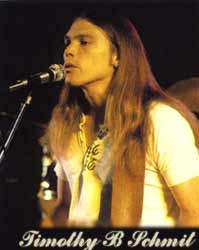
Vocals , Bass Guitar
Born on October 30, 1947
Sacramento, California, USA
Joined the Eagles in 1977
Replaced for Randy Meisner
Peacefull Voice
Best Work : Love Will Keep Us Alive, I Can't Tell You Why
Timothy Bruce Schmit was born on October 30, 1947 in Oakland, California. He spent the first few years of his childhood in a camper with the rest of his family following his musician father, Danny Schmit, from gig to gig until finally settling in Sacramento, where his father was a musician in the house band of a local club. As a child, he first took tap-dance lessons, and, at ten, he finished second to a rock band in a local talent competition. This caused him to give music a look. The first musical instrument he played was violin, followed by trombone and ukelele. At 15, Timothy and some friends formed a folk trio called Tim, Tom & Ron. They later switched to surf music and changed their name to the Contenders. When they changed to a more Beatles-esque style, they changed their name to New Breed. They had quite a following in the northern California area, opening for such acts as Sonny & Cher, Herman's Hermits and Big Brother and the Holding Company. In 1968, under the name Glad, the band recorded an album called Feelin' Glad.
While in Los Angeles recording that album, a mutual friend of his & Richie Furay's invited him to audition for Poco. He eventually lost the bass player job to Randy Meisner. Nine months after winning the audition for Poco, Meisner quit the band during the recording of their first album, Pickin' Up The Pieces, and Timothy replaced him. When he joined Poco, their lineup consisted of Richie Furay, Jim Messina, Rusty Young and George Grantham. After their self-titled Poco album (aka "Oranges") and the excellent live album DeLIVErin', Messina left the band and was replaced by Paul Cotton. This lineup recorded the albums From the Inside, A Good Feelin' To Know, and Crazy Eyes. Instead of replacing Furay when he left after these albums, they remained a four-man band, with Timothy taking a more central role-acting as band spokesman on stage and sharing more lead vocal duties with Paul Cotton. Between 1974 and 1977, they recorded the albums, Seven, Cantamos, Head Over Heels, Rose of Cimarron (my favorite), Live, and Indian Summer. Anyone who thinks Timothy is strictly a ballad singer, needs to check out the song "Restrain" from the album, A Good Feelin' To Know or better yet, the live version from the second Live album.
After Randy Meisner left Poco, he eventually formed the Eagles along with Don Henley, Glenn Frey and Bernie Leadon. In mid-1977, after a tour in support of their monstrously successful Hotel California album, Randy Meisner quit the Eagles. Once again, Timothy replaced him and was reportedly the Eagles' first and only choice. In a November 29, 1979 article, Rolling Stone said, "Schmit, who obviously enjoys being onstage, is an improvement over his predecessor, Randy Meisner, who loathed performing toward the end of his tenure." Ironically, after Timothy left Poco, they scored their biggest hit with their next album Legend and its' hit single "Crazy Love."
In 1979, the Eagles released what unfortunately is their only studio album to feature Timothy, The Long Run. One of the best songs on this album, is Timothy's "I Can't Tell You Why," which reached Number 8 on the Billboard charts. It would be the Eagles' last Top Ten hit before their "vacation." After touring and recording the Eagles Live album, the band broke up in 1981.Following the breakup of the band, Timothy moved into even more session work and also recorded a cover of the Tymes' classic "So Much In Love" for the movie soundtrack Fast Times at Ridgemont High. Fellow Eagles Don Henley, Don Felder and Joe Walsh also contributed songs to this soundtrack, along with Jimmy Buffett, Jackson Browne, Stevie Nicks and Poco, just to name a few. He also appeared on about half the songs on Don Henley's first solo album, I Can't Stand Still, including the beautiful harmonies on the ballad "Long Way Home."
Among his session work at this time were appearances on Toto's Toto IV, singing background vocals on "Good For You" and "Africa" along with a more prominent vocal role on "I Won't Hold You Back." He also appeared on the Crosby, Stills & Nash album Daylight Again, singing on such hits as "Southern Cross" and "Wasted On The Way" as well as appearing on Don Felder's 1983 solo album, Airborne. Also during this time, he began touring with Jimmy Buffett, playing bass and singing background vocals. At one show in Cincinnati, he and Buffett were standing backstage looking out at the audience, when Jimmy made a comment about the fans in their brightly colored clothes, saying they looked like tropical Deadheads. When Timothy replied, "yeah, Parrotheads," Jimmy's marketing empire was born! Along with touring with Buffett, he also appeared on four of his albums, One Particular Harbour, Last Mango In Paris, Hot Water, and Off To See the Lizard.
In 1984, he released his first solo album, Playin' It Cool. This album contains songs that cover a broad range of styles from straight-ahead pop to a capella and others and also features appearances by his former Eagles band mates Don Henley and Joe Walsh. Included among the songs is "Tell Me What You Dream", which was co-written with Vince Melamed and Josh Leo. This song was covered by country band Restless Heart on their 1992 album Big Iron Horses and was a crossover hit for them. Another highlight of the album is a beautiful semi-a capella song called "Voices" on which Timothy sings all the vocal parts. This song was written years before the recording of the album and was even presented to the Eagles for possible recording, but was rejected. The title track seems a bit Beach Boy's-inspired to me, and features a chorus of "Coolettes" in the middle of the song. Among them are Timothy's wife Jean and his oldest daughter Jeddrah. Timothy's second solo album, Timothy B. followed in 1987. This album has an obvious R&B feel to it which was a surprise to those who expected to hear country-rock from this former member of Poco and the Eagles. This was his most successful solo effort with the songs "Boys Night Out" and "Don't Give Up" both charting.Timothy B. was followed in 1990 by Tell Me The Truth. Like Playin' It Cool, this album covered a range of styles--jazz, pop, acoustic, etc. Highlights include the acoustic songs "In Roxy's Eyes" and "Something Sad," the New Orleans-flavored "Down By the River" and the title song which was co-written and co-produced by Don Henley. The last song on the album is called "For the Children" and features a choir of children. Among them are Timothy's two daughters Jeddrah and Owen Faye, Joe Walsh's daughter Lucy, and two of Graham Nash's children.
In 1993, the country Eagles tribute album, Common Thread was recorded and released. Timothy was in Nashville while Vince Gill was recording his cover of "I Can't Tell You Why" and was invited to join Vince on background vocals of the song. After touring with Dan Fogelberg that year, Timothy was invited to join the other Eagles in December for the taping of the video for Travis Tritt's version of the Eagles classic "Take It Easy." Pretty soon after this and an appearance by Don Henley, Glenn Frey and Joe Walsh at a benefit in Aspen, the wheels were set in motion for an Eagles reunion album and tour. In April 1994, the band taped their Hell Freezes Over MTV special which was televised in November 1994. The band performed four new songs including "Love Will Keep Us Alive" which featured Timothy on lead vocals. The next month the guys began a highly successful tour which was only supposed to run through 1994. Due to Glenn Frey's illness and also the success of the tour, it lasted for 2-1/2 years. On January 12, 1998, the Eagles were inducted into the Rock & Roll Hall of Fame along with Santana, Fleetwood Mac, The Mamas and The Papas, Gene Vincent, Lloyd Price and Jellyroll Morton. It was a historic night for the band as it marked the first time that all seven past and present members of the Eagles performed together on the Eagles' classics "Take It Easy" and "Hotel California."
On May 1, 2001, Timothy released his fourth solo album, Feed the Fire, and also launched his official web site.
Back to Top
Return to Home Page