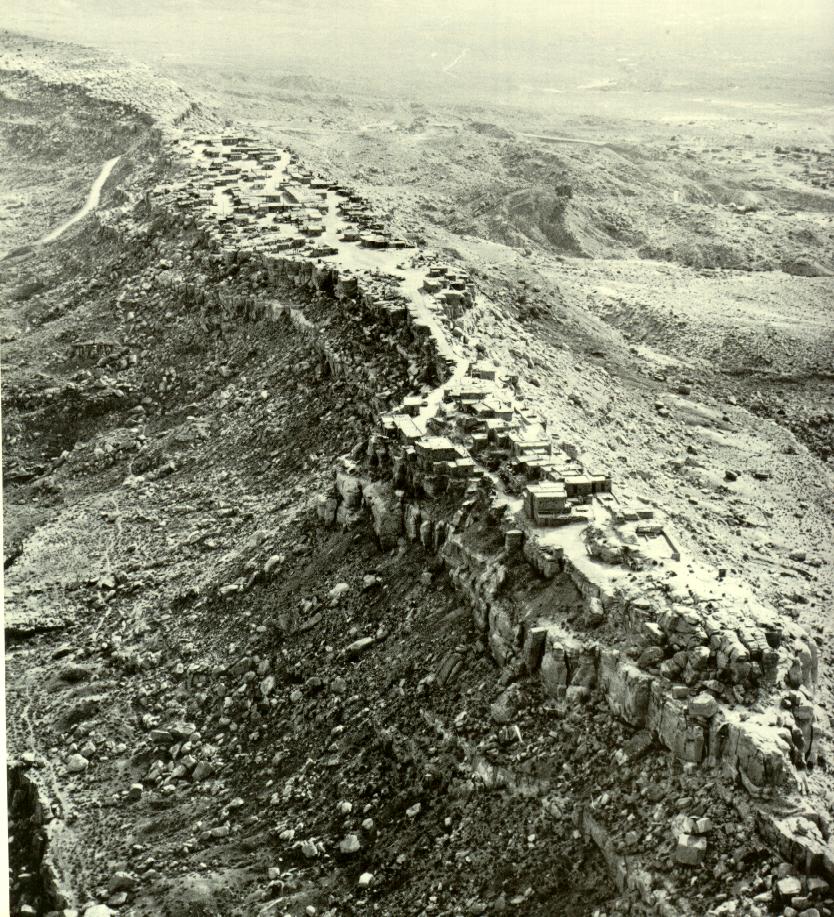
Hopi villages on First Mesa, with Walpi in the foreground. The three mesas with which 11 of the 12 presently-existing Hopi villages are associated project from the southern edge of Black Mesa and are named First Mesa, Second Mesa, and Third Mesa going from East to West. The First Mesa villages, which are almost continuous, are Walpi ("place of the gap"), Sichomovi ("hill place where flowers grow"), and Hano ("place of the eastern people"). The latter name alludes to the fact that the village was founded by Tewa-speaking people who migrated to the Hopi Mesas from the upper Rio Grande area about 1700. It has also been claimed that the name Hano refers to the fact that the residents frequently interject a "ha" sound into their speech. Another name for this village is Tewa. The village of Polacca, named after a former resident, Tom Polaccaca, is located near the base of First Mesa. There are also three villages on Second Mesa: Mishongnovi ("place of the black man" in reference to Mishong, chief of the Crow Clan which founded the village), Shongovapi ("water place where reeds grow"), and Shipaulovi ("place of mosquitoes"). Oraibi or Old Oraibi ("place of orai" - a type of rock), Hotevilla ("a scraped back"), and Bakabi ("place of [a kind of] reeds") are on Third Mesa. Oraibi, in existence at least as early as 1120 A.D., has the distinction of being the oldest continuously-occupied town in the United States. Kykotsmovi ("place of the hill of ruins"), formerly known as New Oraibi, is situated near the base of Third Mesa; and the village of Moencopi ("place where water flows"), a satellite of Oraibi, lies about 40 miles to the northwest. Some of the mesa-top villages were originally located below the mesas but were moved to their present locations for defensive purposes.
In addition to the 12 extant Hopi villages, there are ruins of over a dozen ancient villages in the area. Two of these, Awatovi and Sikyatki, are of particular importance. Awatovi, on Antelope Mesa, was destroyed in 1700 by men from Oraibi and Walpi in retaliation for allowing the Spanish ("Castillas") to reestablish a mission in the village after the Pueblo Revolt of 1680 had succeeded in driving the Spanish out of the entire Pueblo territory. Sikyatki was abandoned in fear of attack from the larger village of Koechaptevela after a man from that village impersonating a Hömsona (He-cuts-your-hair) Runner Kachina beheaded the daughter of the Sikyatki chief in revenge for the earlier murder of the daughter of the Koechaptevela chief. However, Sikyatki is far better known for its pottery style, which was made world-famous by the Hopi potter Nampeyo (born 1859 or 60, died 1942) who incorporated the designs from pot fragments collected from the Sikyatki ruins by her husband, Lesou, in her own pottery. (Photo by Peter Dechert, Fig. 35 in Hopi Kachina: Spirit of Life, Dorothy K. Washburn, editor. California Academy of Sciences. 1980.)
Click on "Back" to return to main page