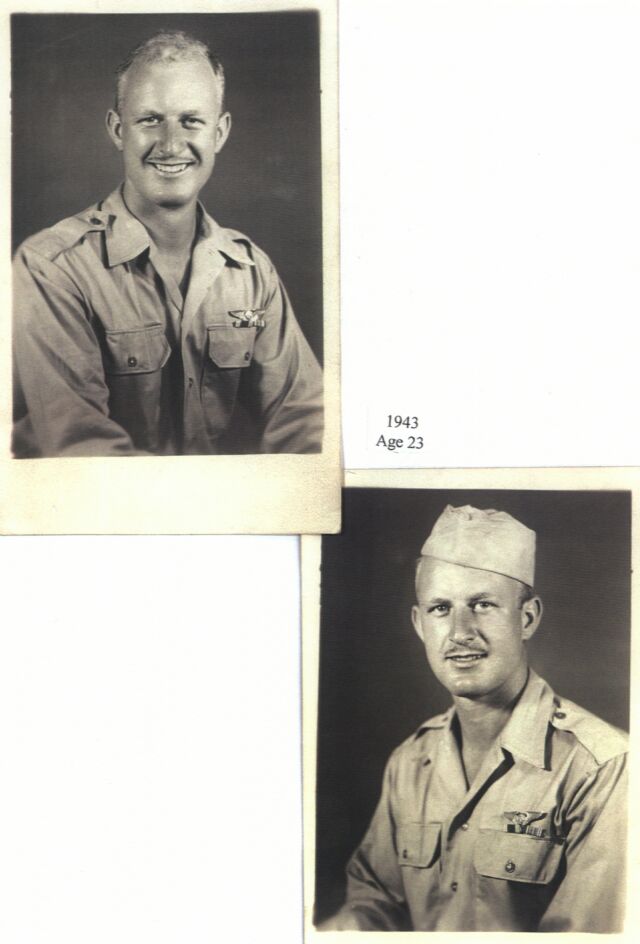
College to War
During our early college years it became obvious to me and my friends that the United States was going to eventually be thrust into the wars that were going on thanks to the Axis Powers: Germany, Italy and Japan.
I was fortunately brought up with the family examples of work hard and honestly, enjoy your life, and always expect the best. One thing to keep in mind was that you will be judged by the type of friends you select.
Reminiscing about the past has made me realize how good fortune smiled upon me during the years of W.W 2. I remembered at that time an old U.S. Navy recruiting poster �~join the navy and see the world�. I had always wanted to go to other parts of the world so I went to a navy recruiting station. There I was quickly rejected because I was wearing glasses.
A few weeks later the local draft board was much more generous. It took only a simple invitation from them to put me in the Army Air Corps. Fortunately my glasses did not bother the Army. As for seeing the world, the Air Corps provided me with a front seat view of a generous portion of it. From a flight engineer�s position in a C 47 cargo plane I was taken to places on the earth I had never thought of visiting.
The Draft Board notice left no doubt that �Uncle Sam wants you.� In a few weeks I found myself taking a train from Oakland to the Presidio at Monterey. Here with hundreds of other draftees I was given a battery of placement tests. The Air Corps was seriously trying to fit each of us into jobs in the military that matched our individual abilities.
The fact that this was a cavalry base did not result in horseback riding lessons. At Uncle Sam�s convenience a group of us recruits were soon enroute to Texas for training to become aircraft mechanics. This suited me fine, since I like all kinds of mechanical objects. Now I could add airplanes to my �been there done that � list.
Monterey to Texas
For our transportation the Santa Fe railroad had some elderly day coaches. Above the aisle there was a raised section of the roof, bordered on each side with what appeared to be leaded windows. Also, over each of the regular windows there was also a section of leaded glass. The seating was mohair fabric, which completed the feeling of being in a train of the last century.
Along the way we were fortunate to have our meals in the Santa Fe Harvey restaurants. The efficient and attractive waitresses made the brief stops a very welcome interlude. I wonder what the girls thought about these trairtloads of soldiers arriving daily. It certainly was a tremendous amount of work for them.
Our destination was Sheppard Field, a few miles outside of Wichita, Texas. The field had not been totally completed. There were acres of two story barracks separated by more acres of dusty dry soil. We were soon to learn the vagaries of Texas weather. We could count on very hot windy days and very cold windy days. It was not uncommon to have rain followed by dry wind that soon raised a dust.
The runway and aircraft-parking apron were almost empty except for a dozen or so primary training planes. These were used to give us students our first hands-on experience around real planes.
Included with our adaptation to military existence was learning to be patient while waiting in line for physicals, shots, teeth examinations and the chow line. Teeth defects got immediate attention and swift correction. All the activities above were fitted in after sessions on the drill field.
The classroom and laboratory work was intensive. Many of the skills and information was for background development. This had to be put to use in the laboratories and in the future on the flight line. When our instruction period ended it was time to wait and wonder what our next assignment would be.
Sheppard Field, Texas to Lawson Field, Georgia
Again it was time to climb aboard a train and speculate about our destination. We climbed off the train in Chicago, no time for sightseeing, as we were quickly loaded aboard another train headed south to Louisville, Kentucky, which we found out later.
Upon arrival at the assigned base in Kentucky, again a surprise awaited us. The unit we were to join had already shipped out to Georgia. After a wait of three days it was our time to go aboard a train headed south. Our ride was courtesy of the Georgia Central Railroad.
This company operated coal-burning locomotives that spewed out heavy smoke every mile of the way. The black smoke left thick layers of soot that settled on everything. It was foolish to touch any flat surface because the layers of coal dust would transfer to hands and clothing. It kept us alert so as to not unconsciously let down our guard and lean against or touch a grimy surface.
The destination for this trip was Fort Benning, Georgia, reportedly the Army�s largest base. On arrival our group was sent to Lawson Field, a part of the large complex. Now we had finally joined the 37th squadron of the 316th Troop Carrier Group. Other squadrons were the 36th, 44th, 45th and the headquarters squadron. Sharing the base with us was a paratrooper-training unit.
I was assigned to be a part of the ground crew of mechanics to maintain a single aircraft. From earlier arrivals flight crews had been selected. Each aircrew was made up of 2 pilots, I navigator, 1 radio operator and 1 crew chief. The whole flight crew was to go on every flight as a team. hnmediately flights were scheduled to other nearby landing practice strips and soon long and short flight went to adjacent states. Eventually flights traveled to California and to northeast states. These gave needed experiences to the entire crew to learn how to fly and care for a DC 3 airplane.
The crew chief of the plane I was assigned to as a ground crew member quickly decided to pick and choose destinations for himself from all scheduled flights. I found myself flying as a substitute crew chief (aerial engineer) on practically every flight of the plane I was assigned to maintain.
Lawson Field
This informal arrangement came to the attention of the line chiefs and in turn to our Squadron Headquarters. Flights to large cities frequently had an uninvited passenger along for the ride. So one day I was called in and told since I was doing the work I was to be assigned as crew chief
After many training flights and after the fledgling paratroopers completed their ground schooling, it was time to take them up for their practice jumps. It was fascinating for me to see these volunteer paratroopers on their first airborne parachute jump. I could see how the initial thrill of being an air borne warrior wore off quickly.
The men formed a line down the center of the cabin when the pilot signaled we were approaching the drop zone. Each one snapped the clip on the end of his static line to the overhead cable. The other end of the static line was fastened to a release pin on his parachute pack. The men were so tightly packed they moved down the aisle as one. A turn to the right as they reached the open doorway and a quick jump toppled each one in turn into the aircraft slipstream. The free fall ended when the static line pulled the lock pin from the parachute pack.
Pack.
As we flew back to the airfield the paratrooper�s landings were not visible to us. Later one paratrooper described a normal landing as being as severe as falling from a 15-foot high fence.
With the completion of our training and the conclusion of dropping paratroopers it was time to move to a new airbase and enter into new training. Our next home was to be Bergstrom Field in Austin, Texas. After settling into our new location, we were introduced to a different training. Now we learned how to load and transport heavy, bulky cargo safely. Typical toads were Jeep vehicles ~nd theirlrailers. These required wooden ramps and coordinated lifting to get them in the plane.
Leaving Austin
Other cargo was large, heavy supply containers and equipment like diesel power generators. Many of our efforts were directed to carrying enough ground troops to use the equipment and supplies.
The new training schedule required flying from Austin to San Antonio to pick up the required cargoes. After loading our planes we flew on to the desert areas of Eagle Pass and Del Rio, near the Mexican border. Here the landing grounds were open deserts with sand, dirt and plenty of cactus. The cactus turned out to be a major hazard to the plane�s tires. Those unlucky enough to have a punctured tire spent many uncomfortable hours waiting for replacement tires.
An important training we did not receive was setting up the plane to carry casualties on stretchers. When the time came in the future to use the webbing provided with each plane we found it to be totally useless. The British stretchers were too large to fit into the American stretcher supports. This was not a complete loss for us in the combat zone. We just carried fewer casualties without the special webbing.
After weeks of trips to San Antonio and out into the Texas desert, rumors started about another move for our group. This time the suggestion was for us to move to an airfield in the panhandle of Nebraska, to the small city of Alliance.
As the four squadrons, the 36th, 37th, 44th, and the 45th lifted off the runway at Bergstrom Air Base in Austin, Texas, our compass heading was east. At Mobile, Alabama, there was a large aircraft service facility. They managed in a few short days to install new engines and large fuel tanks in the fuselage of every plane. Why all these preparations since our next destination was Miami, Florida? In Miami each individual got a personal overhaul. It included teeth removal, if necessary, and lots of shots from every side. (Our radio operator, Emory, had had to have every tooth removed. He chose to continue flying with the group) When they ran out of things to stick us with, we were delighted to leave.
Khartoum Landing
War in the Pacific or war in Europe, which would it, be? It was becoming plain neither war was for us because our next destination was the Caribbean.
Our first stop was Puerto Rico for refueling and a brief rest. Then came TrinidadiTobago for another stopover. Our next destination was Belem in Brazil near the Amazon River and deep in a tropical forest. The river was so broad at this place we could not see the opposite shore. Continuing south our next temporary stop was Natal, Brazil. After flying over seemingly endless jungle we had finally traveled far enough in a southerly direction, now it was time to fly east. Here is where the shoulder of South America points across the South Atlantic to Africa.
The Atlantic Ocean beneath our wings stretched out for hours until the peaks of the mountains on Ascension Island appeared. Here the center of a mountain had been removed to create a runway. The remaining mountainsides crowded the landing strip on both sides. So close it seemed a small movement to either side and a wing would surely scrape the mountain. Time again to refuel, check the plane and get some rest.
A longer flight over the water brought us to the town of Accra, on the Gold Coast of Africa. There was a need for fuel, rest and a complete aircraft checkup. Here we got a wake-up reminder that the Gennanlltalian Axis along with the Vichy French controlled all of Africa north of our route of flight. They were not to be considered friendly folks.
Khartoum, in the Anglo, Egyptian Sudan, was to be our next stop. My plane changed that plan. It developed an air lock in the fuel system of both engines. A wheels up landing in the desert isn�t at all bad with two good Staff Sergeant pilots in control. They carefully missed the large boulders, scattered everywhere across the desert, and set the plane down gently. The only uasualties were the two propellers that fo1ded~back on contact with The ground. In due time a truck came from the airbase at Khartoum with replacement propellers and necessary equipment. Wing jacks were placed to support the plane while we dug trenches to permit the landing gear to be lowered. Ramps were then shoveled in front of each landing gear. Cables from the truck allowed it to tow our plane up the ramps.
After many thorough inspections, our pilots were permitted to fly on to Khartoum.
The rest of us, navigator, radio operator, crew chief, a permanent K.P. and two aircraft specialists had a long ride to town in the rescue truck. These last three had been assigned as special passengers for the trip. Bouncing along the dusty road east, the driver called our attention to a range of mountains to the south of us. In a few hours a large canyon came into sight that was literally packed with native mud huts. They appeared to be square and a dark brown color. It was considered to be the largest native village on the continent.
On to Khartoum and a reunion with our 37th T.C. Squadron. We had to spend time with a board of inquiry answering questions about our forced landing. The inquiry results were never publicized and had no effect on our crew. We were reunited and very happy to fly again as a team.
Between Khartoum and Cairo, Egypt, was a desert of huge ridges of sand, miles of them. We bad been warned that if any plane crashed into the sand, it could expect to be rapidly buried. The warning was no exaggeration. The seemingly endless, gigantic hills and valleys of glistening sand passed below our wings.
We flew on over the huge mountains of sand. All thirteen of our aircraft amved safely at the Cairo airport in the suburb of Heliopolis. It was a British airfield. They were efficient in installing I.F.F. (Identification, Friend or Foe, radio transmitters) and painting small identification emblems on the vertical tail fins.
Eastern Egyptian Desert
During our stay in Egypt, the 316th Group occupied various bases east of Cairo. First, was Devorsoir, then Kabrit, where we shared facilities with a British Group. It was interesting to see how rigidly the ranks were socially divided in such a simple place as their makeshift bar. In a row were the tents, first was a bar for privates, attached to that was a bar for corporals, attached last came the sergeants bar. Of course, we Yanks did not pay any attention to these separations. The Brits were too polite to throw us out.
Our next base was near Ismalia at the northern end of the Great Bitter Lake. This base was different in many ways from previous ones. It was within a long walk of an attractive city. There was a narrow barge canal paralleling the main road past town. The canal was well used, with barges passing by, and some were tied to the stone walls, making up the shoreline. At the airfield our planes were sheltered in concrete block revetments that enclosed the planes on three sides. The revetments, randomly placed, offered some protection from attack. That danger was very remote now that the battlefields had moved many miles into Libya.
One incident made this a memorable area for me. The electrical specialist, actually an electrical engineer in civilian life, and I, went to Ismalia for a late afternoon-evening visit to town. We dropped into the British NAAFI Institute restaurant and bar. My friend managed to consume more liquor than he should have. As it was beginning to get dark, we started on the long walk back to base. My friend wanted one more drink for the road. I decided that we must stay together and find the wanted bar. In order to find a doorway, one needed to touch each wall as we walked along searching for a curtained wall opening. Finding one, we entered and found the usual alcove facing a second heavy curtain. After letting the first drape fall into place we stepped forward and pulled aside the second, not allowing any interior light show outside in the street.
The place was well filled with allied troops on leave from the desert. My friend made the evening less than fun for me by having his drink, then wobbling over to a huge Scottish soldier and snatching off his beret.
My companion said in a loud voice, �Now I have a real souvenir of the war and I won�t give it back.� The Scot, in a very nice way, said �Yank, the cap is too expensive for me to lose. Please return it.� My partner moved back and said, �no, it�s mine now.�
I had thoughts of two American G.I.s finishing the war stomped into the barroom floor, because the Scottish soldiers were known as �the ladies from hell�, even when they weren�t wearing kilts. The Scot asked again for his cap and tried to explain to my drunken companion the pay differences between his anny and the American. It was so great that it would take a large share of his future pay to replace the cap. My friend wasn�t about to be reasonable, and I figured the Scotsman and his friends had had enough. Grabbing with one hand the cap and handing it to the Scotsman, my other hand took a firm grip on my buddy and shoved him through the curtains, out into the night.
After a short walk he said, �I was only fooling with the cap. I might have given it back without your help.�
This I doubted. As we walked out of town toward our base, he didn�t seem able to hold all he had drunk that day. My job became less pleasant as it was necessary to support an unstable, weaving drunk while stumbling along the soft sand of the road. The sound of ajeep made us step to the side. It stopped alongside us and I saw two officers. One was our Squadron commanding officer. He pleasantly offered us a ride, and drove us to the base, showing me that �All�s well that ends well.�
The Great Bitter Lake connected the city of Suez with the Suez Canal, which in turn leads to the Mediterranean Sea. The base at Kabrit was near the southern end of the Lake. From here, all planes were required to follow established routes. Our route to the western desert required a turn at the imposing DeLesseps Monument. It was a tall sturdy, imposing structure honoring the builder of the Suez Canal. After the war, the monument was destroyed by the Egyptians.
Shortly after our arrival, four aircraft and crews were reassigned to fly the Hump, to support Clair Chennault�s Flying Tigers. The rest of us stayed to carry our mission to support the British 8thAnny in its drive to defeat the German/Italian Armies, which were led by Rommel, and to push them out of the Middle East.
In November 1942, the British forces were an assortment from the
Commonwealth. Almost daily we met troops from India, Australia, New Zealand, South Africa, Scotland, Union of South Africa, the British Isles, and probably other places. They had driven the enemy out of El Alamein and Tobruk, and were advancing on Benghazi.
Flying over the Egyptian Western Desert into Libya, we carried whatever was needed to bases behind the fighting areas. The return flights carried troops back from the front as well as equipment that needed servicing. Trucks were still needed for supplies too large or heavy, for the planes. It was always interesting to fly over the one highway through the desolate desert and see the debris of war, the burned out wrecked vehicles along its edges. Within weeks the clean up had started and most of the wreckage was removed for salvage by the British.
Our base of operations moved to a flying field over the mountains from Tobruk. With this port in Allied hands, ships could bring supplies closer to where they were needed and we could fly them farther into Cyrenecia. The transport of fuel and gasoline in 55-gallon drums continued out of Cairo Airport.
One such trip gave us time to think for hours about our coming landing. The plane had blown the left tire just after take-off We were carrying a full load of full gasoline drums. The first pilot, a 19 year old, decided he would have the co-pilot who was 20 year of age, do the coming landing, since he, himself, had made the last emergency landing.
An explanation is in order about desert landing fields. First, no paved runways, second, the landing area was as flat a space as possible, cleared of brush and rocks, and usually quite large in width and length. These fighter fields usually served four squadrons, arranged in a large square. Each flight would take off in turn, after a short interval to allow most of the dust to settle. One Squadron would take off to the north across the field, the next to the south, then east and west in turn.
Here we come heading for what was not to be a normal landing in the middle of such a field. The co-pilot was skilled. The plane touched down on the starboard wheel and rapidly lost its ability to keep the left wheel and its blown tire off the ground. As contact was made, the plane swirled to the left and spun in a tight circle to a welcome stop.
No damage other than torn up hydraulic lines and a ruined tire. Truck support from this base was on scene immediately to unload our cargo and two the disabled plane off the center of the field. Soon we had a close view of the fighter taking off We were glad no to be in the center of things. Necessary parts and equipment were flown in the next day. With everything in order, we were soon on our way back to our own field and to routine flying.
Crash In Heliopolis
After a week in the Libyan Desert, it was a dark and moonless night as we circled over Cairo. To prove that rank has its privileges, we were being piloted by two strangers to us. They were majors who needed flying time. Our regular Staff Sergeant pilots were left behind. We had lifted off in late afternoon to take some Colonels and half a dozen of their entourage on an inspection of various desert encampments.
Along the way two fighter plane engines were loaded aboard for shipment to an overhaul facility. As always, trips on leave were permitted to come aboard for a ride to Cairo. The bucket seats along each side were well filled. Everyone sat facing the engine cargo, which was down the center. A half dozen men without seats were sitting by the cargo door, on the floor, facing anyway they wanted. Cheerfulness reigned for all of us. We were heading back to civilization. Unfortunately, our pilots had decided to head back in the late afternoon because they wanted to attend a party that night. The late start brought us over the city well after dark. Flying over a city that is blacked out in a war zone is universally frowned upon. There is always a possibility of ack-ack gunners deciding to practice their firing skills. After all, we were not supposed to be up there.
Returning to Heliopolis, with its dirt runway, we cleared the ridges of hills that to us were no more than dark humps in the gloom. Whoooeee, what a relief is will be to feel the tires as they bump on the ground. Only the tires did not gently bump. Instead, the plane dropped like a falling rock. It smashed into the ground and the plane rocketed back into the air, but oh, so briefly. Gravity took over and we returned to earth with a crash. Starboard landing gear thrust up through the wing. Metal snapped apart as the wing hit the runway, and an engine ripped free and slammed into the fuselage. Smashing through the plane, it demolished the radio operator station. Fortunately, Emory had earlier moved into a position behind the pilots and so missed being eligible for a Purple Heart, or worse.
For the very briefest time, all was silent. Then a voice yelled FIRE! The pilots and our passengers made a fast move to the rear cargo door. The soldiers already there scrambled to open it. They were struggling to force open the exit with too many helping hands.
For me, the closest way to leave was by the small door over the wing. Others followed me down the wing to the ground. No fire ever started, but the word �fire� was enough to ensure a violent exodus. Within seconds the cargo door was open and everyone spilled out of the opening.
Immediately a fire crew and ambulance were in position to be of help. The Colonel sitting by my side was injured when he slammed into one of the engines we were freighting. When he was loaded into the ambulance, I was asked to come along. It was then I noticed that my left thumb was torn where it joined my palm.
At the British hospital, the Colonel was taken to the officer�s quarters and I was delivered to the sergeant�s wing. When the doctor examined me, he ignored the injured hand and concentrated on my eyes. (He didn�t know that my pupils were normally slightly enlarged). The diagnosis was �shock from the crash� so I found myself hospitalized for 2 days. Daily inspection required each patient to stand near the foot of his bed while the doctors walked by. No one paid any attention to my hand. Waving it and suggesting a stitch or two did not help. I settled for a simple bandage.
On the morning inspection of the third day, I was told everything is O.K., you can leave. The walk back to the airport was only a mile or two. I came to the wreckage of our plane and found our radio operator standing guard to prevent parts from being removed. He was glad to see me and wanted to know where I had gone. I joined him there on the guard duty. Always left aboard the plane were our weapons: a rifle for Emory and a Thompson sub machine gun for me. Both of us had shot targets with a rifle in Georgia. We had no instruction on the machine gun.
After a few more days, we were taken back to our base and we teamed the plane had been given to the British.
Tobruk Field
The airbase outside of Tobruk was shared with British aircrews. They flew some very antiquated aircraft. Their Hurricane fighter was covered in fabric in an age of mostly metal planes. Their casualty evacuation airplane was a high winged monoplane on extremely long landing gear. It was eager to fly. One of these planes tried to land in a brisk wind. It could come down just fine, but then lifted off again when the engine RPM was increased for taxiing. It finally had to be towed to a parking place with its engine shut down.
The British were always friendly and generous. Certainly they were more knowledgeable after almost three years in the desert. Visiting their hospitality tent one evening, we could hear the ack-ack guns firing at Tobruk. Good show! Tracer shells scooted across the sky and the bark and rumble of the explosions was satisfying to hear, until the sound of a diving plane alerted everyone, especially the British. Suddenly they were gone, disappeared.
We stood looking at each other for a brief instant, then we ran out of the tent. The roar of an airplane engine was getting closer. It dropped three small bombs that made the rocky ground shake. We were lying face down and longing for a foxhole. The next day we dug shallow fox holes in the dry ground, just in case this should happen again. Lucky for us, it never did.
Palestine
Occasionally planes from our squadron flew to Palestine to deliver cargo and passengers and to return with an equally large load. Some of the passengers were squadron members on R&R leave. It was a great opportunity to see parts of the Holy Land.
Finally my turn came, along with 19 others. We were flown to the Lydda airport, which was located in an area of orchards. From there it was a long bus ride to the city of Tel Aviv, a large, modern city located on the shores of the Mediterranean. Our accommodations were in a very plan hostelry. After settling into our quarters, we walked some of the downtown, and enjoyed seeing the bathing suit clad girls using the beach.
The next day we separated into small groups. Those that wished to see historical places caught a bus to Jerusalem. I do not believe that there was a Bible scholar in this group of airmen in their late teens and early twenties. Still, everyone was eager to learn about everything we could possibly see. The guide we hired was very knowledgeable; at least we accepted everything he told us as fact. None of us could argue the reality of the locations we visited.
Several things held our complete attention. We walked the complete length of the Via Dolorosa. At the end we were taken to the lower level of a church where the guide told us this was the original street level at the time of Jesus. After a short walk back through the old town we were able to enter the Dome of the Rock church. A Muslim facility, they furnished soft slippers to wear over our shoes so we could enter the sanctuary. It was well carpeted with beautiful Persian carpets. It was all very impressive. Next we were led to a portion of the old city wall where Jews had established their Wailing Wall. It amused us to find the wall restricted to men only. From here, we could see the rise of earth the guide called Golgotha Hill, the site of Jesus� crucifixion. Then we were taken to a small well-kept garden. It had a tomb carved into a very large rock that formed one side of the garden. This, the guide explained, was the tomb Jesus occupied for a short time after his execution. From this site we walked on to portions of the more modern Jerusalem. We were still surrounded by substantial stone and concrete buildings. None of these were very inspiring. It was time to return to our hotel and a good night�s rest. The next day our guide toured us through the Church of the Nativity in Bethlehem. The plain, large stone facade did not look especially inviting. The only entrance was a tiny opening that required everyone to bend over double to enter. This was intended to encourage humility. Inside were massive columns that seemed to completely fill the interior. No seating. A chapel off to the far left at the opposite end of the building looked very eastern with heavy metal decorations hanging everywhere. Steps to the right side of the altar led down to a small heavily decorated room that was claimed to be the birth site of Jesus. Nothing I had ever heard or seen in illustrations had prepared me for this version.
A fairly long bus ride through desolate country brought us back to Jerusalem. Here another walking tour took us through a gate in the old walled city. Inside was a multistory building that our guide claimed contained the room that was the site of the Last Supper. I must confess the street scene interested me more, a line of very small shops and many people dressed in Middle Eastern fashion. Again, I noticed when a very bulky object needed to be moved, helpers loaded the object on the back of one person. As he staggered along, the helpers walked alongside to help balance the load.
We were shown a large area under the old city. It had been the king�s stables through the centuries.
Another trip took us across a valley to a hill where the guide showed us the Garden of Gethsemane. He took us into a church, in the garden called the Church of All Nations, and built with donations from many countries. The view was towards the walls of Jerusalem where a cemetery had been developed through the centuries, from the valley floor towards the wall. It stretched from the valley floor towards the wall. A recess in this wall was called the Golden Gate and was considered an eventual quick route to heaven by some ancients.
Another day and another trip, we had a look at the ruin of an extensive old wall that was supposed to have protected the city of Jericho. The words of an old folk tune came to mind� and the walls came tumbling down.� We went on down the road to a body of water that was very salty and had a barren shoreline. We were soon wading in the Dead Sea. It really wasn�t as attention getting as was the Great Salt Lake of Utah.
Flight To India
Back at our base I was on one of three of the squadron planes sent to India. The cargo was in many large containers without identifying marks. It must have been important cargo, but none of us ever learned what we were freighting. Oh well, no one needed our approval to ship any of the cargo we transported.
The first leg of the trip took us to the airport at Abadan, Iran, (Persia). Two surprises awaited. First, it was a transfer point for American P-39 aircraft being given to Russia. American pilots flew the planes in, parked them, and left the field. Only when the Americans were gone did the Russian pilots climb in and fly away to Russia. That government would never allow contact between the Americans and the Russians. The second big surprise was to find that the barracks were air-conditioned. The outside temperature was 100 degrees, plus.
The next leg of this trip required a refueling stop at an isolated desert fort. It was a building resembling what I was certain a French Foreign Legion fortress would have looked like. It had high gray stone walls in a rectangular shape, encompassing an area of half an average city block. The wooden entry doors were huge with black iron bands. The big doors were so large that a smaller walk-in door was cut in one of them. It bore the name of �eye of the needle�. No camel could walk through it.
The refueling took the better part of a day. All the fuel came in five-gallon tins. The native workers, in long white robes and turbans, poured the gas through funnels lined with chamois skin filters to remove water and possible dirt. The wing fuel tanks were almost empty, so each aircraft took almost 400 gallons of 100-octane gasoline.
The final leg of this trip brought us to Karachi, India, which has since become a part of Pakistan. I remember a modem appearing city with bright lights, movie theatres, and a few motor scooters. I thought it interesting to see a lady in her beautiful sari, riding on the rear of a scooter. Another reminder that we were not in a western city was to see a dead camel lying in one of the streets. The restaurants were fine. The people were friendly and fluent in English. The areas we traveled in were free of the poor and lower classes we had read and heard about.
After a few days it was time to load up and return to our own base. It was an uneventful, , slightly boring trip, over almost ending barren wastes and finally ended in our return to Egypt. We had hoped for some interesting things to see, but were disappointed.
While on scheduled flights in and out of the Heliopolis Airport, we had opportunities to visit parts of Cairo. One of our well-liked places was a short-order restaurant named Groppi�s. It was a place to return to after wandering the streets sightseeing and shopping for souvenirs. I seldom bought anything, but enjoyed the shopkeeper�s routine of a thimbleful of thick, strong coffee before they would start a serious sales pitch.
One day a few of us became real tourists by hiring a taxi to take us across the Nile to the pyramids of Giza. We climbed the side of the large pyramid over huge stone blocks the size of big metal storage sheds. The guide took us down a narrow passage inside the pyramid to a small, cramped, and bare burial chamber. Not a pleasant place for king, peasant or tourist.
Our bumpy camel ride took us down for a look at the poor damaged Sphinx. It was large and impressive, but unfortunately not well cared for. I was able to change the jammed roll of film in my camera in one of the totally dark passages in a large one-story stone building near the Sphinx.
From now on our flights into Egypt�s western desert to Libya would take us within sight of these ancient historic piles of stones.
Gura, Eritrea
The airplane engines that were hauled out of the desert had an additional long trip to Eritrea in Northern Ethiopia. The necessary equipment and skilled workers to overhaul aircraft engines were located there. The flight required an overnight stop at Port Sudan along the western shore of the Red Sea. Here we were faced with an Arab custom in the bathroom. A bucket of water instead of toilet paper was �the necessary�. I learned of the Arabic custom �eat with the right hand�, because the left had other chores.
Flying on to Gura in Eritrea, the scenery changed from flat shoreline to steep, rocky mountains. Once the cargo had been taken from the plane, there was time to find a taxi for a ride to Asmara, a much larger city. The taxi was unique, as it was equipped with a charcoal burner mounted on the rear. This furnished burnable vapors that fed the engine in place of gasoline. It was neither speedy nor powerful, but it climbed hills and delivered us to the city. I was glad to have my memory of this validated by a mention in the book Flight of Eagles by Jack Higgins, on page 342. �The Gazog�ne was a truck operated by gas generated by a charcoal burner at the rear of the vehicle�.
One other feature about Asmara was the presence of uniformed Italian officers. They were remnants of the Italian Army that had conquered Eritrea in the 193 Os. When Britain entered the war against the Italian/German Axis, Entrea was a high priority to be freed. Another bit of information that was fascinating was that Eritrea was lion country. Sorry, I did not see even a cub. The return flight was a repeat of the trip there, except our cargo was overhauled engines ready for installation.
Emergency Landing
One popular saying about war in general was �there are no atheists in foxholes.� This was certainly true in many war situations, particularly if an incident was prolonged and gave sufficient time for thought. This opportunity occurred while we were transporting a planeload of British infantry with all of their possessions from Libya to Tunisia. We were taking the usual short cut across the Gulf of Sidra when suddenly a streak of oil appeared on the left engine cowling over the wing. The pilot could see the flow of oil was increasing. A fire was possible if the oil splashed down on the red-hot exhaust pipe. Also, an engine losing its oil could never run very long. The engine was instantly turned off and the propeller feathered to prevent it from wind milling. This action would act as a brake to the plane�s forward motion. Now was the time for serious thought about flying for a long time on a single engine. After all, the engines had exactly the same amount of service and wear. Maybe the second engine was equally prone to failure.
Like a well-disciplined army should act, no one got agitated or noisy. There must have been many sincere prayers quietly thought by most everyone.
With care the pilot turned toward the shore. With only a one chance landing the pilot brought us down perfectly on a beach as if it were a normal occurrence. The soldiers efficiently set up camp and patiently waited for whatever was next.
The following day a plane came from an airport at Marble Arch to take me there to scavenge a part from one of their planes to replace the one that failed. On examining it I had found that the propeller governor had damaged seals in its control shaft. I was able to obtain the entire unit. The following day the propeller governor was replaced. We were then able to complete our mission.
War Tragedies
Terrible things happen in war, some unnecessarily, as chanced near our desert encampment. One aircrew scouted the area around the camp looking for battle souvenirs. They discovered an abandoned mortar (short-range artillery piece) with many unexploded shells. It took only a short time to set up the piece and fire it. A good experience. The gun was then hidden soit could be used again. Our squadron was moved to a new base, but it wasn�t too many months before we were back. It did not take long before the mortar was set up again for a good time. This time two pilots set the gun in a shell crater. The radio operator thought it best to stay up out of sight at the crater�s edge. When the explosion came, it was the mortar blowing itself to pieces. The two pilots were buried in the military cemetery at Tobruk.
Three of our planes on a routine flight to a fighter aircraft field were loaded with the usual cargo of aviation fuel in 50-gallon drums. They followed the shoreline of the Gulf of Sidra to make the delivery.
Years later at a squadron reunion in Seattle, Washington, I met the co-pilot of the last plane in that flight. He described the trip as routine until he and the other pilot saw the leading planes swerve away from the shoreline and head into the desert. Being curious to see what caused the lead planes to change course, they flew straight on. Within seconds they found themselves over a German/Italian camp. Bullets from ground fire soon set the plane on fire and killed the pilot instantly. The co-pilot grabbed the controls and immediately set the plane down in the sand. The crew, the radio operator, crew chief and co-pilot scrambled out of the burning wreckage. Once outside they realized the pilot was not with them. Rushing back to the flaming aircraft they tried to get inside to the pilot. The fuselage was so hot it burned the flesh of the palms of their hands. The plane had to be left to burn away. The remaining crew was taken to a prisoner of war camp in Italy.
Many weeks later when allied troops occupied the area, they found the wreck and a single grave with a cross marked �to a brave airman.�
Another lasting memory of war�s unpleasantness was a trip to a B-24 bomber base. They had recently carried out a raid on the oil refinery at Ploesti in Romania. The raid accomplished little, but our bombers suffered horrendous losses. It was necessary for us to pick up and deliver the boxes of personal effects to a shipping point. The boxes were destined for a Kansas City military depot for distribution to the victim�s families. This brought home the tremendous cost of war in lives lost.
Thank goodness some of our squadron�s crashes did not turn out all bad. One of our crews had made a forced landing in the rolling hills of the Libyan Desert. They were found by a tribe of Arabs who took them to their own village. It was an encampment m a place we might call �the middle of nowhere.� They were given places to stay in one of the tents.
In a letter home, the radio operator shared with us and his family, a vivid description of the Arab�s welcoming dinner. The part that was very different to all of us was the one bowl serving everyone. Reach in with your right hand and eat. The bowl contained rice, vegetables with goat meat, and the goat�s eyes were staring our of the center. After a few days the crew was found and returned to base.
Marble Arch
As the war progressed, our bases moved farther west and we were based for a short time at the place called Marble Arch. This airfield was located near the two lane coastal highway that went all the way from Tunis to Alexandria, Egypt. The Arch straddled the highway and was large enough to be seen for many miles. It reminded me of other massive arches I had seen in photos of ancient wonders of the world. Probably not as elaborate or as high as the Arc de Triumph in Paris, but very impressive nevertheless.
After a week of operating out of this base, an explosion startled everyone. A plane taxiing across the airfield ran over a buried land mine. One landing gear was blown off and shrapnel peppered the wing and fuselage. Almost instantly smoke billowed up from the wreckage. With a burning mixture of oil and gasoline an intense fire soon filled the sky with a massive column of smoke. The fire continued until the center of the plane was gone. With limited equipment there was no way the fire could have been controlled. I never was able to find out the extent of injuries to the crew.
At this isolated field we found things to do to occupy our time. It was interesting to climb the interior steps to the open space high in the Marble Arch. Here was a very large statue of a reclining man. Nothing about the statue gave a clue to whom the figure represented or who created it. The times we crawled around the figure gave us a great view of the planes on the field below us an expanded view of the expanse of desert.
On a dirt trail outside the base, friends introduced me to a sport none of us had tried before. The necessary pieces to play were scattered along the trail we were following. The path was littered with discarded live rifle and pistol shells with a scattering of antipersonnel concussion grenades. This sport consisted in putting the grenades out on the road and trying to make them explode with rifle and pistol fire. Thank goodness on one could shoot straight enough to hit a grenade at the generous distance allowed between shooters and their targets.
Ambulance Plane
Three planes were detached from the squadron and sent to Castle Bemto to airlift casualties back to the hospital at Bengazi. We were placed at the edge of a vineyard and had to park on top of several rows of grapevines. This is one of the few places where we had access to a mess ball. It was a British installation taken over from the Axis forces. It was nice to be able to sit at a table for a change, even though the benches were lacking in comfort. Like many before us, our eyes lighted up at the sight of totally full marmalade jars at every table. Who could resist the temptation to try something we had not seen for over a year? Not us! The marmalade was neither to my taste nor to my buddies. It was absolutely the strongest stuff I can ever recall. For the days we were there, our entertainment was in watching new arrivals rush to try the marmalade. The volume of jam in the jars never diminished.
On the flight line we met large squarish British ambulances that brought casualties from outlying first aid stations. It was our job to transport the injured to the base hospital at Benghazi. The first snafu was that British stretcher design was much heavier than the American style. We were unable to fit the thicker carrying rails into the narrow pickets in the webbing designed for the much thinner hand supports. This made our carrying capacity for stretchers less than half what it could have been. We loaded on as many stretchers as we could fit on the aircraft cabin floor. Then, the walking wounded were grouped in the aft end near the loading doors. We had neither medical supplies nor medical personnel on board, so this was strictly fast transportation to a hospital. No one ever complained about our lack of necessities. Getting to the hospital in hours instead of days more than made up for the other inadequacies.
Similar ambulances met us at Tobruk and with careful efficiency took care of our patients. These ambulances were built to carry many patients, stowed away in a side to side pattern. There was no provision for first aid personnel in the back with the patients. We made quite a few trips into the desert to carry casualties.
Invasion Of Sicily
Three of the squadrons from 316th Group were involved in carrying paratroops and towing gliders in the invasion of Sicily. Our squadron was used to ferry allied government officials to places that came under our control.
One of my friends, a glider pilot, told me his experiences in the taking of Sicily. Troop Carrier planes were trained to fly at low altitudes so paratroops and gliders were able to land swiffiy on target. Unfortunately this time, while flying over some allied warships and troop ships, gunners on the ships opened fire. Some of the pilots released the gliders so their own planes could escape. Many planes were damaged or destroyed. Most were able to continue the mission. Years later, Lt. Sam Fine said that he was able to talk the pilot of the plane towing his glider into gaining enough altitude for him to reach Sicily before the tow line was dropped. Once the glider landed, all on board became infantry, including the two pilots.
In carrying out our duties after Naples was secured, we flew to most of the central Mediterranean islands. Every island my plane visited had great things to see and enjoy. One flight to the Island of Pantelleria was noteworthy for its use as an Axis fighter base. Here the mountain had been carved to form a runway with an abrupt bend in its middle. Everything from the air seemed normal, but when landing, only half the runway was visible. When we hurtled down towards what appeared to be the runway end, the pilot braked hard and caused the tires to skid. Within seconds we came to the bend where the second half of the runway became visible. We all breathed a gigantic sigh of relief.
The second very creative thing that was done to this island was that very large tunnels were carved into the mountain for aircraft storage and maintenance.
Italian Islands
A flight to the city of Ajacio on the island of Corsica brought the crew in contact with a smidgen of history. This, we were quickly reminded by the people we met, is the birthplace of Napoleon. The dirt landing field and the typical stone buildings and narrow crooked streets were definitely old Mediterranean. Another days stay let us walk thought the old city. Then back to Tunis.
Going into Sardinia, I enjoyed talking to some of the members of the Allied Military Government on their way to Cagliari to take up their duties. They had no secrets to share.
The trip to Malta was routine until we noticed this well cared for runway ended where a large, steep waterway crossed it at a right angle. Fighter airplanes operating out of Malta had this terrible hazard to face, especially with a severely damaged aircraft without brakes.
Trips to Sicily brought us to both Messina and Catania, cities that were large and attractive. The volcano, Mt. Etna, served as a background between these two cities. Other aircrews were sent to Crete, Rhodes and Cyprus.
As the war zone moved farther up the Italian Peninsula, our duties changed to being M.A.T.S., (Mediterranean Airline Transport System), with our home base of operations at Tunis in Tunisia. For a time our regular route was from Tunis to Ban in Italy. Then on to Naples at a flying field close to Vesuvius, a rather well known volcano, then on to Catania on Sicily, finally a return to Tunis.
One of these trips was during severe wet weather. At Ban we splashed down in a muddy, rain saturated field. When brakes were applied, the plane splattered merrily on and refused to slow down. The pilot was frozen at the controls with his feet hard down on the brakes. The co-pilot, realizing we were well on our way to crashing into a massive stone fence that outlined the field, slapped the pilot�s hand off the controls and immediately gave full throttle to the left engine and reduced power to the right engine. This maneuver spun the plane in a half circle so that we were parallel to the rock wall and had a generous amount of field to slow our speed. All in a day�s work for the right pilot. Boy, was I glad we had the right co-pilot for this landing. Not only cats have nine lives!
Tunis and Sicily
Exciting news, President Franklin Roosevelt had flown into Tunis for a meeting with the British Prime Minister, Winston Churchill. We anxiously waited for an opportunity to get a glimpse of these famous people. That was not to be. Everything and everybody was restricted from the airfield area where the meeting was to take place. It was undoubtedly necessary, but it was hard to be classified as the enemy.
World War II in the Mediterranean had virtually come to a close in the fall of 1943. Our outfit had been relocated to an airfield outside the city of Tunis. The need for flying was less, so there was time to sightsee in the city. It was a preview of the kind of cities I would visit years later in Mexico. The town plaza was well cared for with lawns, pathways and benches. They were resting and for observing the people strolling by. This was my introduction to family groups enjoying the afternoons and evenings together. The young ladies were very well chaperoned.
The location, design and odors from the public toilets came as an unwelcome discovery. These were to be found adjacent to main street sidewalks, with siding that blocked the view of the occupants from knees to shoulders. It was impossible to believe that these stalls had ever been cleaned out.
Back at the airfield a bad accident marred an otherwise uneventful day. A fighter plane came in for a landing using a very short final approach. As it touched down, one of our larger aircraft came down directly on top of the fighter plane, crushing it. That was not a good day.
Another change of base took my group to a field outside of Palermo, on the island of Sicily. Here we were lodged in American style field tents. With winter on its way we settled down on a rain soaked muddy field. Soon it was cold enough to require a jury-rigged, home made oil-drip heating system. A couple of men had made it from a heavy steel pan set on rocks, with a tank of oil near it. An adjustable drip was set blazing and within minutes the pan was red hot. Evening entertainment consisted of huddling around the fire, swapping stories and for those so inclined, smoking. The smokers were literally burning up currency because cigarettes were an important item as a medium of exchange in town.
Without exception every place we visited had fascinating places to see and explore. Here we were able to visit and make use of an ancient Roman bath. One very fine day some of us received a special notice. Based on accumulated overseas flying time we could choose to take a 10 day R&R on the Isle of Capri, or accept orders to return to the United States for re�assignment. I know of no one who received this offer that chose the Isle of Capri. Probably the fastest decision I ever made was to turn away from this part of the war and anticipate going home.
Going Home
After leaving Palermo, we flew west over the Mediterranean towards North Africa. In a few hours we reached Morocco. Here our accommodations were in a torn army tent. It took three days of uncomfortable waiting before a flight was available to take us on our long journey to the United States. A B-24 converted for passengers was our mode of transportation. The plane was spacious, especially the overhead area. This was a through flight to Natal, Brazil. What I missed the most was the ability to see where we were headed, even though the only things to see would be the sky and ocean.
After the long flight over the south Atlantic, Natal was a very welcome stop. The opportunity to have fresh fruits was wonderful. For two days the coconuts, bananas, and mangos all seemed too good to be true.
The next leg of this trip was over the jungles of the Amazon basin, then over the mighty river itself The crossing over the river seemed like we were passing over a very large bay. Then on over miles and miles of jungle until the shores of the Caribbean came into view.
The next stopover was to be at a military field in Puerto Rico. We were definitely still in the tropics as our first look at the multistory barracks clearly showed. The building had many large window openings, but no glass in any of the openings. What a lifesaver to have the breezes freely enter the rooms. A time for more fresh fruit and a welcome change from sifting hour after boring hour. Strange to be bored with all the beautiful clouds and trees plus the sight of many islands.
After a night�s rest it was time to board the plane for the final leg of the trip. Next stop the continental U.S. and the military base at Miami, Florida. After a year overseas I was completely surprised to find what a sheltered life I had been leading. Here was complete focus on security. No miscreant backsliding veteran was going to upset the need for unlimited surveillance.
At what could have been the welcome home desk, I was asked to give over my personal effects, including saved letters from home and the contents of my wallet. Some Welcome! Nothing personal, they assured me, everyone gets the same intrusive treatment. Then as reassurance, they told me all that passed the censor would me mailed to my home. I said throw it away, but
they could not do that. I could only hope a system was in place to intercept those who really had plans to harm our war efforts.
Now for the good things. I was in the good old U.S. A. I was to be paid all back pay and had orders to take a leave of absence for 30 days and afterwards to report for R and R in Santa Monica, California. Hooray!
These are the members of the Air Echelon of the 37th Troop Carrier Squadron.
After completion of their various training programs, these men were brought together at Lawson Field, Fort Benning, Georgia, to form the 37th Squadron. We trained together in flights to many states, from Georgia and Texas, and flew overseas November, 1942.
The crew I was with is listed on the second page, second from the bottom.
It consisted of:
Pilot, Staff Sergeant Billy Smith, about 19 years old.
Co-pilot, Staff Sergeant Robert Quinn, around 20.
Crew Chief, Staff Sergeant Max Samsel, 22.
Radio Operator, Corporal Daniel Emery, around 21.
Navigator, 2nd Lieutenant Samuel Weisbraut, around 23.
Those listed as passengers flew with us to stations overseas because they were specialists. Tech Sergeant James Aldridge was a Line Chief, responsible for supervising the ground crews who maintained four airplanes. Sergeant Douglas Wheeler took care of fabrics, the control surfaces of the planes were fabric covered and maintained the parachutes. He was an ex-navy man, and later drank himself to death during the war. Sergeant Bruno Rodighiero was a propeller specialist.