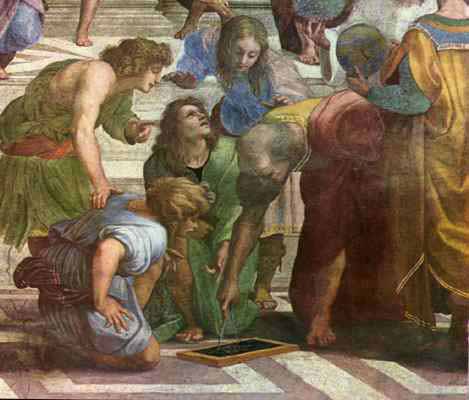
(Above is a detail from the fresco The School of Athens by Raphael - Click any image to begin)
A WebQuest by Jeff Johnson ([email protected])
For
TRED 701
Dr. Libby Hall and
Dr. Karen Kortecamp
November 4, 2000
Our math textbook tells us that the Pythagorean Theorem describes a relationship between the sides of a right triangle. To be more specific, the sum of the squares of the lengths of the two legs equals the square of the length of the hypotenuse (you may know it as a2+b2=c2, where a and b are the leg lengths and c is the hypotenuse length). Are you asleep yet? I’m starting to doze off myself...
The Pythagorean Theorem is much more interesting if you know that it has been around for approximately 3500 years and has been proven in more than 250 different ways. It provides a valuable link between arithmetic, algebra, geometry, trigonometry, and calculus. It is extremely simple, yet very powerful. In fact, Pythagoras, who is credited with proving the theorem about 2500 years ago, was viewed as divine by many of his followers.
Wait a minute! If the theorem is 1000 years older than Pythagoras, why is it called the Pythagorean Theorem? Here is your chance to find out. In this WebQuest, we will look back on the life of Pythagoras, look at some of the proofs of the theorem, and discuss the importance of the theorem throughout history.
At the end of the WebQuest, each team will have done four things:
The "Evaluation" section will provide more details about how each of these things will look.
Teams and Roles
Each team will be made up of four students. Since there are four "end products" of the WebQuest (see "Tasks"), it is suggested that each team member have one of the roles listed below:
Suggested Schedule of Activities
Two class periods will be devoted to working on the WebQuest ("work sessions"). At least one computer will be provided for each team during these sessions. Additional class time will be used for presentations and the round table discussion. It is assumed that students will also work outside of class, both with and without a computer. Below is a suggested schedule for the team:
Work Session 1:
Between Work Sessions 1 and 2:
Biographer:
Technical Writer:
Spokesperson:
Ambassador:
Work Session 2:
Between Work Session 2 and Presentations:
Biographer:
Complete the biographical sketch
Technical Writer:
Complete the writeup of the proof selected by the team
Spokesperson:
Prepare a presentation of the proof selected by the team
Ambassador:
Complete the team’s prepared statements and prepare for the round table discussion
Presentations:
Class time will be set aside for presentations. Each team will be allowed 8 minutes to present their proof.
Approximately 25-30 minutes of class time will be set aside for a round table discussion. One member from each team will sit on a "panel of experts" and participate in a discussion moderated by the teacher. The purpose of the discussion is to help understand the importance of Pythagoras and the Pythagorean Theorem by attempting to answer three central questions:
The discussion will be structured according to the following format:
There are a lot of resources listed below (a total of 11 different websites). The sites are split up into three different categories and short descriptions are given for each site. The idea is not to spend a lot of time on each site. Rather, you should try to efficiently browse through the sites and see which ones you like.
Background and Explanation of the Pythagorean Theorem
http://forum.swarthmore.edu/~sarah/hamilton/ham.namesides.html
Describes the names of the sides of a right triangle
http://www.math.com/school/subject3/lessons/S3U3L4DP.html
Right triangle facts and a description of the Pythagorean Theorem
http://www.pbs.org/wgbh/nova/proof/puzzle/
Basic description of Pythagorean Theorem (also has a proof – see below)
Biographical Information
http://euler.ciens.ucv.ve/English/mathematics/pitagora.html
A pretty generic look at Pythagoras – a good starting point
http://www-groups.dcs.st-andrews.ac.uk/~history/Mathematicians/Pythagoras.html
This site provides a little more detail
http://www.utm.edu/research/iep/p/pythagor.htm
This site concentrates more on Pythagoras’ work and philosophy
http://plato.evansville.edu/public/burnet/ch2a.htm
This site has a lot of information and it has a helpful Table of Contents. Don’t be scared off by the first section ("Character of the Tradition"). The rest of the information is a lot more straightforward.
Proofs of the Pythagorean Theorem
http://www.math.ubc.ca/~morey/java/pyth/
An award winning interactive geometrical proof
http://www.davis-inc.com/pythagor/
Animated geometric proof
http://www.pbs.org/wgbh/nova/proof/puzzle/
A good "paper cutout" geometrical proof
http://www.emsl.pnl.gov:2080/docs/mathexpl/ptprove.html
This is a good algebraic proof.
http://www.cut-the-knot.com/pythagoras/index.html
This site has 29 proofs! Check out President Garfiled’s proof (#5) and Leonardo da Vinci’s proof (#16).
The "Tasks" section of the WebQuest lists the things that each team needs to do. Each of these tasks counts equally towards the grade for the team. Below are descriptions of how each task will be evaluated. From these descriptions, you can figure out what should be included in each.
Biographical Sketch (25 points)
This should be a maximum of two pages long. It is up to the team to decide what to include and how to structure the paper, but there are some minimum requirements for content. Each biographical sketch should include information about:
Papers will be assessed for...
Content (15 points)
Style (5 points)
Format (5 points)
Written Proof of the Pythagorean Theorem (25 points)
There are many different proofs to choose from, so the appearance of the writeup will depend on the proof chosen. However, all written proofs should share some things in common. First is the intended audience. The proof should be written such that someone who is NOT a math student can understand it. Each proof should also include:
Papers will be assessed for...
Content (15 points)
Style (5 points)
Format (5 points)
Presentation of a Proof of the Pythagorean Theorem (25 points)
There are many different proofs to choose from, so the type of presentation will depend on the proof chosen. For example, some proofs might work well as a computer animation, narrated by the presenter. Others might work well as a class activity where everyone cuts geometrical shapes out of construction paper. Although the type of presentation might vary, all should have some things in common. First is the intended audience. Gear your presentation towards a group of geometry students who already know the Pythagorean Theorem (don’t spend time defining "leg" and "hypotenuse"). Each presentation should also:
Presentations will be assessed for...
Content (15 points)
Style (5 points)
Format (5 points)
Participation in a Round Table Discussion (25 points)
This will be the concluding activity of the WebQuest. One member from each team will sit on a "panel of experts" and participate in a discussion moderated by the teacher. The purpose of the discussion is to help understand the importance of Pythagoras and the Pythagorean Theorem. Each participant in the discussion (each team Ambassador) should bring three things to the discussion:
1. A written "prepared statement" which attempts to answer the question:
If the theorem is 1000 years older than Pythagoras, why is it called the Pythagorean Theorem?
2. A written "prepared statement" which attempts to answer the question:
How is mathematics different today than it was in the time of Pythagoras?
3. A written account of a practical application for the Pythagorean Theorem
The "prepared statements" involve questions which are rather open-ended. Teams are encouraged to be creative with their answers. For example, we all know from the biographical information that Pythagoras is said to have been the first person to prove the theorem. At least 250 others also came up with proofs, though. Why not name it after the first person(s) to use the theorem? Why not the person with the best proof? Whatever your answers are, they should meet the following basic requirements. Each "prepared statement" should...
The practical example does not have to be earth-shattering. It simply needs to demonstrate a way that the Pythagorean Theorem could be used effectively.
Participation in the Round Table Discussion will be assessed for...
Content of Prepared Statements (15 points)
Style of Prepared Statements (5 points)
Participation in the Discussion (5 points)
Hopefully, the Round Table Discussion will be a useful concluding activity for the WebQuest. The idea is to think about math as more than just numbers, symbols, and geometric shapes. Math has practical applications, which are demonstrated during the WebQuest, but it also has connections to other things, such as history and philosophy. Another important thing to think about is the vast number of different proofs of the same theorem. In math, something that we often ignore is that there is usually more than one "correct" way to go about things.
Think about some other mathematical concepts that you’ve learned about recently. Who was the first to use these concepts? Were they more important at one time in history than another? Is there more than one way to "look at" the concepts? How are they used today? Thinking about these questions can help you understand the concepts as well as understanding why they are important for us to learn. Keep these questions in mind as you learn new concepts in math.
Ok, now that you’re an expert on the Pythagorean Theorem, how about a joke?
There were three Medieval kingdoms on the shores of a lake. There was an island in the middle of the lake, which the kingdoms had been fighting over for years. Finally, the three kings decided that they would send their knights out to do battle, and the winner would take the island.
The night before the battle, the knights and their squires pitched camp and readied themselves for the fight. The first kingdom had 12 knights, and each knight had 5 squires, all of whom were busily polishing armor, brushing horses, and cooking food. The second kingdom had 20 knights, and each knight had 10 squires. Everyone at that camp was also busy preparing for battle. At the camp of the third kingdom, there was only one knight, with his squire.
This squire took a large pot and hung it from a looped rope in a tall tree. He busied himself preparing the meal, while the knight polished his own armor. When the hour of the battle came, the three kingdoms sent their squires out to fight (this was too trivial a matter for the knights to join in).
The battle raged, and when the dust cleared, the only person left was the lone squire from the third kingdom, having defeated the squires from the other two kingdoms.
I guess this just proves that the squire of the high pot and noose is equal to the sum of the squires of the other two sides.
(Courtesy of Seth Yoshioka-Maxwell’s Pythagoras’ Theorem website: