WebQuest: Pythagoras' Theorem
Planning and Organization Page
Prepared by
Jeff Johnson
For
TRED 701
Dr. Libby Hall and
Dr. Karen Kortecamp
November 4, 2000
General Description
This WebQuest is designed to guide students through a multi-disciplined investigation of the Pythagorean Theorem. This theorem is extremely important as it provides a valuable link between arithmetic, algebra, geometry, trigonometry, and calculus. Students will take an in depth look at the theorem by learning some of its history, examining some of its proofs, and discussing its importance in the mathematics of today and of history. Teams of four students will work together towards four "end products" of the WebQuest:
Purpose
The primary purpose of the WebQuest is for students to gain a deep understanding of the Pythagorean Theorem. This includes a thorough understanding of what the theorem states and how it can be proven. It also includes some historical background of the development and use of the theorem. The historical background is included mainly to raise the level of interest of the students. It is also important, however, in demonstrating the various roles of mathematics in society, both today and in the past.
The use of proofs serves several purposes. First and foremost, it demonstrates that the theorem is not true just because a textbook says it is true. Even more importantly, it shows students that they are capable of understanding such proofs. Finally, the use of multiple methods of proof shows students that there is more than one way to do a particular math problem. The misconception of "one correct answer" in math is one of the most difficult to correct.
The secondary purpose of the WebQuest is to show students that math is not just numbers and symbols. "Real" math involves thinking, writing, and discussion. It also overlaps other areas of study, even history and philosophy!
Intended Audience
The intended audience is a class of high school math students. These students could be in a geometry, trigonometry, or integrated algebra/geometry class. Prior to beginning the WebQuest, they should be introduced to the Pythagorean Theorem, but they need only have a basic understanding.
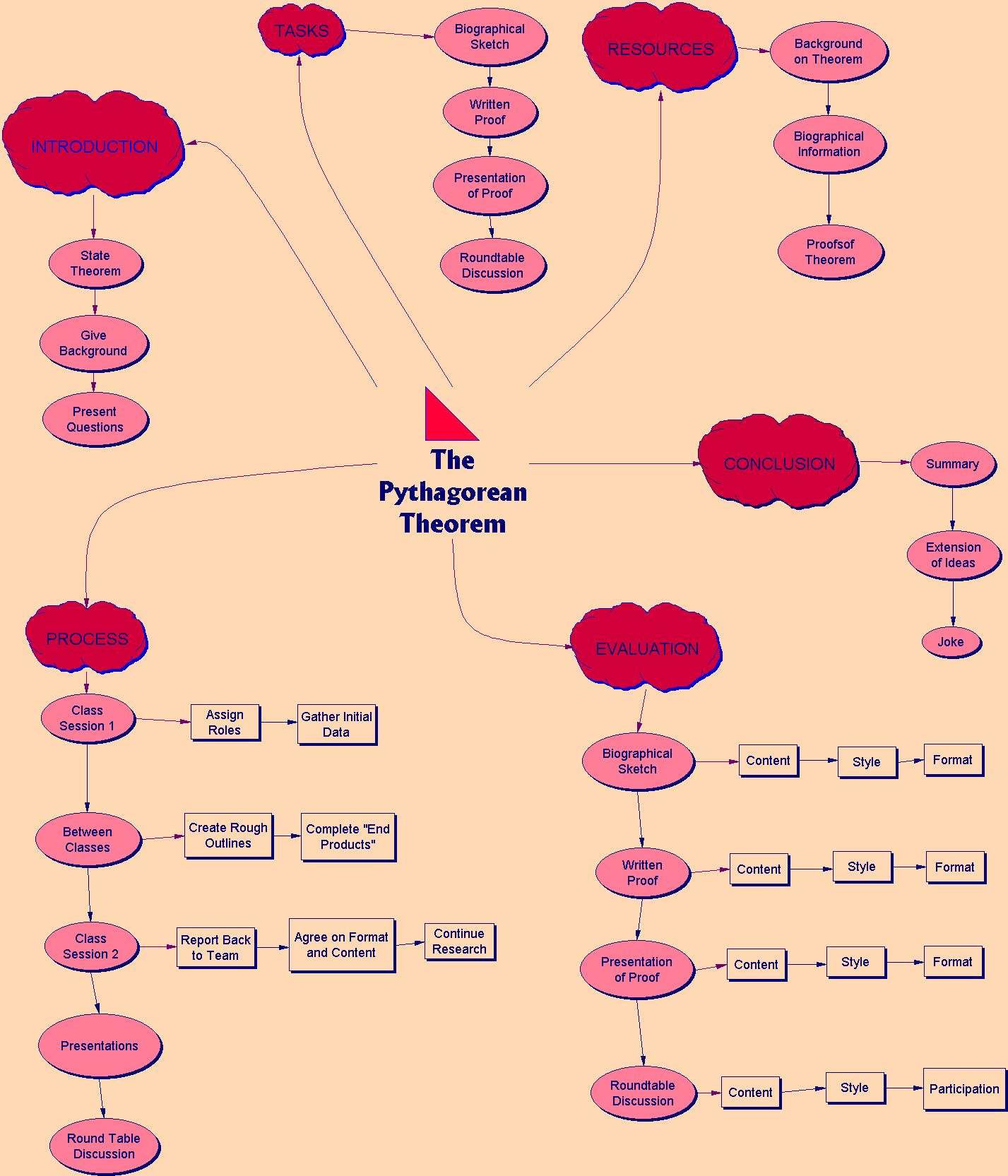
Graphic Organizer