 |
The Rules |
|
The rules have four main sections:
|
In
the rules,
|
|
Click here to get a printable
version of the rules.
|
|
|
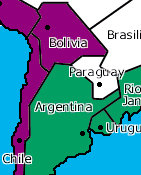
We begin with a map of the world. It's not accurate: smaller countries have been lumped together into one region, and the bigger ones have been divided into different regions.
THE OBJECT OF THE GAME
Some regions are marked with black dots. These are supply depots. You'll have one army for every supply depot that you control. If you lose a supply depot, you'll lose one army — whichever one is furthest from your home territory.
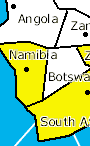
All the players begin with three supply depots, their home territory. Each territory is marked with a different colour. As their armies move about the world, they are represented by flags that match the colour of their home territory. Whenever you successfully take over another region, the background color changes to show that it is yours. It remains yours — even if your army moves on — unless some other player conquers it.
The ocean regions and the seas may never be conquered, and they will never change colour on the map. But the ocean regions — like the land regions — may only hold one army at a time. If some other army is in an ocean region, you may not go there unless you defeat them in an attack.
GAINING AND LOSING ARMIES At the end of each B turn, we'll count the supply depots and update the scores. It's at this point that you'll gain or lose armies. If you gain a new territory during the A turn, your army must still be there at the end of the B turn to get the new army. If you lose a supply depot during the A turn, you won't lose an army until the B turn is over. The number of supply depots (the score, in other words) you control must match the number of flags you have on the map. After I update the scores, I will add or subtract flags to make these numbers agree. When I remove armies, I'll start with the one that is farthest from your home territory. Any new armies you gain must appear in your home territory. This has two important results.
Typically you lose armies only when you lose supply depots, but there is another way it can happen. Sometimes an army will lose a battle and have to retreat. If the army is surrounded and has absolutely no where to run, then that army is squeezed out of existence. The flag simply disappears from the map, though you may get it back at the next score update. MOVING YOUR ARMIES Our armies are amphibious: they may move equally well on land or water, but armies may only move one region per round. In one round, your army may move from one region to any region that borders it or onto any body of water that borders it.
Plan your moves carefully. Remember: your army has to be sitting in a new region at the end of the B turn for you to claim it. So if you're going into a region that is more than one move away, try to arrive there on the B round. For example, imagine you have an army in Guyana and you want it to move up to attack Cuba. For the A turn, write for one turn "Guyana army to Carribbean." Then in the next turn, write "Carribbean army to Cuba." When the B turn ends, you'll have a new supply depot and get another army. To move an army, just say in your written orders what army you want to move and where you want to move it. For simplicity sake, we'll just name the army after the region that it's in before it moves, either land region or sea region.
Technically, this last one isn't necessary: unless you write orders telling me otherwise, I'll assume that your armies are just staying where they are and doing nothing. I'll never assume anything about your orders. If you don't write something down, it didn't happen. SUGGESTION: The game gets complicated, especially later on when the players left have more forces, so it's easy to forget or overlook something. I suggest you begin your orders by making a written list of all your armies. Then work your way down the list, giving all the armies something to do, even if it's just to stay put and support someone else.
A good rule of thumb is "Every army does something every turn."
But if someone else is occupying that region or moves into it at the same time, you haven't won your attack. The result was one army on your side versus one army from some other player. That's a tie, and it means that your army goes back where it came from. If the other army was there before you attacked, they stay there. If they attacked when you did, they go back to. Bottom line: neither army wins.
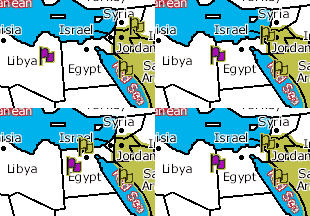
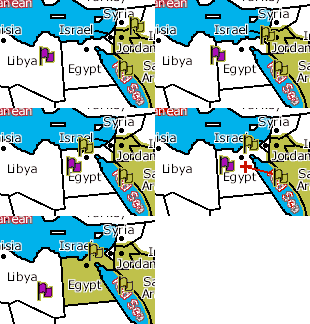
So the only way to win is for your army to outnumber the competition. In this game, we do this by having other armies support our attacks. Any army can support an attack so long as that army borders the country that is being attacked. You can use one of your armies to support another of your armies, like in the example below, or you can get support from one of the other players. This is one of the big reasons for having our players make deals with each other.
To support an attack, an army must be in a region borders the region that is being attacked. It's not enough that the army borders the attacker; it has to border the victim in order to be of any help.
When writing down orders, be very clear about who is supporting whom where. SUGGESTION: A useful technique for holding on to a large area is use what I call "The Wall." This means that you take and hold certain regions to surround your area. Each region should have an army which supports the region next to it, building a sort of wall. The regions inside the wall usually don't need armies, so their armies can venture out and gain you new regions. Again, I'll never assume anything about your orders, including your armies supporting each other. If you don't write something down, it didn't happen. |

 For example, if you have an army in Venezuela, in one round you may move to Colombia, the Amazon Basin, Guyana, or onto the Caribbean Sea. You may not move to places like Cuba, Guatemala, Panama, or Puerto Rico until the next round because they are two regions away.