

Political Fallout of the Crisis
United States Political Involvement in Iran in the Decades Before the Crisis
Political Fallout of the Crisis in U.S.
���� Even before the Iran Hostage Crisis took place, President Carter was facing several problems in both his domestic and foreign agenda.� Although elected on a platform promising economic recovery and expansion, the United States economy was in shambles.� Unemployment was on the rise, nearly reaching 8% and inflation rates were hitting the double digits.� Carter also seemed to not be able to get any legislation passed through Congress.� Carter was more successful when dealing with foreign affairs.� He had brought Egyptian President Anwar Sadat and Israeli Premier Menachem Begin to Camp David in order to forge an historic peace agreement for the Middle East.� Carter also pushed through Congress a treaty which would eventually restore the sovereignty of the Panamanians over the Panama Canal.� He also restored America's reputation in Africa and Latin America after promising to preserve the freedom's of peoples in the region which were often oppressed by numerous dictatorial regimes.� Carter was less successful when dealing with OPEC (the Organization of Petroleum Exporting Countries) whose high prices for oil caused massive shortages throughout the United States and extraodinarily high prices.� This failure of Carter's stood out in the minds of citizens as opposed to his other accomplishments in foreign affairs.
������� So when the Iran Hostage Crisis developed in November 1979, many Americans were already dissatisfied by Carter's presidency. Although Carter was largely a victim of circumstance, his presidency quickly became disabled by the hostage situation.� When Carter seemed to not be able to do anything in order to get the hostages freed, including negotiations and failed rescue missions, people began to turn against him, even those in his own party.� Senator Edward Kennedy, the leading rival for the Democratic presidential nomination, called Carter a Republican "clone."� Americans thought it was time for a change and wanted to end, once and for all, the humiliation the United States had suffered with the hostage crisis. The crisis helped to reinforce the idea that America had lost control and, although the leader of the free world, the United States was not even able to deal with a fanatical religious leader in Iran.�
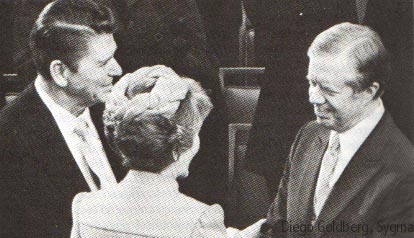
������� Jimmy Carter was able to secure the Democratic nomination for President after heated debate within the party which caused a rift between supporters of Carter and supporters of Kennedy.� This rift, along with growing discontent with Carter by the American people, helped secure the election of Republican Ronald Reagan as president.� To the American people, Reagan offered the chance to try and reclaim what had been lost and his proposed programs reminded Americans of the former power of the United States.� The freeing of the hostages only hours after Reagan's inauguration only secured this belief for many Americans.
Listen to Carters Concession Speech After Losing the 1980 Presidential Election
Listen to President Reagan Disclose the Freeing of the Hostages to the American Public

