| A Survey on Philippine Heraldry |
| By: Jude K. Grupe |
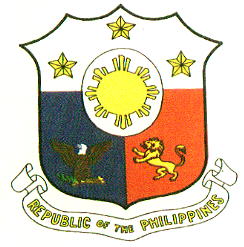
| Having Been republic only in 1946, the Philippines has not taken thought of a central heraldic authority or official body of heralds nor has it taken any great interest in the subject. Except during the commonwealth government when in 1940 Pres. Manuel Quezon issued an executive order No. 310 creating the Philippine Heraldry Committee. It's mandate, however, was only to study and recommend ways and means for the adoption of coats-of-arms for different government agencies, towns and cities. During the outbreak of World War II the operations of the Committee were suspended, and after the war on January 1946, Pres. Sergio Osmena Sr. revived the Heraldry Committee and appointed Prof. Galo Ocampo as it's chairman & secretary. The United States granted the Philippines it's independence on the same year was an opportunity for the new Heraldry Committee to create the country's great coat of arms. |
 |
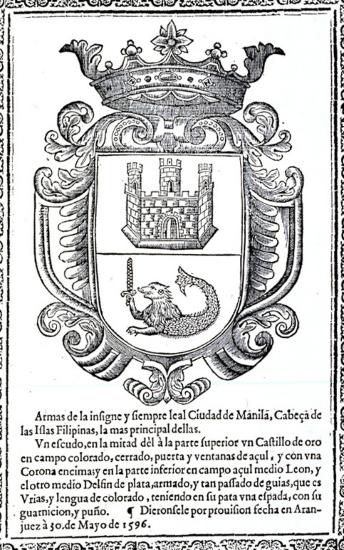
| Today, the committee exist as the Monuments and Heraldry division under the National Historical institute. It is clear that the Philippine Heraldry Committee tasks was limited only to political and civic heraldry, leaving behind the study of arms borne by Filipino families and landed gentry, by private corporations and by the church. Several heraldic evidence are to be found in the Philippines, though, there was no attempt to record it's existence. Writers both on Philippine art and culture also took no interest in it, depriving the country's historian of an important facet of our country's Spanish heritage. It is no surprise that this interest remains a closed book to a majority of the Filipinos. Heraldry set foot in the Philippines when King Philip II of Spain issued a royal decree on March 20, 1596 granting the "Distinguished and ever loyal" City of Manila it's own coat of arms. |
 |
| There is no doubt that heraldry was used in the Philippines for several centuries as arms of the Spanish monarchs, Generals and Friars are found carved on the old walls of Manila. Old Spanish corporations, colleges and universities are still displaying their arms arms dating back from the Spanish colonization. The Spanish Governors-general, the Monarch's viceroy in the Philippines may have also used them as most are in the rank of 'Condes' and 'Marquees' To this day no one really knew how much heraldic treasures the Philippines has to offer, the answer may be buried deep down with it's forgotten history. I believe that heraldry should take it's rightful place in Philippine culture, and the national pride of the Filipinos might just require a worthy glimps of it's heraldic past. |
 |
 |