Kilkenny

Kilkenny is a city in Ireland and the county town of the eponymous County Kilkenny. It is built on both banks of the River Nore in the province of Leinster, in the south-east of Ireland. The city is administered by a Borough Council and a Mayor which is a level below that of city council in the Local government of the state although the Local Government Act 2001 allows for "the continued use of the description city". The borough has a population of 8,711, however the majority of the population live outside the borough boundary, the 2011 Irish Census gives the total population of the Borough & Environs as 24,423.
Kilkenny is a popular tourist destination. In 2009 the City of Kilkenny celebrated its 400th year since the granting of city status in 1609. Kilkenny's heritage is evident in the city and environs including the historic buildings such as Kilkenny Castle, St. Canice's Cathedral and round tower, Rothe House, Shee Alms House, Black Abbey, St. Mary's Cathedral, Kilkenny Town Hall, St. Francis Abbey, Grace's Castle, and St. John's Priory. Kilkenny is regarded for its culture with craft and design workshops, the Watergate Theatre, public gardens and museums. Annual events include Kilkenny Art Festival, the Cat Laughs comedy festival and music at the Rhythm and Roots festival and the Source concert. It is a popular base to explore the surrounding towns, villages and countryside.
Kilkenny Castle
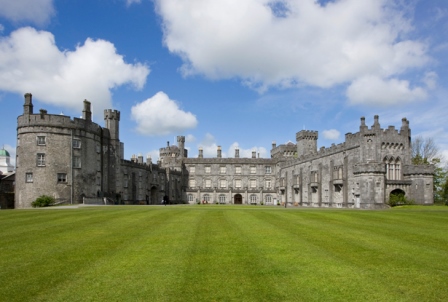 Rising above the Nore, Kilkenny Castle is one of Ireland's most visited heritage sites. The first structure on this strategic site was a wooden tower built in 1172 by Richard de Clare, the Anglo-Norman conqueror of Ireland better known as Strongbow. In 1192, Strongbow's son-in-law, William Marshall, erected a stone castle with four towers, three of which survive. The castle was bought by the powerful Butler family in 1391, and their descendants continued to live there until 1935. Maintaining such a structure became a big financial strain and most of the furnishings were sold at auction. The castle was handed over to the city in 1967 for the princely sum of �50.
One glance tells you that the castle has been modified through the centuries. First of all it's missing a wall � a key defensive deficiency. Second, there are all those windows � perfect targets, say, for a catapult. Most of the changes visible today date from the 19th century when efforts were made to banish the gloom and bring in the cheer. By then the only real defensive worry was a peasant flinging a rotten potato.
About 20 hectares of parkland are a refuge from city nuttiness. The grounds echo with chirping birds and extend to the southeast, with a Celtic cross-shaped rose garden, a fountain to the northern end and a children's playground to the south. There are many good views of the river. The castle's former stables are now home to the Kilkenny Design Centre.
St. Canice Cathedral
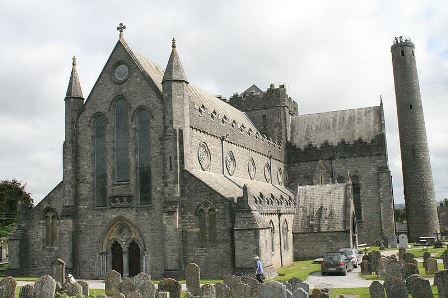 St. Canice's Cathedral, also known as Kilkenny Cathedral, present building dates from the 13th century and is the second longest cathedral in Ireland. The Cathedral is named after Saint Canice, who also gave his name to the city.
Cruciform, the cathedral was built in the Early English, or English Gothic, style of architecture, of limestone, with a low central tower supported on black marble columns. The exterior walls, apart from the gables, are embattled, and there are two small spires at the west end. The cathedral is seventy-five yards long, and its width along the transepts is forty-one yards.
Beside the cathedral stands a 100 ft 9th century round tower. St. Canice's tower an excellent example of a well-preserved early Christian (9th century) Round Tower. Accessible only by a steep set of internal ladders, it may once have been both a watchtower and a refuge, and the summit gives a good view of Kilkenny and the countryside around. The hill on which the cathedral stands is believed to be the centre of the first major settlement at Kilkenny, and the round tower suggests an early ecclesiastical foundation
Green's Bridge
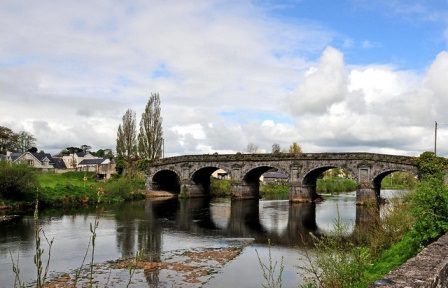 Green's Bridge, also known as the 'Great Bridge of Kilkenny', is one of two main bridges in Kilkenny and is an important element of the architectural, civil engineering and transport heritage of Kilkenny City.[34] It was first built before 1200 and been called Green's Bridge since the Middle Ages. The bridge has been rebuilt many times since the twelfth century due to constant floods including the great floods of 1487 and 1763. The current bridge was built in 1766 after the Great Flood of 1763. Green's Bridge crosses the River Nore in St. Canices Parish in the townland of Gardens.
The present-day Green's Bridge was built by William Colles (c.1710-70) in 1766 to designs prepared by George Smith (1763-7), a pupil of George Semple (c.1700-82). The Classical-style detailing indicating the lasting influence of the Roman Bridge at Rimini as described by Andrea Palladio's (1508�80) in The Four Books of Architecture (1570) (I Quattro Libri dell'Architettura). Carved limestone of high quality stone masonry enhance the architectural design value of the bridge while the series of five elliptical arches identifies the civil engineering heritage significance of the bridge. The bridge was renovated in 1835 where parapets were added but alteration works carried out in 1969 removed one parapet and a steel railing was added.
John's Bridge
 John's Bridge is one of two main bridges in Kilkenny spanning the River Nore it connects John Street to Rose Inn Street in Kilkenny city. It was first built after 1200 and has been rebuilt many times since the twelfth century due to constant floods including the great floods of 1487 and 1763. It has been called John's Bridge since the Middle Ages.
The present-day John's Bridge was completed in 1910 and spans 140 ft (43 m) across the River Nore. It was reputedly, at the time it was completed, the longest single-span reinforced bridge in Ireland or Britain. The Design was by Mouchel & Partners using the Hennebique system of reinforcement. The arch consists of three ribs, tapering from 2 ft 6 in (0.76 m) to 2 ft (0.61 m) deep. The traverse deck beams are each 2 ft (0.61 m) deep.
During the flood of 1763, people gathered on John's Bridge after Green's Bridge collapsed, John's Bridge whole structure collapsed and sixteen people died.
Rothe House
 Rothe House, is a unique Irish 17th century merchant�s townhouse complex located in the city of Kilkenny, Ireland. The complex was built by John Rothe Fitz-Piers between 1594-1610 and is made up of three houses, three enclosed courtyards, and a large reconstructed garden with orchard.
Rothe House is considered to be nationally significant because of the wide range of original post-medieval features which survive in good condition in Ireland. The property, an important element of Kilkenny�s heritage, is owned by the Kilkenny Archaeological Society and houses some of the society's collection of artefacts relating to Kilkenny City, County and Ireland.
The garden to the rear of the house has been reconstructed to reflect a typical 17th-century garden. The burgage plot on which Rothe House was built survives intact one of a few in such an unaltered state. Kilkenny's medieval city wall forms part of the curtilage of the Rothe House complex.