Galway

Galway, or the City of Galway, is a city in Ireland. It is in the West Region and the province of Connacht. Galway City Council is the local authority for the city. Galway lies on the River Corrib between Lough Corrib and Galway Bay and is surrounded by County Galway. It is the fourth most populous city in the state and the sixth most populous on the island of Ireland.
With a population of 75,529, Galway is the fourth most populous city in the State and the 23rd most populous area of local government. It is located on the River Corrib.
Galway is known as Ireland's Cultural Heart and is renowned for its vibrant lifestyle and numerous festivals, celebrations and events. Every July, Galway hosts the Galway Arts Festival which is known for its famous Macnas parade.
Eyre Square
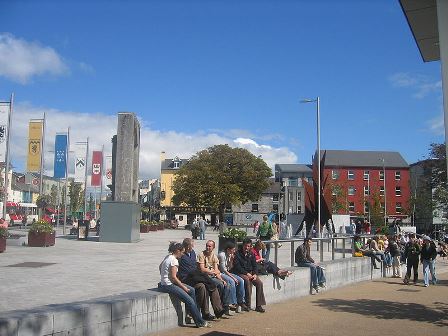 John F. Kennedy Memorial Park is an inner-city public park in Galway, Ireland, formerly officially named Eyre Square (Irish: An Fhaiche Mhór) and still widely known by that name. The park is within the city centre, adjoining the nearby shopping area of Williams Street and Shop Street.
The park is rectangular, surrounded on three sides by streets that form the major traffic arteries into Galway city centre; the West side of the Square was pedestrianised in 2006.
The Browne doorway is also another attraction in Eyre Square as it was originally the doorway of the Browne family's home on Lower Abbeygate Street but it was moved in 1905 from Abbeygate street to Eyre Square.
Claddagh
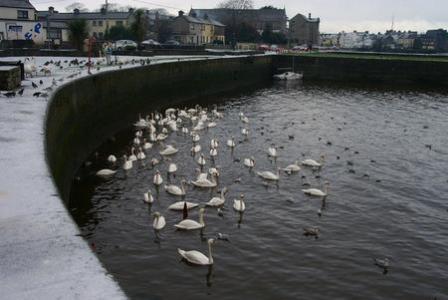 Claddagh is an area close to the centre of Galway city, where the Corrib River meets Galway Bay. It was formerly a fishing village, just outside the old city walls. It is just across the river from the Spanish Arch, which was the location of regular fish markets where the locals supplied the city with seafood as recently as the end of the 19th century. People have been gathering seafood and fishing from the area for millennia. It is one of the oldest former fishing villages in Ireland - its existence having been recorded since the arrival of Christianity in the 5th century.
The Claddagh is most famous internationally for the Claddagh ring,[citation needed] which is popular among those of Irish heritage as both a friendship and wedding ring. This traditional design consists of two clasped hands holding a crowned heart, and symbolizes love, friendship and loyalty.
Taibhdhearc na Gaillimhe
 Taibhdhearc na Gaillimhe, meaning "Galway Theatre" is the national Irish language theatre of Ireland. It was founded in 1928.
The word taibhdhearc appears as a gloss for the Latin teatrum (theatre) in an old Irish document, derived from roots meaning "dream" and "glance." The modern Irish for a theatre is amharclann.
The building itself is actually built on the ruins of the city's original Augustinian friary. The rear wall incorporates a wall from this friary, including some carved stone window frames. With its location on An tSráid Láir (Middle Street) the Taibhdhearc is situated in the heart of the mediaeval city of Galway.
Throughout the year the theatre is a much sought after venue for drama and music productions, as well as occasionally screening international films. The busiest period for the arts in the city happens during the two weeks of the annual Galway Arts Festival.
In 2004 An Taibhdhearc awarded the Gradam Bhaitéir Uí Mhaicín prize for scriptwriting to Coinneáil Orainn by Darach Ó Scolaí, which was staged by An Taibhdhearc the following year.
National University of Ireland
 The National University of Ireland, Galway (NUI Galway) is a constituent university of the National University of Ireland. It is a tertiary-level educational institution located in Galway, Ireland.
The university was founded in 1845 as Queen's College, Galway, and was more recently known as University College, Galway (UCG). Michael D. Higgins, President, Enda Kenny, Taoiseach (Prime Minister), Eamon Gilmore, Tánaiste (Deputy Prime Minister) and Máire Whelan, Attorney General of Ireland are all Alumni.
NUI Galway has a strong community of international students, which make up 13% of the student population. It welcomes over 500 Visiting Students from colleges and universities around the world each year, from countries including the USA, Canada and Malaysia. Various societies are present in the University to cater for international students, including the International Students Society, Malaysian Societyand many more.
Coole Park
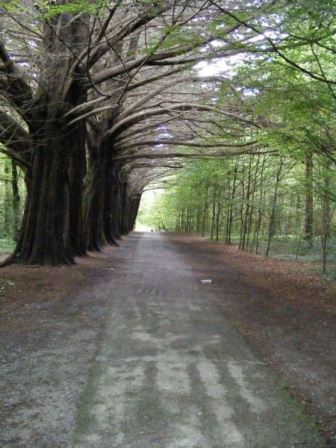 Coole Park is a nature reserve of approximately 1,000 acres (4 km2) located a few miles west of Gort, County Galway, Ireland. It is operated by the Irish National Parks and Wildlife Service, part of the Department of Arts, Heritage and the Gaeltacht. The park is in a low–lying karstic limestone area characterized by seasonal lakes, known as turloughs, and has extensive woodlands. There are 6 kilometres of signposted nature trails plus a formal late 18th century walled garden.
The grounds are open to the public all year round (free admission). A visitor centre located in the former outbuildings (late 18th century) operates during high season (April to September inclusive). The centre offers a tea room, an audio/visual presentation on Lady Gregory and the literary history of Coole Park, and also a multi-media exhibition called "Coole Park through the eyes of 'Me and Nu', Granddaughters of Lady Gregory".
Since 1990 Coole Lough and Garryland Wood has been protected as a Wetland of International Importance under the Ramsar Convention. The park is included in a Special Protection Area for birds under the EU Birds Directive: this site of 520 ha (site code SPA 107) was designated in 1996 because of its importance for wintering waterfowl, notably whooper swan. It overlaps with a smaller Important Bird Area. Coole Park is part of the Coole-Garryland Complex, a candidate Special Area of Conservation (site code SAC 252).