Dublin

Dublin is the capital and most populous city of Ireland. The English name for the city is derived from the Irish name Dubhlinn, meaning "black pool". Dublin is situated in the province of Leinster near the midpoint of Ireland's east coast, at the mouth of the River Liffey and the centre of the Dublin Region.
Originally founded as a Viking settlement, it evolved into the Kingdom of Dublin and became the island's principal city following the Norman invasion. The city expanded rapidly from the 17th century; it was briefly the second largest city in the British Empire and the fifth largest in Europe. Dublin entered a period of stagnation following the Act of Union of 1800, but it remained the economic centre for most of the island. Following the partition of Ireland in 1922, the new parliament, the Oireachtas, was located in Leinster House. Dublin became the capital of the Irish Free State and later the Republic of Ireland.
Dublin is situated at the mouth of the River Liffey and encompasses a land area of approximately 115 km2. It is bordered by a low mountain range to the south and surrounded by flat farmland to the north and west. The Liffey divides the city in two between the Northside and the Southside. Each of these is further divided by two lesser rivers � the River Tolka running northwest from Dubin Bay, and the River Dodder running southwest from the mouth of the Liffey. Two further water bodies � the Grand Canal on the southside and the Royal Canal on the northside � ring the inner city on their way to the west and the River Shannon.
Grafton Street
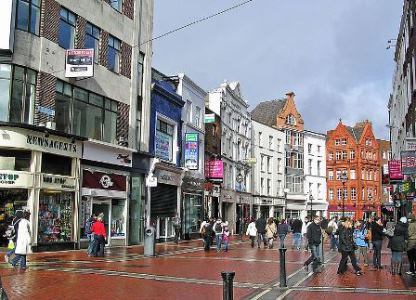 Grafton Street is a popular attraction in Ireland. This unique destination is located in Dublin. However, the street itself is a famous Irish landmark. Some consider it an institution. This historic area is home to a major upscale shopping center. There are many nods to Grafton Street�s original early 1900s birth, including an Art Deco building that sits on the corner welcoming shoppers and travelers.
Grafton Street is one of the two principal shopping streets in Dublin city centre, the other being Henry Street. It runs from Saint Stephen's Green in the south (at the highest point of the street) to College Green in the north (to the lowest point). In 2008, Grafton Street was the fifth most expensive main shopping street in the world, at �5,621/m�/year.
Guinness Storehouse
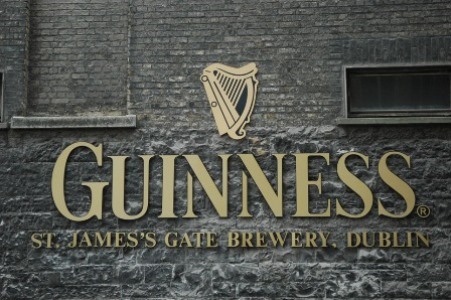 The most popular visit in town is the beer-lover's Disneyland, a multimedia bells-and-whistles homage to the country's most famous export and the city's most enduring symbol. The old grain storehouse, the only part of the massive, 26-hectare St James's Gate Brewery open to the public, is a suitable cathedral in which to worship the black gold; shaped like a giant pint of Guinness, it rises seven impressive storeys high around a stunning central atrium. At the top is the head, represented by the Gravity Bar, with a panoramic view of Dublin.
From the time Arthur Guinness (1725�1803) founded the brewery in 1759, the operation has expanded down to the Liffey and across both sides of the street; at one point, it had its own railway and there was a giant gate stretching across St James's St, hence the brewery's proper name. At its apogee in the 1930s, it employed over 5000 workers, making it the largest employer in the city. Increased automation has reduced the workforce to around 600, but it still produces 2.5 million pints of stout every day.
St. Stephen's Garden
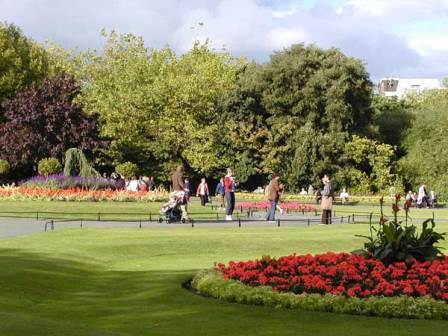 As you watch the assorted groups of friends, lovers and individuals escaping the confines of the office, splaying themselves across the nine elegantly landscaped hectares of St Stephen�s Green and looking to catch a few rays of precious sun, consider that those same hectares once formed a common for public whippings, burnings and hanging. These days, the harshest treatment you�ll get at Dublin�s favourite lunchtime escape is the warden chucking you off the green for playing football or frisbee.
The buildings around the square date mainly from the mid-18th century, when the green was landscaped and became the centrepiece of Georgian Dublin. The northern side was known as the Beaux Walk and it�s still one of Dublin�s most esteemed stretches, home to Dublin�s original society hotel, the Shelbourne. Nearby is the tiny Huguenot Cemetery, established in 1693 by French Protestant refugees.
Ha'ppeny Bridge
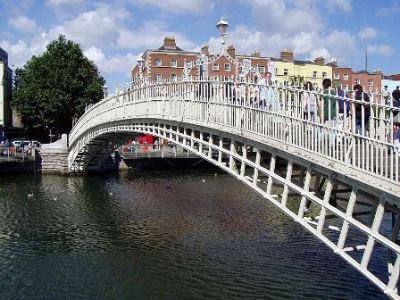 The Ha'penny Bridge, known later for a time as the Penny Ha'penny Bridge, and officially the Liffey Bridge, is a pedestrian bridge built in 1816 over the River Liffey in Dublin, Ireland. Made of cast iron, the bridge was cast at Coalbrookdale in Shropshire, England.
The bridge has three lamps supported by curved ironwork over the walkway. In a bad state of repair, the bridge was closed in 2001 for major repair. It was reopened, with its original paint colour restored and changed made at the ends to allow standing room for pedestrians before crossing the road. The original line of the decking was restored.
St. Patrick's Cathedral
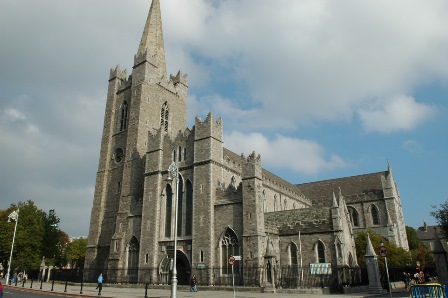 It was at this cathedral, reputedly, that St Paddy himself dunked the Irish heathens into the waters of a well, so the church that bears his name stands on one of the earliest Christian sites in the city and a pretty sacred piece of turf. Although there's been a church here since the 5th century, the present building dates from 1190 or 1225 (opinions differ) and it has been altered several times, most notably in 1864 when the flying buttresses were added, thanks to the neo-Gothic craze that swept the nation. St Patrick's Park, the expanse of green beside the cathedral, was a crowded slum until it was cleared and its residents evicted in the early 20th century.
Like Christ Church Cathedral, the building has suffered a rather dramatic history of storm and fire damage. Oliver Cromwell, during his 1649 visit to Ireland, converted St Patrick's to a stable for his army's horses, an indignity to which he also subjected numerous other Irish churches. Jonathan Swift, author of Gulliver's Travels, was the dean of the cathedral from 1713 to 1745, but prior to its restoration it was very neglected.
Spire of Dublin
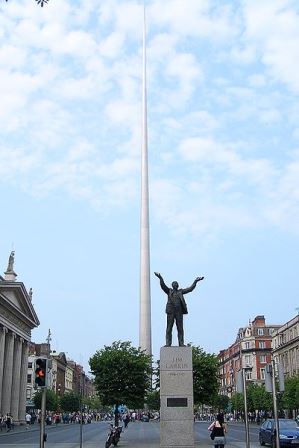 The Spire of Dublin, officially titled the Monument of Light is a large, stainless steel, pin-like monument 121.2 metres (398 ft) in height, located on the site of the former Nelson's Pillar on O'Connell Street in Dublin, Ireland.
The pattern around the base of the Spire is based on a core sample of earth and rock formation taken from the ground where the spire stands. The pattern was applied by bead blasting the steel through rubber stencil masks whose patterns were created by water jet cutting based on core sample drawings supplied by the contractor.
During the day it maintains its steel look, but at dusk the monument appears to merge into the sky. The base of the monument is lit and the top 12 m (39 ft) is illuminated to provide a beacon in the night sky across the city.