Derry

Derry or Londonderry is the second-largest city in Northern Ireland and the fourth-largest city on the island of Ireland. The name Derry is an anglicisation of the Irish name Daire or Doire meaning "oak grove". In 1613, the city was granted a Royal Charter by King James I and the "London" prefix was added, changing the name of the city to Londonderry. While the city is more usually known as Derry, Londonderry is also used and remains the legal name.
The old walled city lies on the west bank of the River Foyle, which is spanned by two road bridges and one footbridge. The city now covers both banks (Cityside on the west and Waterside on the east). The city district also extends to rural areas to the southeast. The population of the city proper (the area defined by its 17th-century charter) was 83,652 in the 2001 Census, while the Derry Urban Area had a population of 90,736. The district is administered by Derry City Council and contains both Londonderry Port and City of Derry Airport.
The Greater Derry area, that area within about 20 miles (32 km) of the city, has a population of 237,000. This comprises the districts of Derry City and parts of Limavady district, Strabane district, and East Donegal (including Raphoe and St Johnston), along with Inishowen. Derry is also the de facto capital of the north west of Ireland, which includes the Counties of; Donegal, Londonderry and Tyrone, with a population of 586,246. Derry forms the main economic and cultural core of this region along with other smaller towns such as Letterkenny, Omagh and Coleraine.
Derry is close to the border with County Donegal, with which it has had a close link for many centuries. The person traditionally seen as the 'founder' of the original Derry is Saint Colmcille, a holy man from T�r Chonaill, the old name for almost all of modern County Donegal (of which the west bank of the Foyle was a part before c. 1600).
In 2013, Derry will become the inaugural city to be designated UK City of Culture, having been awarded the title in July 2010.
Bloody Sunday Memorial
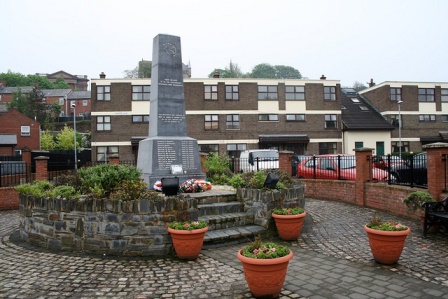 A simple granite obelisk that commemorates the 14 civilians who were shot dead by the British Army on 30 January 1972. Bloody Sunday tragically echoed Dublin's Bloody Sunday of November 1920. Derry's Bloody Sunday was a turning point in the history of the Troubles. On Sunday 30 January 1972, the Northern Ireland Civil Rights Association organised a peaceful march through Derry in protest against internment without trial, which had been introduced by the British government the previous year.
The exact sequence of events is disputed, but it now seems clear that soldiers of the 1st Battalion the Parachute Regiment opened fire on unarmed civilians. Fourteen people were shot dead, some of them shot in the back; six were aged just 17. Another 14 people were injured, 12 by gunshots and two from being knocked down by armoured personnel carriers. The Catholic population of Derry, who had originally welcomed the British troops as a neutral force protecting them from Protestant violence and persecution, now saw the army as enemy and occupier. The ranks of the Provisional Irish Republican Army (IRA) swelled with a fresh surge of volunteers.
Guild Hall
 The Guildhall in Derry, County Londonderry, Northern Ireland, is a building in which the elected members of Derry City Council meet. It was built in 1890.
The Guildhall houses a large hall where many events of social and political nature have been held. It has been home to the Feis Doire Colmcille � an event which celebrates Irish culture - and the now-discontinued Londonderry Feis. It was also home to the Saville Inquiry into the events of Bloody Sunday 30 January 1972 in Derry.
The exact sequence of events is disputed, but it now seems clear that soldiers of the 1st Battalion the Parachute Regiment opened fire on unarmed civilians. Fourteen people were shot dead, some of them shot in the back; six were aged just 17. Another 14 people were injured, 12 by gunshots and two from being knocked down by armoured personnel carriers. The Catholic population of Derry, who had originally welcomed the British troops as a neutral force protecting them from Protestant violence and persecution, now saw the army as enemy and occupier. The ranks of the Provisional Irish Republican Army (IRA) swelled with a fresh surge of volunteers.
Craigavon Bridge
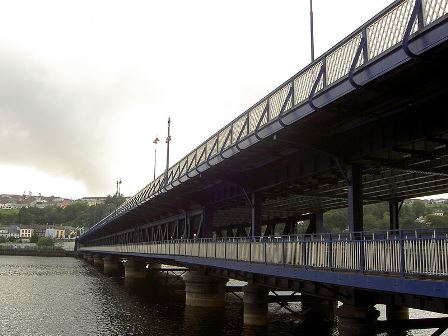 The Craigavon Bridge is one of three bridges in Derry, Northern Ireland. It crosses the River Foyle further south than the Foyle Bridge and Peace Bridge. It is one of only a few double-decker road bridges in Europe. It was named after Lord Craigavon, the first Prime Minister of Northern Ireland.
The present bridge began construction in the late 1920s and was finished in 1933. The lower deck of the bridge originally carried a railway line for freight wagons, but this was replaced by a road in 1968, and at each end a silhouetted mural of a railway station stands to mark the railway. On 3 July 1968, as part of a series of protests against housing conditions in Derry, the Derry Housing Action Committee (DHAC) held a sit-down protest on the newly opened second deck of the Craigavon Bridge.
A pair of bronze statues forming a sculpture entitled Hands Across the Divide are situated at the west end of Craigavon Bridge in Carlisle Square and were produced by Derry sculptor Maurice Harron.
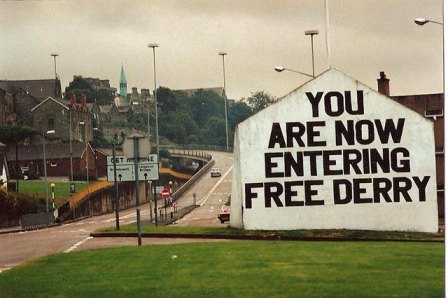
Free Derry Corner
 The Craigavon Bridge is one of three bridges in Derry, Northern Ireland. It crosses the River Foyle further south than the Foyle Bridge and Peace Bridge. It is one of only a few double-decker road bridges in Europe. It was named after Lord Craigavon, the first Prime Minister of Northern Ireland.
The present bridge began construction in the late 1920s and was finished in 1933. The lower deck of the bridge originally carried a railway line for freight wagons, but this was replaced by a road in 1968, and at each end a silhouetted mural of a railway station stands to mark the railway. On 3 July 1968, as part of a series of protests against housing conditions in Derry, the Derry Housing Action Committee (DHAC) held a sit-down protest on the newly opened second deck of the Craigavon Bridge.
A pair of bronze statues forming a sculpture entitled Hands Across the Divide are situated at the west end of Craigavon Bridge in Carlisle Square and were produced by Derry sculptor Maurice Harron.
St. Columb's Cathedral
 St Columb's Cathedral in the walled city of Derry, Northern Ireland is the mother church of the Church of Ireland Diocese of Derry and Raphoe and the parish church of Templemore.
It is dedicated to Saint Columba, the Irish monk who established a Christian settlement in the area before being exiled from Ireland and introducing Christianity to Scotland and northern England.
The original site of the diocesan cathedral was in Templmore. Due to the violence of the Nine Years' War, the church was destroyed. It was first damaged by an accidental explosion on 24 April 1568, the church having been appropriated for the storage of gunpowder. On 16 April 1600, Sir Henry Docwra entered Londonderry with a force of 4,000 soldiers. He tore down the ruins of the Big Church and used its stones to build the walls and ramparts of the city.A small square stone tablet from An Teampall M�r is today fixed into the porch of the present structure. The Latin inscription reads "In Templo Vervs Devs Est Verec Colendus" ("The True God is in His Temple and is to be truly worshipped").
The Cathedral also contains a memorial to Valentine Munbee McMaster VC. St Columb's is the first cathedral to be built by the Anglican church after the Reformation in the British Isles and the first Protestant cathedral to be built in Europe.