Cork

Cork is a city in Ireland. It is located in the South-West Region and in the province of Munster. With a population of 119,230, it is the second largest city in the state and the third most populous on the island of Ireland.
The city is built on the River Lee which divides into two channels at the western end of the city. The city centre is located on the island created by the channels. At the eastern end of the city centre where the channels re-converge, quays and docks along the river banks lead to Lough Mahon and Cork Harbour, which is one of the world's largest natural harbours.
The city's cognomen of "the rebel city" originates in its support for the Yorkist cause during the War of the Roses. Corkonians often refer to the city as "the real capital" in reference to the city's role as the centre of anti-treaty forces during the Irish Civil War.
Blarney Stone
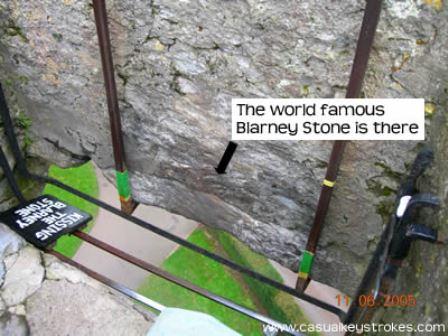 Many visitors to Ireland make sure they kiss the Blarney Stone, which is located at Blarney Castle near Cork. Here, you can learn about the castle�s history. It was originally a timber lodge built in the 10th Century, but was replaced by the stone castle in 1210. Many believe that kissing the Blarney Stone brings good luck, so take your chances. Be sure to get a picture while you�re there!
Among the most visited of Irish landmarks, Blarney Castle stands near the River Martin in County Cork, Ireland. The original castle dates to the 11th century and was improved upon during the interceding centuries, but it remains one of the best-preserved medieval castles in the country and is a favorite destination among tourists who come to kiss the Blarney Stone, which is said to bestow the "gift of gab."
St. Patrick's Street
 St Patrick's Street is the main shopping street of the city of Cork in the south of Ireland. Since its redevelopment in 2004, it has twice won the award as Ireland's best shopping street.
St Patrick's Street runs in a curve from Saint Patrick's Quay to Daunt Square, where it meets Grand Parade. The street obtains its curved shape due to its location over an arm of the River Lee. It is home to a number of notable retail outlets such as Brown Thomas, Dunnes Stores, Debenhams (formerly known as Roches Stores), Marks & Spencer and Penneys.
Red Abbey Tower
 The Red Abbey in Cork, Ireland was a 14th-century Augustinian abbey which took its name from the reddish sandstone used in construction. Today all that remains of the structure is the central bell tower of the abbey church, which is one of the last remaining visible structures dating to the medieval walled town of Cork.
In late 13th or early 14th century, an Augustinian monastery was built in Cork, and was occupied by the friars until at least the rebellion of 1641, and possibly as late as 1700.
The abbey tower was used by John Churchill (later the Duke of Marlborough) as a vantage point and battery during the Siege of Cork in 1690. The siege sought to suppress an uprising in the city and its association with the expelled Catholic King of England, James II.
In the eighteenth century, the Augustinian friars established a new friary in Fishamble Lane, and the Red Abbey was turned over to use as a sugar refinery. However, a fire in the refinery destroyed much of the abbey's structure in 1799.
All that remains today of the structure is the bell tower of the abbey's church. The tower is designated as a national monument and maintained by Cork City Council.
Cathedral of Saint Mary and Saint Anne
 The Cathedral of Saint Mary and Saint Anne (also known as Cork Cathedral, Saint Mary's Cathedral, North Cathedral or The North Chapel) is a Roman Catholic cathedral located in Cork, Ireland. It is the seat of the Bishop of Cork and Ross, and the mother church of the Roman Catholic Diocese of Cork and Ross.
The cathedral was dedicated in 1808, but was extensively damaged by an act of arson in 1820. George Richard Pain undertook the restoration of the cathedral. In 1964 the sanctuary of the cathedral was extended, and a sanctuary tower was built. As well as this, the internal layout of the cathedral was reorganised.
The most recent large-scale works were undertaken at the cathedral in 1996. The tower and sanctuary were renovated and refurbished, the roof was re-slated and the gothic ceiling was repaired. External stonework of the cathedral was also repointed. The cathedral closed for the duration of the works.
County Hall
 The County Hall is a 17-storey office block, owned by Cork County Council and housing its administrative headquarters. The building is located on Carrigrohane Road in the City of Cork (which is actually a separate administrative area from the County). At 67m (219 ft), the building was the tallest storeyed building in the state until surpassed by The Elysian in 2008.
The building was designed by Patrick McSweeney, then Cork County Architect and opened in 1968 and is now a protected building, although its modern design was not universally admired. Ois�n Kelly's statue Two Working Men stands outside the complex. A redevelopment project began in 2002, which was opposed by An Taisce. The original distinctive concrete facade had been severely eroded, and it was decided to replace rather than repair this, as part of an expansion scheme. A louvered glass cladding replaced the original concrete, and a six-storey extension at ground level was completed in June 2006. The building was previously measured at 64m, but the addition of an extra storey extended its height to 67m. This new top storey is a glazed pavilion, containing a restaurant offering panoramic views of the city and environs.