Belfast
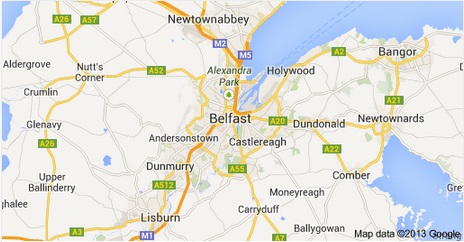
Belfast is the capital and largest city of Northern Ireland. Most of Belfast is in County Antrim, but parts of East and South Belfast are in County Down. It is on the flood plain of the River Lagan.
By population, it is the fourteenth largest city in the United Kingdom and second largest on the island of Ireland. It is the seat of the devolved government and legislative Northern Ireland Assembly. The city of Belfast has a population of 286,000 and lies at the heart of the Belfast urban area, which has a population of 579,276. The Larger Urban Zone, as defined by the European Union, has a total population 641,638. Belfast was granted city status in 1888.
Today, Belfast remains a centre for industry, as well as the arts, higher education and business, a legal centre, and is the economic engine of Northern Ireland. The city suffered greatly during the period of conflict called the Troubles, but latterly has undergone a sustained period of calm, free from the intense political violence of former years, and substantial economic and commercial growth. Belfast city centre has undergone considerable expansion and regeneration in recent years, notably around Victoria Square. Belfast is served by two airports: George Best Belfast City Airport in the city, and Belfast International Airport 15 miles (24 km) west of the city. Belfast is also a major port, with commercial and industrial docks dominating the Belfast Lough shoreline, including the famous Harland and Wolff shipyard. Belfast is a constituent city of the Dublin-Belfast corridor, which has a population of three million, or half the total population of the island of Ireland.
Peace Line
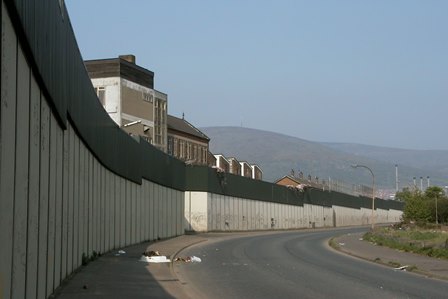 There are steel gates that mark the beginning of the so-called Peace Line, the 6m-high wall of corrugated steel, concrete and chain link that has divided the Protestant and Catholic communities of West Belfast for almost 40 years. Begun in 1970 as a 'temporary measure', it has now outlasted the Berlin Wall, and zigzags for some 4km from the Westlink to the lower slopes of Black Mountain. These days the gates in the wall remain open during the day, but most are still closed from 17:00 to 08:00.
There are now more than 20 such barriers in Belfast, and a total of more than 40 throughout Northern Ireland, the most visible sign of the divisions that have scarred the province for so long.
Cave Hill
 The best way to get a feel for Belfast's natural setting is to view it from above. In the absence of a private aircraft, head for Cave Hill (368m) which looms over the northern fringes of the city. The view from its summit takes in the whole sprawl of the city, the docks and the creeping fingers of urbanisation along the shores of Belfast Lough. On a clear day you can even spot Scotland lurking on the horizon.
The hill was originally called Ben Madigan, after the 9th-century Ulster king, Matudhain. Its distinctive, craggy profile, seen from the south, has been known to locals for two centuries as 'Napoleon's Nose' - it supposedly bears some resemblance to Bonaparte's hooter, but you might take some convincing. On the summit is an Iron Age earthwork known as McArt's Fort where members of the United Irishmen, including Wolfe Tone, looked down over the city in 1795 and pledged to fight for Irish independence.
A little bridge and some steps lead up to the summit proper, an Iron Age fort surrounded by crags. There's a superb view across the city, harbour and lough, with Scrabo Hill and Tower prominent on the eastern horizon, and the rounded forms of the Mourne Mountains far away to the south.
Titanic Belfast
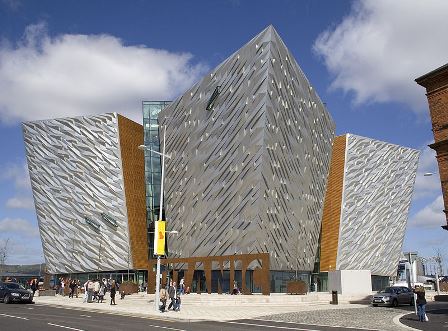 Titanic Belfast is a visitor attraction and a monument to Belfast’s maritime heritage on the site of the former Harland & Wolff shipyard in the city's Titanic Quarter. It tells the stories of the ill-fated RMS Titanic, which sank on her maiden voyage in 1912, and her sister ships RMS Olympic and HMHS Britannic. The building contains more than 12,000 square metres (130,000 sq ft) of floor space, most of which is occupied by a series of galleries, plus private function rooms and community facilities.
In front of the building is Titanica, a sculpture by Rowan Gillespie depicting a diving female figure. Made of bronze, it is mounted on a brass base, evoking the design of figureheads on ships' prows, and is meant to represent hope and positivity. The figure was dedicated by representatives of the Anglican, Catholic, Methodist and Presbyterian churches on 27 March 2012, a few days before the opening of Titanic Belfast.
Ulster Hall
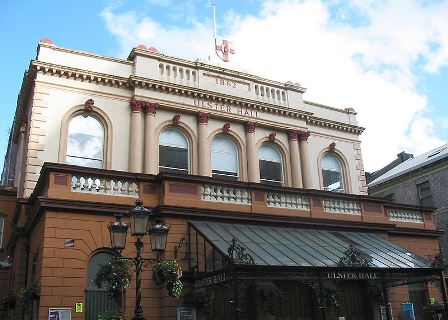 The Ulster Hall is a concert hall and grade B1 listed building in Belfast, Northern Ireland. Situated on Bedford Street in Belfast city centre, the hall hosts concerts, classical recitals, craft fairs and political party conferences. Despite the opening of larger concert halls in the city, such as the Waterfront Hall and the Odyssey, the Ulster Hall has remained a very popular venue, and is considered to evoke much more atmosphere than the newer venues.
Built in 1859 and opened in 1862, the hall's purpose was to provide the expanding city of Belfast with a multi-purpose venue of sufficient size. It was designed by William J. Barre (also responsible for the Albert Clock) for the Ulster Hall Company.
The Ulster Hall features one of the oldest examples of a functioning classic English pipe organ. The Mulholland Grand Organ is named in honour of former Lord Mayor of Belfast, Andrew Mulholland, who donated it to the hall in the 1860s. It was built by William Hill & Son and donated after the hall was officially opened. In the late 1970s, the organ was extensively restored to Hill's own original design. Mullholland's great-great-grandson, Henry Mulholland, 4th Baron Dunleath, oversaw the restoration.
Great Victoria Street
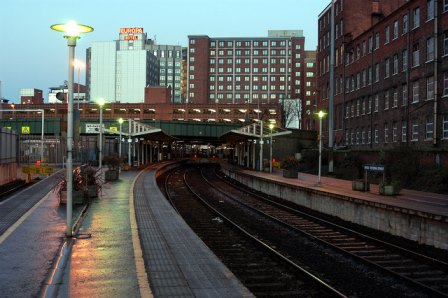 Belfast Great Victoria Street is a major railway station serving the city centre of Belfast, Northern Ireland. It is one of two major stations in the city, along with Belfast Central, and is one of the four stations located in the city centre, the others being Belfast Central, Botanic and City Hospital. It is near Great Victoria St. one of Belfast's premier commercial zones, and Sandy Row. It is in a more central position than Belfast Central, with the Europa Hotel, Grand Opera House and The Crown Liquor Saloon all nearby.
The current station has two island platforms providing a total of four platform faces. Platforms 2 and 3 run the full length of the site and open onto the station's main concourse. Platforms 1 and 4 are half the length and are accessible by walking down the other platforms.
Great Victoria Street is the hub of Northern Ireland's suburban rail services, with Bangor line, Derry~Londonderry line, Newry line and weekend Larne Line trains all terminating there.