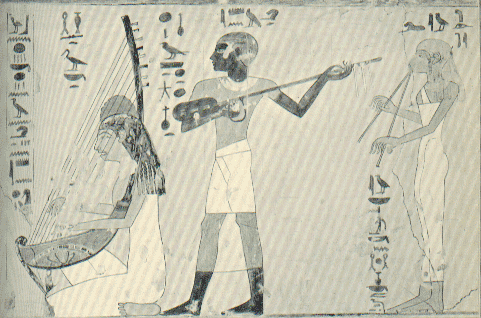
The image above depicts the Egyptian harp, lute, and double-reed pipe.
(c. 1475 BC)
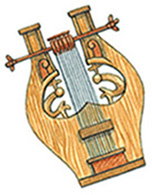 | The kithara was made of the most splendid woods and often inlaid with precious stones and metals; for instance, gold and diamonds. The professional kithara players were called kitharodes. |
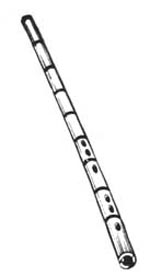 | Nay is the generic Arabic name for simple open-ended reed instruments which usually have 6 holes in the front for the fingers to play and 1 hole underneath for the thumb. Fine, mellow tones are brought forth by blowing gently over the orifice of the tube while manipulating the fingers and thumb; by blowing with more or less force, sounds are produced an octave higher or lower, and tunes in different scales can be played by utilizing nays of various lengths. |
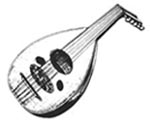 | The Oud is a short-necked, half pear shaped, lute type instrument. It has six pairs of strings and is usually played with a plectrum. Across the Middle East, the oud is referred to as 'the King of all instruments'. |
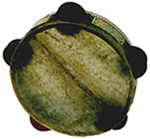 | The riqq, pronounced (" rick "), is a tambourine or a small, round, frame drum stretched with goat, or preferably, fish skin on one side. It is made with especially well-tuned cymbals, and is played in a delicate and sensitive manner. The kotim or hatam is the inlay around the frame of the drum and is usually made from bone or mother-of-pearl. |
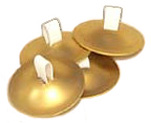 | The sagat are small metal disks, worn on the hands and played while belly dancing. Most belly dancers wear four of them: one on each thumb, and one on the middle finger of each hand. |
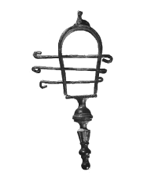 | The sistrum makes a rattling sound by means of rings on the metal cross-bars. It was used by women in temple ritual which included singing and dancing in honour of the goddess Hathor. |
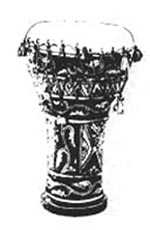 | The tablah is a small hand-drum also known as the durbakke. One of the most commonly played of the percussion instruments, the tablah is a membranophone made of goat or fish skin stretched over a vase-shaped drum with a wide neck. Usually made of earthenware or metal, it is placed either under the left arm or between the legs and struck in the middle for the strong beats and on the edge for the sharp in-between beats. |
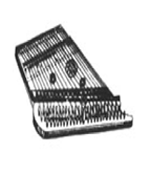 | The qanun is a descendent of the old Egyptian harp and has played an integral part in Arab music since the tenth century. A kind of dulcimer, its Arabic name means 'rule' or 'law.' It has 81 strings which are stretched in groups of three with 24 treble chords consisting of three chords to each note. The instrument is placed flat on the knees or table of the musician; the strings are plucked with the finger or with two plectra. |
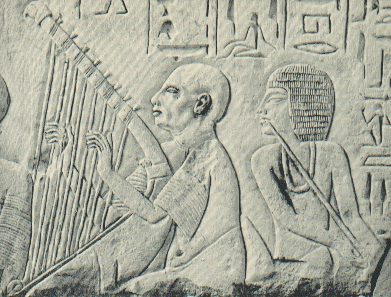
The image above shows musicians playing the harp and flute.
(1570-1310 BC)