
 |
|
Links: Luneta Park Landmark Events in history Gallery Guestbook |
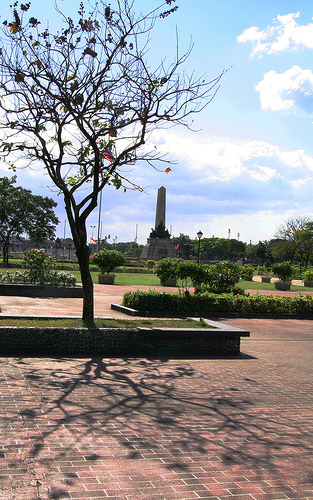 The site is guarded 24 hours a day, 7 days a week by ceremonial soldiers. His poem, "Mi Ultimo Adios" ("My Last Farewell") is inscribed on the memorial plaque. The name "Luneta" is synonymous to the word lunette; the park was said to have the shape of a half moon in Spanish times and situated next to a Spanish fort serving as a buffer during rebellions by the locals. Monumentalizing Rizal (text by Robert Paulino)[citation needed] The bronze and granite Rizal monument has long been considered among the most famous sculptural landmarks in the country. It is almost protocol for visiting dignitaries to lay a wreath at the monument. Located at the Luneta is not merely the statue of the national hero, but also the mausoleum that houses his remains. Both statue and mausoleum are located near the very spot where Rizal was executed. On 28 September of that same year, the Philippine Assembly approved Act No. 243, �granting the right to use public land upon the Luneta in the city of Manila� where a monument shall be erected to Jose Rizal.� As conceived by the Act, the monument would not merely consist of a statue, but also a mausoleum to house Rizal�s remains. A Committee on the Rizal Mausoleum consisting of Poblete, Paciano Rizal (the hero�s brother), Juan Tuason, Teodoro R. Yangco, Mariano Limjap, Dr. Maximo Paterno, Ramon Genato, Tomas G. del Rosario and Dr. Ariston Bautista was created. The members were tasked, among others, with raising funds through popular subscriptions. The estimated cost of the monument was P100,000. By January 1905, that goal had been oversubscribed. When the campaign closed in August 1912, the amount collected had reached P135,195.61 More than twelve years after the Philippine Assembly approved Act No. 243, the shrine was finally unveiled on December 30, 1913 during Rizal�s 17th death anniversary. |