|
The Ark of the Covenant, pt. 1 THE CRUCIFIXION SITE AND TOMB OF CHRIST
Ron Wyatt was in Jerusalem in 1978, after having been diving at the Red Sea inspecting a possible site of the crossing by Moses at the Gulf of Aqaba, and was preparing to return to the states, when he was approached by a member of the Israeli Antiquities Authority who invited him to take a walk in the Garden Tomb grounds. While walking through this area, his arm pointed to a pile of trash next to an escarpment and these words came out of his mouth, "There is Jeremiah's Grotto and the Ark of the Covenant is in there." He hadn't even thought of those words, but they came out through God's direction. The official with Mr. Wyatt said that was wonderful to hear, and he would give Ron a place to stay, and food to eat while working on the site. This was puzzling to Ron because he had not even thought about the Ark, and yet God spoke through him with those words. First, Ron had to return to the states and begin research on the idea of the Ark even being in that location. Over the next three and a half years he worked at the site, and on January 2, 1982, Ron entered the chamber that contained the Ark of the Covenant. The Garden Tomb Grounds
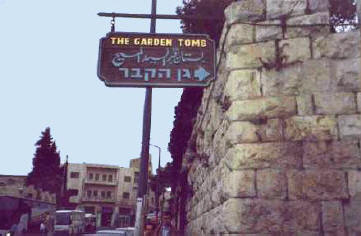
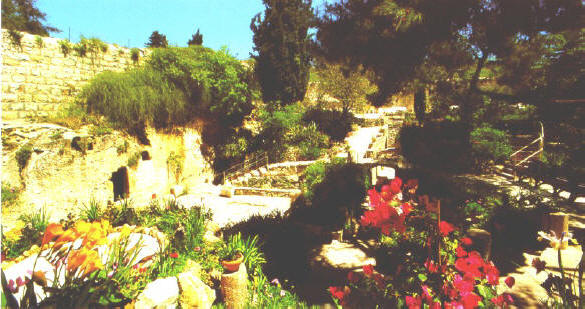
Before we begin studying about the the Ark, let's take a look at the beautiful area which is behind the story of the discovery. The Garden Tomb area is along an escarpment north of the city wall of Jerusalem, and is a tourist spot frequented by many people each year. It is owned and maintained by the Garden Tomb Association in London and was acquired in 1894. It had been speculated, then confirmed in Ron Wyatt's excavations, that this is the authentic burial site of Christ. Nearby is the rock formation Golgotha "the place of the skull." Near both of these sites is the actual crucifixion site of Christ, and the Ark of the Covenant is in a cave below that spot!
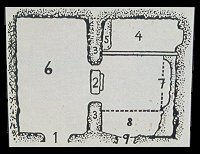
The location of the Garden Tomb is north of the old city of Jerusalem. The sacrifice was to take place north of the tabernacle as required in Levitical law. Also, in the New Testament it states, "The place where Jesus was crucified was near the city." John 19:20. Golgotha and Calvary are both in close proximity to the Damascus gate. John 19:41,42 "Now in the place where He was crucified there was a garden, and in the garden a new tomb in which no one had yet been laid. So there they laid Jesus, because of the Jews' Preparation Day, for the tomb was nearby." There are several elements in this area which give credibility to this tomb and indicate it was once in a garden area. First the tomb itself, second an ancient underground water cistern, third a large winepress, and fourth the place of the skull. The Tomb
Matt. 27:59, 60 "And when Joseph had taken the body, he
wrapped it in a clean linen
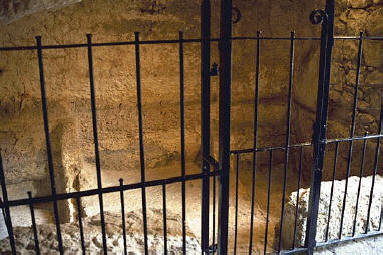
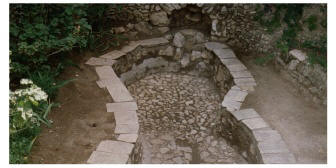
(Above) Looking from weeping chamber into tomb area, we see the probable burial place of Christ on our far left.
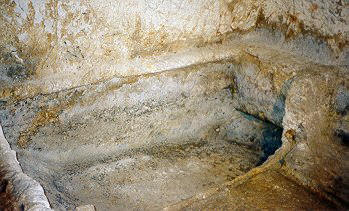
(Above) This is the burial place of Christ and you will notice the area at right that was enlarged to accommodate Christ's feet, as he must have been taller than Joseph of Arimathea who had the tomb constructed for himself and was apparently 5' 8" tall. The cutting of the stone was hastily completed in order to accomplish the task of burial before the Sabbath hours, Friday evening. Mark 16:5 says Mary saw a young man (angel) sitting on right side of tomb, which may have been in the right hand portion of this photo.
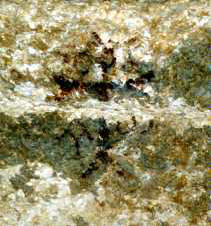
Ancient red cross on wall inside tomb with Greek alpha and omega letters
White cross outside the tomb. Crossbar near top.
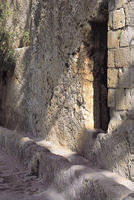
Outside tomb are two iron shafts that were installed by the Roman soldiers to secure the rolling stone. Perhaps a chain connected the two shafts. "Make it as secure as you know how. So they went and made the tomb secure, sealing the stone and setting the guard." Matt. 27:65,66 "And they made His grave with the wicked-- but with the rich at His death" Isaiah 53:9. This text describes the other tombs to the left of this one where wealthy and wicked men were buried. The Cistern Near the Garden Tomb is an underground 250,000 gallon ancient rain water cistern hewn out of rock. It is the third largest in Jerusalem. A cistern this size would be designed to supply water for a large garden, matching the biblical record of a garden area. The evidence shows this cistern was built prior to the time of Christ. There probably was a large olive tree grove and a vineyard in the garden which benefited from this cistern. The Winepress Near the tomb is an ancient wine press (above) which was excavated in 1924, is one of the largest in Israel. It is thought to be of pre-Christian origin. A very large vineyard must have been in the area for a press this size to have been in use. Golgotha - The Place of the Skull
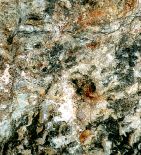
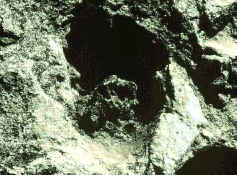
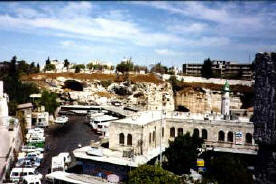
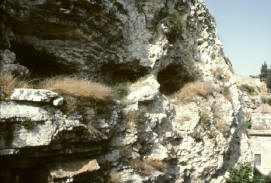
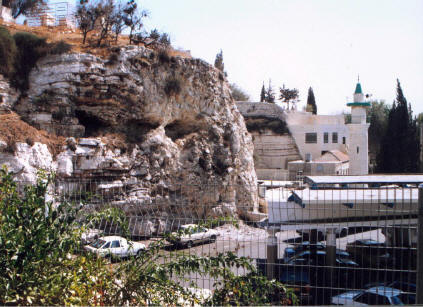
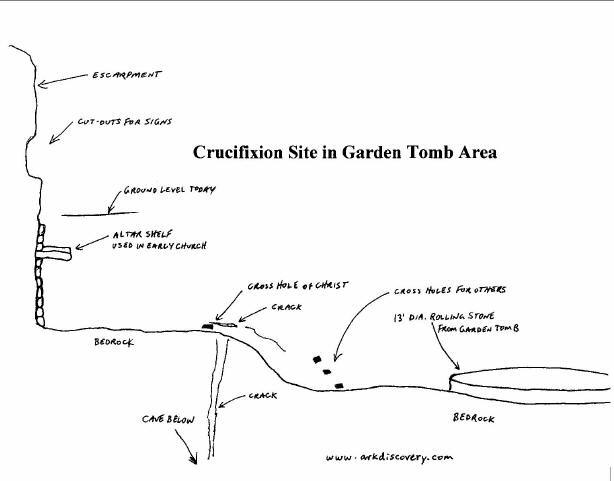
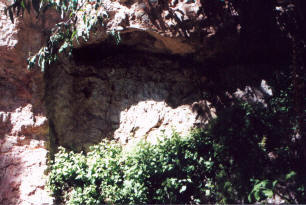
150 yards east of the Garden Tomb is Skull Hill, or Golgotha - Place of the Skull, or the Latin equivalent - Calvary. "And He, bearing His cross, went out to a place called the Place of a Skull, which is called in Hebrew, Golgotha, where they crucified Him." John 19:17,18. Notice the two eye sockets and the nose. It was below this area that victims were stoned to death, including perhaps Stephen, and approximately 100 yards to our left is the area where the crucifixion took place. Today there is an Arab bus station in front of Golgotha. Garden Tomb Association Seeking Donations Due to a large drop off in tourism in Israel, the Garden Tomb Association is accepting donations to help maintain the grounds. The amount of visitors today is only one-seventh of its former count. You may send donations to Hon. Treasurer of the Garden Tomb Association, Mr. R J Barwick, Maybury Copse, The Ridge, Woking, Surrey GU22 7EQ, UK. Ron Wyatt Begins His Work Ron Wyatt completed extensive excavations in the Garden Tomb area over a period of approximately 10 years, beginning around 1978. Ron began digging near the location where he mysteriously spoke the words, "There is Jeremiah's Grotto, and the Ark of the Covenant is in there." This area was along an escarpment in the Garden Tomb grounds. While digging 14 feet down through the soil along the escarpment, Ron uncovered four crucifixion holes in solid rock, and one on a higher level and about ten feet out from the escarpment measuring 12x13x23 inches deep, and three more on a lower level four feet below and further out. The single, higher cross hole was designed to be used on the featured victim. Crucifixion site at Garden Tomb today....
Cut-out in escarpment where a Roman sign was placed.
Cut-out at left where sign was placed in escarpment at
crucifixion site.
"The rocks were rent...."Matt. 27:51 |
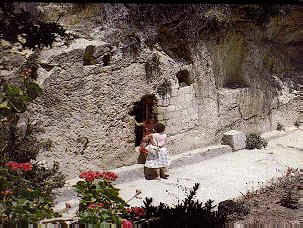
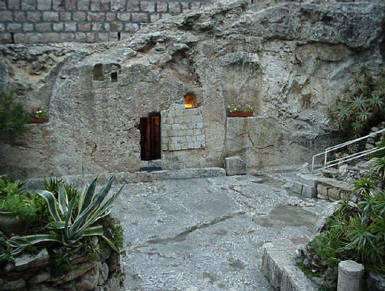
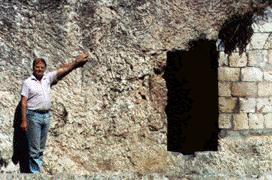
 cloth, and laid it in his new tomb which he had hewn out of the rock. and he rolled a large stone
against the door of the tomb, and departed." Notice in the photo
above, the arched radius to the left of the entrance. This follows the
contour of the 13 foot tall rolling stone ("...it was very large." Mark
16:4) that sealed the tomb. It was cut
out of the face of the tomb, then rolled in a channel in front of it.
When the stone was in place to seal the tomb, it covered a small window to the
right of the entrance. When the stone is rolled back, the open window allowed
light to enter the tomb. A large block was used to stop the stone
from rolling further to the right, in the downhill direction. Luke 23:53 also says the tomb was hewn
in stone, like this one.
cloth, and laid it in his new tomb which he had hewn out of the rock. and he rolled a large stone
against the door of the tomb, and departed." Notice in the photo
above, the arched radius to the left of the entrance. This follows the
contour of the 13 foot tall rolling stone ("...it was very large." Mark
16:4) that sealed the tomb. It was cut
out of the face of the tomb, then rolled in a channel in front of it.
When the stone was in place to seal the tomb, it covered a small window to the
right of the entrance. When the stone is rolled back, the open window allowed
light to enter the tomb. A large block was used to stop the stone
from rolling further to the right, in the downhill direction. Luke 23:53 also says the tomb was hewn
in stone, like this one.