 |
|
|
|
|
|
|
|
|
|
|
|
|
|
|
|
|
|
|
|
|
Things I Think You Should Know About China |
|
|
|
As the title indicates. Random trivia about China. Some points are somewhat biased towards my personal opinion. Mostly about dynastic China, because that's what I'm interested in, but you never know what will turn up here. |
|
|
|
 |
|
|
|
|
1. Despite what your highschool world history book may have told you, the Shang was not truly the first Chinese dynasty. That honor belongs to the Qin, which unified an empire in 221 B.C. (if I'm not mistaken) under Qin Shi Huangdi. The Shang was most likely one of a number of strong local cultures, none of which can really properly be termed "Chinese." It's the one we remember because it's the only one we have written records for.
2. In my opinion, it's inaccurate to label Confucianism a religion. If you read the Analects and Mencius, it seems pretty clear that the system of thought being described is of the type we typically think of as philosophical, rather than religious. It's not until Zhu Xi and the other Neo-Confucians come in in the Song that it acquires any sort of metaphysical element, and well, if you ask me, Neo-Confucianism's a whole different animal. I believe it is accurate to say that Chinese religion absorbed many Confucian elements. Confucianism itself, however, does not quite fit the bill.
3. There are substantial differences between modern and classical written Chinese in terms of grammar, syntax, and vocabulary. Classical written Chinese is a monosyllabic language, unlike modern spoken and written Chinese (and, most likely, also unlike classical spoken Chinese). There is some speculation that this characteristic terseness is a result of classical written Chinese being originally a shorthand form. Given that the earliest examples of characters we have are carved into oracle bones, it makes sense that the carvers would want to say as much as possible in the fewest characters they could. |
|
|
|
|
|
|
 |
|
|
|
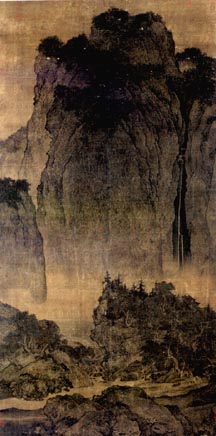
4. This is "Traveling Amid Streams and Mountains" by Fan Kuan. It was painted during the early Northern Song and is one of the very few authentic paintings left from that era. To get the full impact, you have to realize that that central peak is almost seven feet high. This is my favorite painting ever. No one should go their life without seeing it. Just thought I'd throw it in as a public service. |
|
|
|
|
|
|
|
|
|
|
|
|
5. People don't pay enough attention to the Opium War. It had a major impact on Chinese social and political evolution, and it deserves a much more thorough exploration than the cursory treatment it usually receives. The fact that a historically powerful (culturally, militarily, and economically) empire was soundly beaten by a foreign upstart and forced to sign the unbearable, humiliating treaties which concluded the war instilled in the national conciousness a conviction that something must have gone drastically wrong with Chinese culture. If you look at the later social revolutions that took place, especially at art and literature (Look at the works of Lu Xun. (e.g. "The True Story of Ah Q.") You'll see what I mean.) you'll see a deep concern that Chinese national character is somehow corrupt. Now, this can't all be traced to the Opium War. But the Opium War, I think, did act as a catalyst for those kinds of sentiments. |
|
|
|
|
|
|
You freak! You have a webpage and you use it to write about this? I'm outta here! |
|