



A passage through time : it may take a short while, but will last a life time
History of India (My Country)
History of Kerala (My State)
History of Cochin (My City)
History of India
The
spirit of India has fascinated the world with its very mystique.
"The
roots of the present lay in the past and so I made the voyages of discovery with
the past
ever seeking a clue in it, if any such existed to the understanding of the
present."
- Pandit Jawaharlal Nehru
A subcontinent with a 5000-year old history. A civilisation
united by its diversity. Experience the richness of culture, the glory
of the past, the turbulences and triumphs. The landmarks of each era,
the achievements of each age, the legacy of the regime. As you
walk through history, through India's geography, through the religious,
linguistic and artistic chapters, your interpretation will be your very own
discovery.
The roots of Indian civilisation stretch back
in time to pre-recorded history. The earliest human activity in the Indian
sub-continent can be traced back to the Early, Middle and Late Stone Ages
(400,000-200,000 BC). Implements from all three periods have been found from
Rajasthan, Gujarat, Bihar, parts of what is now Pakistan and the southern most
tip of the Indian Peninsula.
These Paleolithic people were semi-nomadic hunters and gatherers for many
millennia. Five main races of people were in existence when the move to an
agricultural lifestyle took place, in the middle of the 9th millennium BC. These
were the Negrito race, the Proto-Australoid; the Mediterranean race, the
Mongloids and the Alpine people.
The first evidence of agricultural settlements on the western plains of the
Indus is roughly contemporaneous with similar developments in Egypt, Mesopotamia
and Persia. These settlements gradually grew and the inhabitants started to use
copper and bronze, domesticated animals, made pottery and began trade
activities.
History of Kerala
KERALA - GOD'S OWN COUNTRY
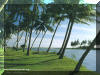
Welcome into a world of palm trees and breaking waves at the south - eastern tip of the Indian peninsula. This land is also known as God's Own Country. The land blessed by nature. The land of festivals. The land of Kathakali. The land of coconut trees. And now the land of complete literacy. There are 14 Districts, 63 Taluks, 991 Panchayaths, 54 Municipalities and 3 Corporations in Kerala.
KERALA'S CREATION MYTH
In
mythology Kerala was created by Parasurama,
an incarnation of
Vishnu. Parasurama was a warrior, renowned for his physical strength, who
acquired his name from his weapon - a parasu(axe). He engaged in a 21-yeart
battle, killing many people. Finally he retired to the Western Ghats where he
undertook a long penance. Distraught at his murderous behavior, he beseeched the
gods for help. The sea god Varuna responded, pledging to give Parasurama land
which equalled the distance that he could throw his axe. Parasurama mustered all
his mighty physical strength and swung his axe which soared through the air to
Kanyakumari, India's southern tip. With that the seas receded, exposing the
strip of land that forms Kerala. Parasurama's act was a repudiation of war and
therefore, for many, Kerala was created as a land of peace and harmony.
Kerala's creation myth tells of how the sea god, Varuna, raised land from
beneath the ocean to create the region now known as Kerala.
Geographically and politically, Kerala is relatively new. Its geological origins
support the popular creation myth. The Western Ghats, the mountains which run
down the east of the state, once formed the coastline of the Arabian Sea. The
land rose above the sea, rendering Kerala a later addition to the main Indian
landmass. Politically, the state was formed by a merging of three regions-Travancore,
Cochin and Malabar- in 1956, almost a decade after Indian Independence. The name
Kerala has several possible meanings. It may derive from the Sanskrit keralam
meaning 'land added on', an obvious association with its mythical and geological
origins. Some claim the state is named after the coconut (kera), Kerala being
known as the land of coconuts. Another version suggests the state is named after
the early Chera dynasty. Like its name, Kerala embraces many narratives. The
language of Kerala is Malayalam and its people are known as Malayalis- after
malai- the mountains.
Throughout Kerala it is possible to see mysterious temple rituals where ancient
traditions are encapsulated in the sustained rhythmic trance of the dancer. The
region is also the home of the famous Kathakali - a complex and ritualised
theatre based on the ancient epics.
If India is an example of diversity, Kerala is a masterpiece. It's incredible
how such a small strip of land can contain so many exotic ingredients. Maybe it
was Kerala's love to play host that brought the Phoenicians, Roams, Chinese,
Arabs and the British to it welcoming shores. May be it was the allure of the
spices Maybe it was the magnetism of the land...
Anyway, immigrants left their footprints in Kerala's architectural scenario. We
have Portuguese forts, Dutch Palaces, British bungalows... The list is endless.
Though Kerala has always been ever ready to imbibe anything new, it has
maintained its customs and traditions to surprising degree of perfection. This
zealous preservation of visual and marital arts makes this place a tourist's
delight.
Here you can see a living example of religious rapport. Churches, Masjids and
temples stand shoulder to shoulder. For those interested in rituals, a visit to
these places of worship will be an eye opener. You can find a Jain temple at
Mattanchery, temple of snakes in Mannarsala and yet another temple at Oochira
which has no idol at all -Talk about variety.
For the sea-friendly, the choice of beaches is staggering. Opt for one of the
well -developed, cosy beach resorts where you can swim surf, or get initiated
into the age-old powers of yoga. Tired bodies can get a massage with herbal
oils. Curious minds can dwell on the mysteries of Advaita Vedanta- The unique
philosophy of non-duality. If you prefer solitude, there are long stretches of
untouched beaches where even the waves are introverts.
When the mountains call, you have to go Munnar, Peerumadu, Wayanad and Ponmudi
are invigorating haunts for poets,artists and all people with beating hearts. If
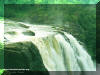
you want to see Nature in all her finery, walk down the forest lane and look up
at the Athirapalli waterfall. If your heart turns a somersault, you're only
human.
Wild life enthusiasts rejoice, kerala's forests are still green. There are game
sanctuaries,which provide you opportunities to see the huge Indian elephants
with their tusks intact,the spotted deer and the sambar. In summer, you can even
catch a glimpse of the ferocious leopards and tigers.
Kerala's backwaters are more of an emotion than a name. It has that unique
quality of serenity, coupled with beauty. No wonder it is called the Venice of
the East. These calm waterways burst into life when the bat-race season begins.
Then Keralites throw off their lethargy and transform into a fiery crowd. To see
Kerala at its best, come with the festivals. Onam is a profusion of flowers,
music, dance and general bonhomie.
Kerala's cuisine is a mouthwatering story. Breakfast in an elaborate affair-Pootu,
Doosa, Idli, Appam, Idiappam are morning specials. For lunch there is rice and
choice of curries with pappads and fish fries. The vegetarian menu is really
long. Sambar, Pachadi and aviyal with side dishes and spicy pickles. Keralites
really know how to end a meal. There is a wide array of payasams -sweet
porridges cooked in milk (as well as coconut milk) - laced with ghee and topped
with nuts. It defies description.
Apart from photographs, you can take home ivory carvings, eye-catching Kerala
saris, block printed bedspreads or maybe an elephant carved in sandalwood. And
when the day is done, lie back on the sand and relax to the lullaby of the wind
and the waves. Tomorrow, the sights to see are many.
History
of Cochin
COCHIN - QUEEN OF ARABIAN SEA
With serene
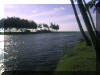
backwaters, beautiful lagoons, wooded isles and a magnificent landscape, Cochin
is indeed the Queen of the Arabian Sea.
Get caught in the
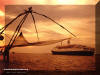
fishing nets and the setting sun on the beaches of Cochin.
Another gateway into India, Cochin has been in cultural and trade contact with
the outside world right from its early years. Cochin, has one of the finest
natural harbours of the world. From here, ships set sail for foreign ports
with spices, rubber, coir and of course fish. In return for these, the
seafarers have left their mark on the town of Cochin and now Ernakulam.
Cochin, which is now known as
Kochi is the commercial capital of Kerala. It is a place which is blended
with historical places, palaces, forts, old churches, beaches, backwaters, snake
boats races, Kathakali, museums and the convenience of a big city with towering
buildings and business centers.
Kochi came into being in 1967, as a result of the merger of the then
neighbouring towns and villages of Fort Cochin, Mattanchery, Ernakulam, Edapally,
Vytilla, Vennala, Tevara etc. Cochin, today is one of the largest and most
important city in Kerala. It is also known to be the second most important
city on the western coast of India.
Kochi
is also known as the Queen of the Arabian Sea. Across its bay and on the
islands are the sleepy coconut villages of Vypin, Bolghatty and Vallaradom.
It is a city with a glorious cultural past. Kochi is located in the
center of Kerala covering about 87,341 sq. km with a population which comes upto
approximately 12,00,000. The language which is spoken here is Malayalam.
The climate is moderate throughout the year and the temperature ranges from a
minimum of 22.5oc to a maximum of 35oc in the summer and
from a minimum of 20oc to a maximum of 32oc in the
winter. The ideal season of visit is between September and May. The
religions practised here include Hinduism,
Christianity, Islam, Jainism and Judaism.
Ernakulam is the commercial centre and forms the main land of Kochi. The
two main railway stations of Kochi are located here. The Airport is based
on Wellington Island which is an elongated island west of Erankulam. The
Airport is about 6 km from the center of Ernakulam. Talking about centers,
Jos Junction in Ernakulam is known as the heart of the city. This Junction
mostly caters to the needs of the shoppers and Jewellery lover. It is
located on M.G. Road which houses most of the retail shops and shopping centers.
You will be amazed to find all that you need on M.G. Road. The city is
pretty clean with the local authorities doing a good job in maintaining it in
that way. Ernakulam is one of the most advanced cities in Kerala, it
depicts the modern life of the Metropolitan Cities of India. The city is
filled with glamourous shopping centers and Jewellery shops. The
Hotels and Restaurants are very enchanting and serve appetizing food.
Among the busy roads and business centers the city also caters to the nature
lover with some very beautiful parks, children's playgrounds and beach side
pavements.
The Naval base and the Cochin shipyard are also based in Ernakulam. Marine
drive is also another business area in Ernakulam which has a beautiful view of
the sea and the islands of Cochin. You can also see the merchant ships and
the cruise liner halting for fueling.
The Naval base and the Cochin
shipyard are also based in Ernakulam. Marine drive is also another
business area in Ernakulam which has a beautiful view of the sea and the islands
of Cochin. You can also see the merchant ships and the cruise liner
halting for fueling.
DOWNTOWN
The Mahatma Gandhi Road (earlier known as the Seventy-feet Road), branching off
from Banerji Road in its north end right upto Thevara Junction, approximately
four kilometers down south, cuts through what is today the city's main
commercial district. A bustling shopping centre where one can buy almost
all kinds of goods on sale, including textiles, ready-made garments, jewellery,
handicrafts, electronic goods, books, footwear, toys, etc. There are also
half-a-dozen cinema houses for your entertainment. Minus the
dazzling range of shops, buildings on either side house banks, finance firms,
insurance companies, hospitals, airline offices, hotels, and restaurants.
By nightfall, the city's main artery brightens up with colourful neon signs and
is enlivened by busy shoppers or people going out to enjoy themselves.
OLD COCHIN
Old Cochin comprising of Fort Cochin, Mattancherry and its adjoining areas is
famous for several sites of historical significance. The St. Francis'
Church, the Santa Cruz Cathedral, and the Chinese fishing nets (Fort Cochin);
the Dutch Palace, the Synagogue, and the ecclesiastically important Coonen Cross
(Mattancherry) beckons you to the bygone era when old Cochin had cultural and
trade relations with Arabia, Rome, and China and to a vibrant history of
European imperialism thereafter. Even today trading continues to be the
chief profession here of a highly cosmopolitan population.
MARINE DRIVE and BROADWAY
Marine Drive is gradually catching up as another busy retail centre. The
lively GCDA Commercial Complex along the waterfront features a kaleidoscope of
several business establishments and other institutions, boutiques, supermarkets,
fast foods, and cafes. Luxury apartments, elegant hotels, and office
buildings are located on either side of the main Shanmugham Road which
terminates at High Court Junction on northern end, where the Ram Mohan Palace -
the seat of the Kerala High Court - is situated. An evening stroll along
the water-side promenade is a favourite pastime.
Broadway - narrow despite its name - running parallel to the east of Shanmugham
Road is among the city's oldest and busiest shopping streets, where the best
buys include clothes and spices.
PARK AVENUE
The green lung of the metropolis so to speak, the well-shaded, tree-lined Park
Avenue gets its name from the beautifully laid-out parks on its western side
overlooking the backwaters of the Vembanad Lake and having impressive views of
Cochin harbour. The ancient Siva temple, old government buildings, the
General Hospital, the main boat jetty, the Cochin Corporation office, the
District Court, and some of the city's finest educational institutions are
located alongside this picturesque boulevard.
The Parikshith Thampuran Museum, the State Archaeological Department, and the
Kerala Lalitha Kala Akademi Gallery of Contemporary Art are of interest along
the Durbar Hall Road which branches eastwards from the southern end of Park
Avenue.
KADAVANTHRA
Half a kilometer east of downtown Cochin is Kadavanthra, the seat of the Greater
Cochin Development Authority, and the Rajiv Gandhi Indoor Stadium - the second
largest of its kind in India. The adjoining areas of Gandhi Nagar, Giri
Nagar, and Elamkulam are huge residential locales. Panampilly Nagar, also
a predominantly residential area located before Kadavanthra adjoining the city
centre, is home to the Malayala Manorama, Kerala's leading publishing house. The
office of the General Manager, Telecommunications, and the Regional Passport
Office are also located here.
UPTOWN
The city's suburbs feature mainly residential colonies mixed with small
commercial enterprises. Kaloor is situated two kilometers from the city
centre. Indian Express, Mathrubhumi, and Deshabhimani, three leading
newspapers, have their Cochin offices located here. Kaloor has also become
a major sporting venue with its 55,000 capacity Jawaharlal Nehru Stadium.
Palarivattom, a further two kilometers uptown, was the erstwhile border between
the royal principalities of Travancore and Cochin. Edappally, a small
township fringing the northeastern part of the city, is the seat of the St.
George Forane Church, famous for its annual May feast, and the unique Museum of
Kerala History. It is also the birthplace of the celebrated Malayalam
bard, Changampuzha Krishna Pillai.
East of Edappally is the exurbia of Kakkanad, the seat of the Collectorate.
Nearby Thrikkakara, with its hills and peaceful ambience, is famous for the
ancient Vamanamoorthy temple.
WILLINGDON ISLAND
Connected to the mainland by the road-cum-railway Venduruthy Bridge, this
man-made island, named after the former Viceroy of India, Lord Willingdon, was
created with the material dredged while deepening the Cochin port. The
island, about four miles long, is divided into two zones - the defence and the
civil. The former includes the naval command and the domestic airport
controlled by the Navy. The civil side including the harbour is under the
Cochin Port Trust. The Customs House and many other central government
establishments are situated here. The island has also on it a busy railway
terminus, some of the city's most luxurious hotels, and a very large number of
business establishments. Housing colonies for staff members, schools, hospitals,
banks, and parks are the island's other highlights.
Some Photographs
|
|


|
|











|
|