Here I will present evidence indicating that dinosaurs were cold-blooded reptiles. This runs counter to the popular opinion that they were warm-blooded like birds, and makes the dinosaurian origin of birds problematic.
I am interested in improving the scholarship of this page. So, let me know what you think. Just click here.
Two examples here are Sinosauropteryx and Scipionyx. Both of these critters have tongue-twisting names that both begin with an ‘S’ and end with an ‘X’. But most importantly, both are theropods: bipedal carnivorous dinosaurs. Sinosauropteryx is the size of a turkey, while the later is a youngster: you could hold it in your hand!
I will first present 4 figures of Sinosauropteryx, found
recently in China. The first 3 figures are slab and counter-slab fossils:
Figures 1 and 2 mirror each other since the fossil was sandwiched between the
sediments. Fig. 3 is a zoom view and Fig. 4 is another fossil of Sinosauropteryx.
If you look closely, or just get a copy of the 7/98 National Geographic and
look on p. 78, you can still make out the remnants of its fin-like frill.
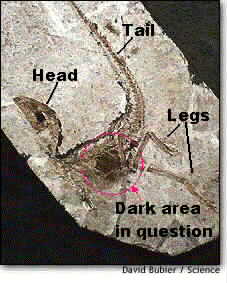
Fig. 1
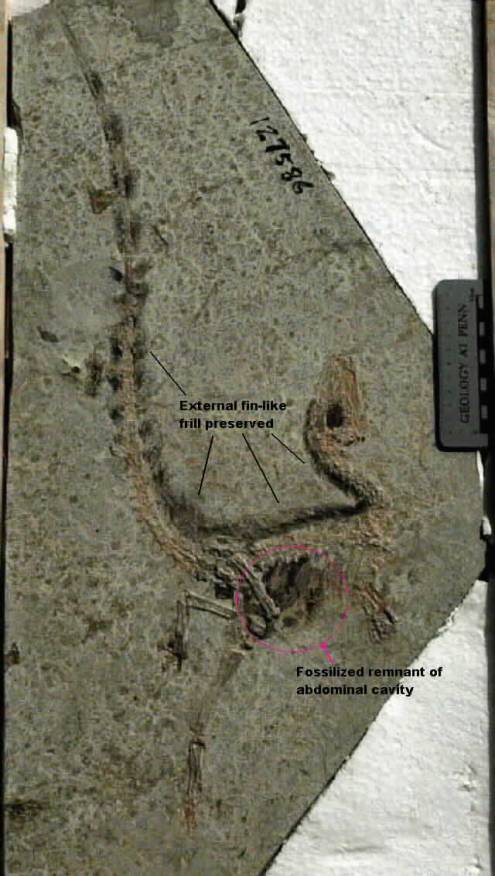
Fig. 2
The dark area in the pink circle has been
described as a fossilized remnant of an abdominal cavity separated from the
thoracic cavity. Since birds lack an abdominal cavity that is separated from
the thoracic cavity, they also lack a diaphragm. However, crocodilians have an
abdominal cavity that is separated from the thoracic cavity, and breath with a
diaphragm. Birds are warm-blooded (endothermic), while crocodilians are
cold-blooded (ectothermic). Therefore, it can be said that the evidence
indicates that Sinosauropteryx had an abdominal cavity and a diaphragm
like crocodiles. This finding complements an earlier discovery: dinosaurs lack
evidence for respiratory turbinates (RTs), nasal structures that both
birds and mammals have to supplement water loss due to high breathing rates that
accompanies endothermy. (With some exceptions for specialized mammals and
birds, like whales and diving birds who don’t need RTs due to their watery
lifestyles, all birds and mammals have RTs—reptiles do not.) Hence, due
to the lack of RTs, accompanied by a crocodilian diaphragm, ectothermy may be
inferred.
As pointed out in figures 2 and 3, fibers are
preserved down [no pun intended!] its head and vertebral column. These have
been described as likely remnants of a fin-like frill, a feature seen today on
reptiles. (Stay tuned, they may turn out to be flattened-out musculature
instead.) It is very unlikely that they were downy feathers, a popular
assertion.
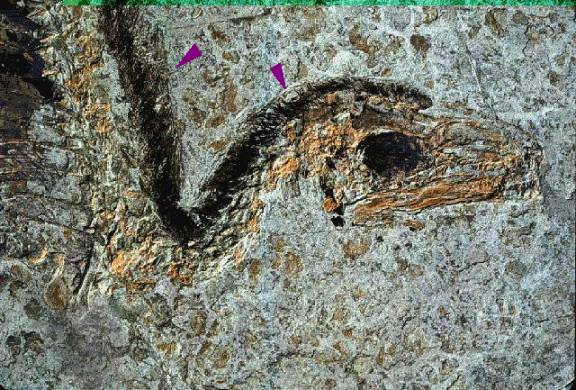
Fig. 3:
Zoom view of Fig. 2's head.
Purple arrows point out the fibrous structures.
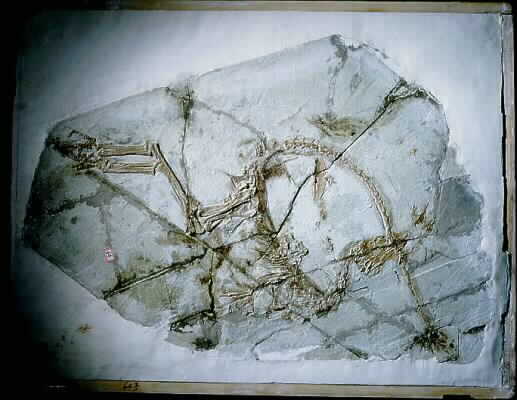
Fig. 4:
Its tail is lying on top of its nose. Pretty
flexible, huh?
Notice too how the body outline was preserved
along the vertebral column.
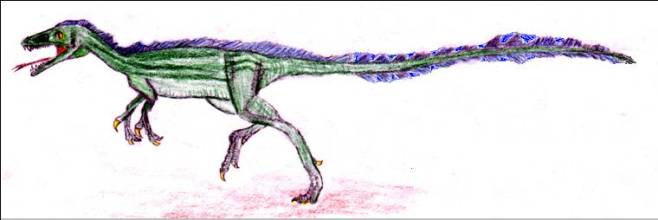
Fig. 5:
This is how I have restored it.*
Fig. 6 is the juvenile Scipionyx, rediscovered recently in Italy! (Believe it or not, it was first thought to be a bird!) It’s Italy’s first dinosaur find and is immediately one of the greatest fossils ever discovered: its liver and intestines have been preserved! Fig. 7 is a zoom view of its guts and head.
Scipionyx had the liver and guts consistent with
reptiles, not birds. In fact, what has been described as traces of
diaphragmatic musculature—running from the pubis to the liver—has been detected
on it too. Since crocodilians breath with diaphragmatic musculature, and not
with a muscular diaphragm like mammals (including us), it may be concluded that
Scipionyx breathed similar to crocodilians. Thus, the evidence indicates
that it too was ectothermic. It was unrelated to birds. Scipionyx
compliments Sinosauropteryx: They both breathed the same and give us
some insight into how theropods in general breathed. (Perhaps even how
dinosaurs in general breathed).
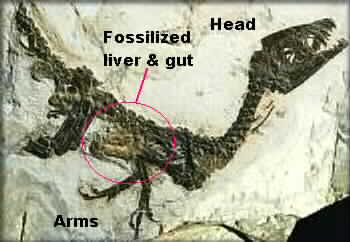
Fig. 6
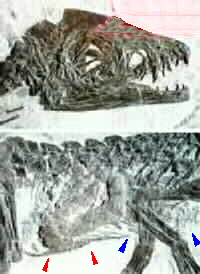
Fig. 7:
Its intestines are the gray coils to the left (red arrows).
Its liver is to the right, under its elbow (blue arrows). Don't worry; it
stopped smelling a long time ago!
Notice the belly ribs, the gastralia, under the intestines.
Thus, the general shape of the abdomen is preserved!
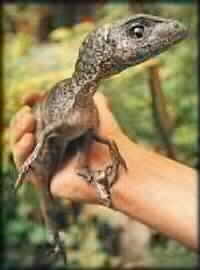
This is a life-restoration.
Conclusion: Since theropods were some of the most active dinosaurs, these two theropods indicate that dinosaurs in general were ectothermic reptiles. But like the ectothermic Komodo dragon, dinosaurs were active and fierce. They could hunt and prey upon large animals, and they could defend themselves violently when cornered, as the fossil record indicates.
Like Ruben et al. said in The Complete Dinosaur, p. 517: "Moreover, even if they were fully ectothermic, if dinosaurs possessed aerobic metabolic capacities and predatory habitats equivalent to those of some modern tropical-latitude varanid lizards (e.g., Varanus komodoensis [Komodo dragon]), they may well have maintained large home ranges, actively pursued and killed large prey, and defended themselves fiercely when cornered."
So even though ectothermic, they were not cold
sluggards. They were active reptiles.
NEW: What has been described as
a dinosaur heart by Fisher et al. [see: Cardiovascular Evidence for an Intermediate or Higher Metabolism
in an Ornithischian Dinosaur. Science 288:503-505. (4/21/2000) (www.dinoheart.org)] has been critiqued and
rejected by Rowe et al. in Dinosaur with a Heart of Stone. Science 291:783a. (2/2/2001). I think it’s best to take Fisher et al.’s dinoheart with
caution and not include it as relevant evidence.
For more information on dinosaurian ectothermy, and for references, see the list below:
 Pulmonary
Function and Metabolic Physiology of Theropod Dinosaurs. Ruben et al. Science 283:514-6. (1/22/99)
Pulmonary
Function and Metabolic Physiology of Theropod Dinosaurs. Ruben et al. Science 283:514-6. (1/22/99)
A Cold, Hard look at Dinosaurs. Discover, 12/96.
The Metabolic Status of Some Late Cretaceous
Dinosaurs. Ruben et al. Science
273:1204-1207. (8/30/96)
Lung
Structure and Ventilation in Theropod Dinosaurs and Early Birds. Ruben et al. Science 278:1229, 1267-1270.
(11/14/97)
A Dinosaur with Guts. Time 4/6/98, p. 63.
Like I said, be sure to visit this page again
for updates!
Visit...
The Ruben
Lab
*My restoration of Sinosauropteryx is based on paleo-artist Brian Franczak's skeletal restoration. (Return)

Thanks for stopping by.
Come back soon!