|
As can be seen, the Greek word hades has been translated differently here. Some leave it alone as a word, the HNV using the Hebrew counterpart sheol, while others use hell or a description (see Catholic translations below). In any case, all these translations have one thing in common: death.
On the other hand, some have the tendency to read “apostasy” in place of Hades,
as if they have the same meaning:
But these two words have very different meanings! Apostasy is rebellion and defection, while Hades is not.
What is Hades then? Hades is the ‘land of the dead,’ the common grave of mankind, the same as Sheol.
A lesser-known Bible (Holy Bible: Easy-To-Read Version) puts it in a way similar to the RSV above:
Catholic Bibles have translated it like this:
The footnote in the NAB Catholic Study Bible says: “the netherworld (Greek Hades, the abode of the dead) is conceived of as a walled city whose gates will not close in upon the church of Jesus, i.e., it will not be overcome by the power of death.” (underscore added)
Is there a scriptural precedent for the phrase “gates of Hades” though? Yes. Jesus was likely alluding to Isaiah 38:10, where the same phrase is used. There, it simply means entering the land of the dead, the common grave of mankind.
| Jesus and Congregation Delivered. Concerning the Christian congregation, Jesus said, at Matthew 16:18, that “the gates of
Hades [“powers of death,” RSV] will not overpower it.” Similarly, King Hezekiah, when on the verge of death, said: “In
the midst of my days I will go into the gates of Sheol.” (Isa 38:10) It, therefore, becomes apparent that Jesus’
promise of victory over Hades means that its “gates” will open to release the dead by means of a resurrection,
even as was the case with Christ Jesus himself. Since Hades refers to the common grave of mankind, a place [the earthly region of the dead] rather than a condition [alone], Jesus entered within “the gates of Hades” when buried by Joseph of Arimathea. On Pentecost of 33 C.E., Peter said of Christ: “Neither was he forsaken in Hades nor did his flesh see corruption. This Jesus God resurrected, of which fact we are all witnesses.” (Ac 2:25-27, 29-32; Ps 16:10) Whereas “the gates of Hades” (Mt 16:18) were still holding David within their domain in Peter’s day (Ac 2:29), they had swung open for Christ Jesus when his Father resurrected him out of Hades. Thereafter, through the power of the resurrection given him (Joh 5:21-30), Jesus is the Holder of “the keys of death and of Hades.”—Re 1:17, 18. (underscore added) Manifestly, the Bible Hades is not the imagined place that the ancient non-Christian Greeks described in their mythologies as a “dark, sunless region within the earth,” for there was no resurrection from such mythological underworld. (From: “Hades.” Insight on the Scriptures.) |
Thus, knowing what Hades is informs us of the meaning of the promise in Matthew 16:18. Instead of promising against wholescale apostasy in Christ’s congregation, it is promising that death will not destroy it. Indeed, this was first manifest when Christ was resurrected. The gates of Hades swung wide open! And they were to open wide again to release Christ’s brothers.
Thus, the apostle Paul was able to declare: “Death, where
is your
victory? Death, where is your sting?” (1Cor 15:55)
So when did the foretold apostasy occur? “Jehovah’s Witnesses are members of an organization which states that it strives to reflect Christianity as practiced in the first century..., consider the Great Apostasy to have properly begun after the death of the last apostle.” (From: “Great Apostasy.” Wikipedia.) The last apostle was John, who received his revelation and wrote his gosple and epistles before his death.
|
The Great Apostasy
When John wrote Revelation, Christianity was upwards of 60
years old. At the outset, it had survived 40 years of constant opposition from Judaism. Then the Jewish system
received a mortal blow in 70 C.E. when the unrepentant Jews lost their national identity and what was to them
virtually an idol—the temple in Jerusalem. |
Thus, not only was apostasy fortold, but it was starting even during the apostolic first century. The second century saw the blossoming and development of total apostasy and even subtle, sneaky apostasy.
And most of all, the “gates of Hades” had nothing to do with it! They opened for Christ, then closed until his brothers were to be released. Thus, to claim that the “gates of Hades” is a promise against apostasy is to misunderstand what Hades is:
Table of Bible abbreviations
(NWT used unless stated otherwise)
| KJV | King James Version |
| NKJV | New King James Version |
| NASB | New American Standard Bible |
| RSV | Revised Standard Version |
| Young | Robert Young Literal Translation |
| Darby | J.N. Darby Translation |
| ASV | American Standard Version |
| HNV | Hebrew Names Version |
| NJB | New Jerusalem Bible |
| DRB | Douay-Rheims Bible |
| NAB | New American Bible |
| NWT | New World Translation |
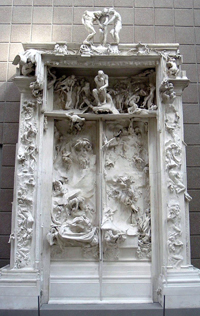
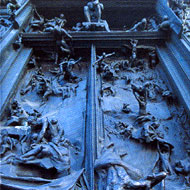
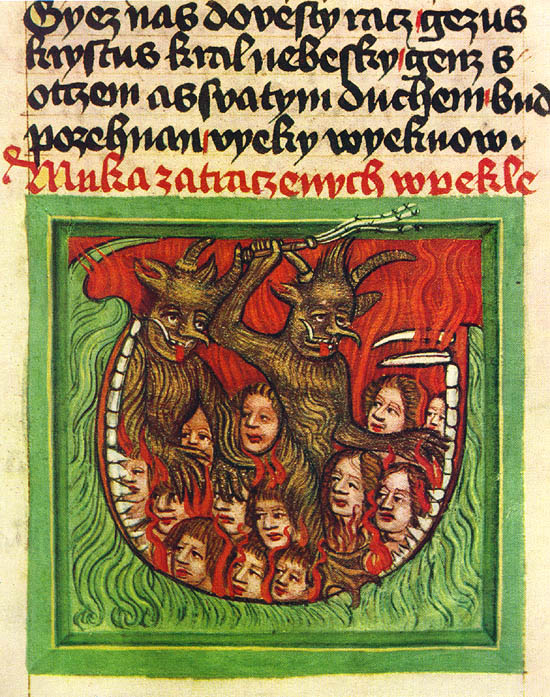
Depictions of the “gates of hell”:
|
Gates of Hell (1919) by Auguste Rodins: |
Krumlov memorial volume, beginning of the 15th century: |
|
|
|
|
|
Started: 6-14-06 Uploaded: 6-16-06 Updated: 6-19-06; 8-3-06. Pictures added: 8-11-06. Apostasy replacement picture: 11-22-06.