How it Works
1.The object (eg. star) being studied must emit or reflect light. When the light leaves the surface of the object it travels through space in the form of electromagnetic waves.
Source 8.
2. This light enters the tube of the reflecting telescope in parallel waves. It continues down the opaque tube onto the concave mirror.
3. At the concave mirror, the properties of the shape of the mirror reflect the light back to a point, known as the focus, at the focus is a diagonal plane mirror (mirror with a flat surface).In some very modern telescopes the surface of the concave mirror can be adjusted to cancel out the effect of our moving atmosphere. This is very expensive and has been adapted from military anti-missile defence systems.
4.This diagonal mirror then reflects the light into the eye-piece where it can be viewed by the astronomer. A camera or sensitive light detector can be placed onto the eye-piece for more efficient data collection. The light detectors are known as CCD's or charged coupling devices. Instruments that can detect ultra-violet or infra red wavelengths can be used here too.
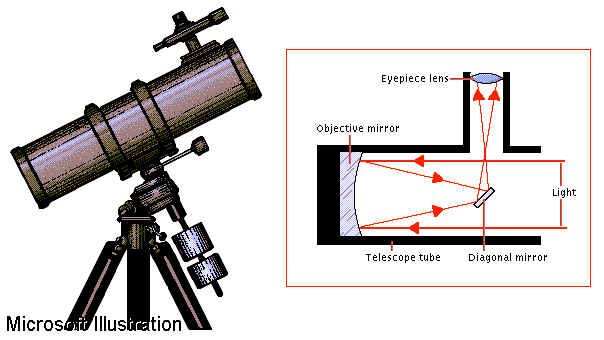
This is a diagram showing the path of light in a reflecting telescope. Note the angle of the diagonal mirror and the shape of the objective or concave mirror. Source 7.
Physics Principles:
The major physics principle involved with the reflecting telescope is the reflection of waves, in particular, light. Without the property of reflection this type of telescope would be impossible. So how and why does light reflect?
Light reflects when it meets an optically denser surface. The surface has to be more optically dense than the medium it is already travelling through. Examples of this type of surface are common, and include water and in the case of reflecting telescope, mirrors. The optical density of a surface is its refractive index. Surfaces with a high optical density have a high refractive index. The refractive index is the ratio between the speed of light in a vacuum and the speed of the light in the given medium. The maximum refractive index is 1 because it is a ratio and it is impossible for a ratio to exceed 1.
The mirror used within a reflecting telescope is usually a concave mirror. A concave mirror has a shape similar to a parabola or inner surface of a sphere. For more information on how the mirrors are made, follow the link at the bottom of the page.
A concave mirror has the ability to focus the light to a point outside the mirror. This point is called the focus and can be calculated using the equation of the shape of the parabola within the mirror. This is very important in the reflecting telescope because it allows all the incoming light to be focused to an eyepiece for viewing.
The reflection on any shaped surface follows the Laws of Reflection. Where the angle created by the incoming light on the normal (perpendicular to tangent which is a straight line touching curve at a point) is equal to the angle of reflection. That is the angle of created by the 'outgoing' light with the normal.
This can be summarised by the formula: i=r, where i is the angle of incidence and r is the angle of reflection. There are other laws involving reflection on a concave surface. They are:
"Any incident ray traveling parallel to line of symmetry on the way to the mirror will pass through the focus upon reflection.
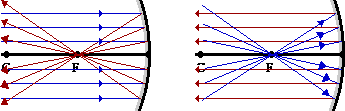
Any incident ray passing through the focus on the way to the mirror will travel parallel to the axis of symmetry upon reflection. "
Source 9.
The conversion of light energy into heat energy is also a physics related principle that caused some major problems for the people working with the hubble space telescope.
A small chip of paint allowed light in where it was not supposed to be. This light caused one of the mirrors to heat up a faction more than it was supposed to and caused the mirror to expand slightly and put the mirrors out of alignment. This problem along with others have now been rectified and the hubble is sending back amazing images to Earth.
For more information:
Famous examples of Reflecting Telescopes
|
CLICK TO RETURN START |