 |
|
 |
|
 |
 |
| The Class Room |
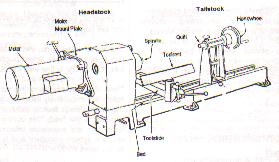
| So you want more information about woodturning? First you will need a lathe and some chisels. Much has been written about which is the best lathe, and manufacturers will try to convince you their's is the best. Talk to as many people as possible and read magaines for user reports. I will offer you my thoughts. There are two types, the first is a general purpose or spindle lathe that will also turn bowls. These have a bed, headstock and tail stock. Most new machines offer a swivel head allowing the headstock to be turned towards the operator. This feature overcomes the restriction of turning relatively smaller bowls. However the speed range must come down to about 200 rpm to compensate for the larger diameter. Then there is the dedicated bowl lathe that usually has a no bed or a very short bed with a removable tailstock. |
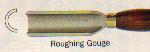
| Did you know that there was only four moulds in wood turning? These are the bead, cove, fillet and taper. Traditionally the skew is used to cut or roll a bead, fillet and taper, a detail gouge is used to cut a cove. And a roughing gouge is used to make the square timber round. |
| So, now you know a basic tool kit consists of a 25mm roughing gouge, a 25mm skew and a 12mm detail gouge. When Christmas or birthday comes up a good present could be a 12mm skew or a 10mm detail gouge, or a 6mm parting/sizing tool, or perhaps even a 25mm round nose scraper. Oh! dont forget a large bowl gouge. By then you will have a comprehensive tool kit. Only buy high quality high speed tools, they hold their edge up to six times longer that carbon steel tools. |
 |
 |
 |
 |
 |
| My preference for a lathe is for a cast iron bed, headstock and tailstock, with a speed range from 200 - 2500 rpm. Variable speed is definitely nice to use. A minimum of 150mm (prefered 200mm) from centre to bed and about 1 metre between centres, with hollow head and tailstock. The spindle thread I prefer 1" x 10 tpi or 30 x 3.5mm, so that alternative manufacturers chucks fit straight on. A No 2 morse taper head and tailstock means that a variety of attachments can be easily used. Above all buy good quality machinery, and it will last a lifetime. |
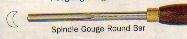
| By the way, a detail gouge is often made from a round bar with a flute machined in the top. It is also known as a spindle gouge and lady finger gouge, they all refer to the same tool. |
| There are quite a few good quality brands on the market now, Henry Taylor and Sorby are well known and reliable Engllish brands. However the best are made here in Ausralia, Boral P & N are made from M2 steel. This is supposed to be a better quality high speed steel. Dont forget to buy the blades only, after all you are a woodturner aren't you? |
| If you are going to make a handle, try this. Put a drill chuck with the appropriate size drill,in the headstock. Fit the driving spur into the tailstock, (yep you read correctly). Fit the blank (300mm of 35 x 35) against the tailstock and turn the lathe on a low speed. Using the tailstock hand wheel drive the blank onto the drill while holding the timber in your left hand. This ensures the hole is in fact down the centre if the blank and not on an angle. Now fit the driving spur into the headstock and a revolving cone centre into the tailstock and put the end with the hole onto the revolving cone center and turn the handle to your favoured shape. Take your time with the first one and the rest will be easy. |
| Classes and workshops can be arranged for personal, groups or clubs. I have my own well equiped studio and can cater for three students. Tuition can be arranged at your place, using your own gear if prefered. Weekend workshops in your town are a speciality. Tuition over a two day period includes, selection, care and maintenance of tools and chucks and machines. Safe turning practices Use of tools to cut beads, coves, filletts and tapers Face plate work, including bowls and lamp bases. Discussions on harvesting and storing found timbers. Advanced turning procedures for the more experienced turners Use the link on the front page to email me for more information. |
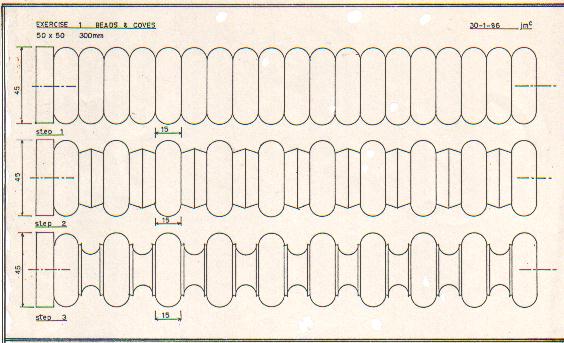 |
| This is an excellent exercise to develope woodturning skills. First rough the blank (300mm of 50 x 50) with a goughing gouge and smooth with a skew chisel. Now with the long point of the skew make shallow marks at 15mm spacings all the way along the blank. Now again with the long point cut a "V" groove about 7 - 8mm deep. With the short corner roll roll ONE side of the bead all the way along from end to end. Now roll the other side of the bead again from one end to |
| the other. This is the first stage of the exercise. Now cut out every second bead with the skew then cut the coves with a detail gouge. Use the diagram for a guide. |