 |
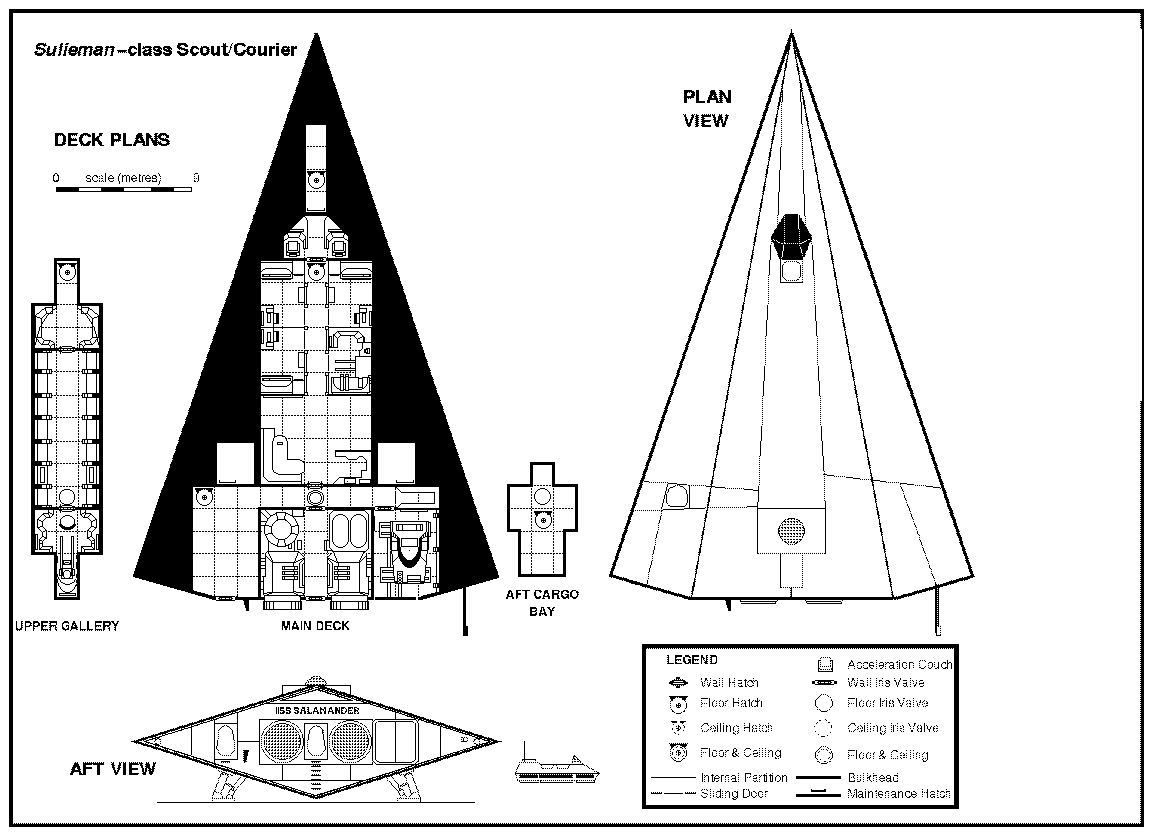
| The Salamander An S Type Scout Courier with a neatened up plan and interior fittings. One stateroom is configured as a sickbay |
|
| So much for the official stuff, and as the Salamanders crew has found, the air filters on this bucket are no better than they've come to expect, let's have a closer look : 1) Avionics are good on the Salamander, only 12 weeks from the last usage expenditure and another 6 months until the next expected component failure. 2) The Bridge is a cramped cockpit with two semi reclining couches (multi-racial, style - 'biped'), the control consoles are chipped, stained but still functional, although the holo display is developing an annoying flicker. 3) The Axial Corridor has the bloody ankle-breaker hatch right behind the cockpit door, it is 'coffin shaped' with power and services conduits running down the side walls through heavy brackets, these are supposed to be covered with heavy, insulated panels that were removed and discarded long ago because of the hassle to remove them in the cramped space available. The log says they're in storage on Lishun. A twin row of lights in the top corners dimly illuminates the corridor, they don't flicker all that much. 4) Pilots Cabin, set up for double usage, this off-white (standard IISS 'Vile White') is the pilots quarters. 5) Gunners Cabin, similar to (4) 6) Engineers Cabin, similar to (4) 7) Medbay, a decent IISS robotic medbay is in here, equipped to take four casualties simultaneously, it's Emotion Simulator Package failed two crews back and was not replaced (possibly an older model). It now has all the charm of a cement mixer, and the same care of it's patients, it does the job though. 8) Greasy settees, an autobar, the slop dispenser which makes all that greasy steam when cooking, and various other fixtures light this dim area. The Salamander at this point is out of fresh food and you've been eating prepack for a week, a Vargr's prepack smells incredibly bad (if you're not a Vargr). On the upside, the well used games console is probably more powerful than the navcomp, considering all the upgrades it gets. 9) Fuel Tankage, much patched but still sound, of collapsible honeycomb construction and self sealing. 10) Landing Pylons, mounting huge floodlights and every crew has promised themselves to rig up some anti-pest grids. Still waiting, although the mounting points are there. 11) Similar to (3), including another stumbling block right behind a hatch. 12) Two Malvatnikov Tetra-IV's sit side by side, powerful and compact beasties, and are famous for rugged service. The Proteus 6K powerplant made some funny noises at Jump engagement, and it's being kept an eye on, as the harmonics aren't balancing well. 13) All the commo gear is long gone, and this is now the preferred crew lounge, boasting couches and other furniture looted from a wrecked freighter that the IISS was transporting for salvage. They'll never miss 'em. 14) Not a pretty sight, the Ling Standard Pegasus sits locked into it's cradle, living proof that there's no such thing as third party insurance in the scout service. Battered, chipped and dusty, the Pegasus air raft is probably good for another fifty years before it needs a tune up, in most scouts opinion anyway. This model is in fact twenty years older than the ship itself. 15) Ships Locker, operated by voice check and handprint (laughably easy to bypass), a long walk-in closet with vacc suit racks and weapons/gear lockers, hopelessly messy. Didn't someone agree to clean this up? 16) The gunners couch is generally used for drunken snoozes or watching vids on the gun control screens, the turret is empty of weaponry. 17) & (18) 'The Attic', all sorts of stuff that won't fit anywhere else is left up here, webbed to the many anchor points on the walls. Anything that someone scrounges and determines to fix 'one day' is left here, it is a cramped low and wide corridor with huge brackets framing the sides, the ever present power bundles running along the walls. It has the worst lighting on the ship (possibly due to all the crap covering the light fixtures), and is enough to give anyone the willies, you occasionally here soft sounds of movement up here. 19) Most of the heavy sensor work is done up here, there is an extendible blister that allows a breathtaking (and groin tightening, if you're not used to it) view of planets turning below when the ship is inverted. The blister is, like all view ports, massively armoured with about as much frame as viewing area. This area is also used for hobbies, and just getting away from everyone else. 20) 'The Hole', pretty much empty at the moment, used for zero-G ball games, swimming and just running-around-and-yelling. The massive anchoring points, armoured control hatches and other fixtures (all designed to survive shifting cargo) makes this a hazardous place to not watch what you're doing. Airlocks There's a few, a little 'croucher' in the corner of (13) is really only a hatch onto the dorsal surface and is used primarily planetside, as is the one in the rear of the room. The aft hatch in (12) is an escape hatch, the forward dorsal hatch in the sensor bay (19) is the main lock, but can only take one man at a time (it takes one round to cycle an air lock). That rotten floor hatch in the main corridor (3) has a lock as well, a one man-er, that leads to the ventral surface as does the straight-out hatch in the cargo bay (20). The main cargo hatch and the airraft hatch are also escape options. The Hull Outside, the Salamander shows her age, once a svelte grey-green she now looks a little slimy-moldy, and very, very chipped and battered. |
| THE SCOUT/COURIER One of the most common starships within the lmperium is the tested and tried type S scout/courier. Originally produced to specification for the Imperial Interstellar Scout Service, this sleek and simple ship was intended for common courier duties within the imperium, and simple survey and exploration duties beyond the Imperial borders. While the xboat system provides fast forwarding of messages and information along the major xboat routes within the lmperium, it falls to the Scout Service's fleet of scout/couriers to relay information from worlds along the routes to outlying fringe worlds. The jump-2 capability of the scout/courier places nearly all such worlds within its range. Beyond the Imperial borders (and in relatively unexplored regions within the lmperium) the scout/courier is pressed into service as an exploratory vessel. It can roam through most areas, refuelling itself from-gas giants or-planetary oceans as necessary, checking up on local conditions, and filing reports when it returns from a mission. In some areas, an exploratory cruiser of perhaps 10,000 tons will carry a squadron of ten or more scout/couriers. As the cruiser passes through an area, individual scout/couriers will range ahead or to the flanks and perform actual data gathering missions. Because the scout/courier is a standard design, the Scout Service has a large quantity of the vessels on hand, with the natural result that some are sold at surplus and find their ways into private or commercial hands, while others are scrapped. In addition, however, many are diverted to a scout program called detached duty. Under the direction of the Scout Service's Detached Duty Office, some former or retired scout personnel are provided with scout/couriers for their own use. The ships are too small for profitable commercial operations, but they do serve as a form of reasonable transport for those with wanderlust. In addition, the Scout Service derives a reasonable intelligence return on its investment through the examination of the ships' logbooks when they are serviced, and through routine interrogation and debriefings of crews. Finally, such detached duty scoutlcouriers are subject to recall and activation (with crew) in the event of a war scare or mobilisation alert. Scout/Courier (Type S): Using the type 100 hull, the scout/courier is equipped with four staterooms (allowing a total of eight passengers and crew if double occupancy is assumed), but there are no low berths. The crew consists of a pilot who also doubles as navigator, engineer, and gunner; additional crew members to fill these slots may be hired on as desired. The ship has jump drive A, manoeuvre drive A, and power plant A, producing a performance of jump-2 and 2-G acceleration. The bridge has a computer Modeill bis (with a standard software package) and one ton of fire control space allocated to the ship's single hard point. The ship is fitted with a dual turret, the weaponry installed varies with the specific ship. The ship has a specially fitted hold which carries a single air/raft; there is a separate three-ton cargo hold. The hull is streamlined for atmospheric landings, and fuel scoops allow local refuelling from oceans or gas giants. Total fuel tankages is 40 tons. Base price to the government for a scout/courier is MCr27.63, which includes savings based on standardised designs. Architect's fees are not necessary, as they were amortised long ago. Weaponry. The actual weaponry carried on the scout/courier varies with the mission accorded the ship. Couriers generally mount a single laser and a single missile rack. Exploratory scouts mount two missile racks. Detached duty scout/ couriers are provided without weaponry, but the crew generally acquires some sort of firepower in a short time. Interior Details. The deck plan indicates the interior layout for the typical scout/courier. The staterooms (4, 5, 6, and 7) are large and spacious, an essential consideration when the crew may be forced to spend long hours together. The common area (8) contains recreation equipment, a galley, and eating facilities. The rear section (13) serves many purposes; on scouts, it carries laboratory and sensor equipment; on couriers, it carries communication equipment and data banks; on detached duty ships, it is cleared out and become a lounge for the crew. The forward cargo compartment (20) carries three tons of cargo, and is accessible from just behind the bridge, or from outside. The upper gallery contains the gunnery position (16), a storage area. (18) much like an attic, and a forward sensor position (19). The void spaces within the hull (9) contain fuel, pumps, and other equipment. Two specific areas (10) contain the landing feet for the ship, including retraction equipment. Peculiarities The major fault of the type S scout/courier is its air system. Although of respectable quality for life support, it begins to smell after about three weeks of use. Thereafter, the smell becomes increasingly obnoxious, and most crew members find the smell intolerable after six weeks. The problem can be corrected by flushing the air system, which operation costs Cr1,000 for parts and components. Temporary respite may be obtained (for about a week) by replacing the system's air filters (at Cr200). Both these processes also require a plentiful supply of breathable air. Instead, the entire air system may be replaced with a better model; it costs Cr70,000 and requires sacrificing one ton of cargo space. Costs A new type S scout/courier, direct from the builder, costs MCr27.63. Using a standard financing arrangement, a down payment of MCr5.53 would be made, with monthly payments of Cr132,600 for 480 months following. Surplus scout/couriers can generally be had for MCr15 to MCr18, but those prices are for cash, and financing is difficult to obtain for such used vessels. |