 |
| CHINA GIRL A PBY-6A Flying Boat |
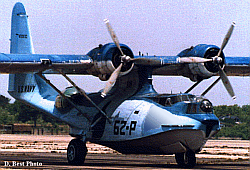 |
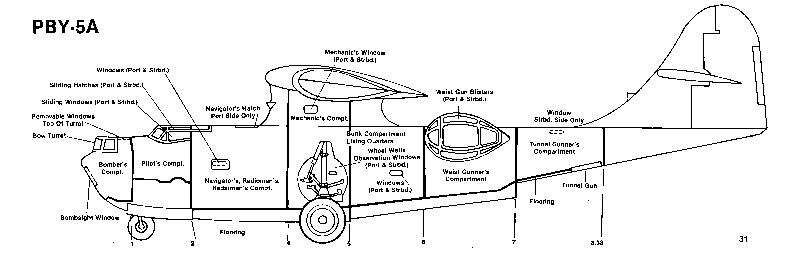
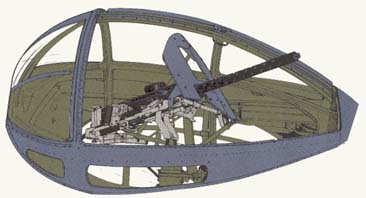
| In the darkened hangar, the flying boat's chipped paint and grease stains still manage to shine in the overhead floodlights. The overall colour scheme is a light grey on top with a dark smoke grey along the spine, the underneath is a dirty white to match the underneath of the clouds, the paint was originally applied over seventy years ago and has only been touched up occasionally since then. The quality of the paint job is thus not high. The design of the plane is 'a twin engined monoplane', the long straight wing sits atop a slender hollow pylon and has a forward facing propeller engine on either side, the wing tips have retractable floats and underneath the wing are the bulbous shapes of the ordnance pylons. The long slim shape of the fuselage depends from underneath the main wing pylon, two large fuselage observation blisters mushroom out from behind the pylon and are the main entrance into the hull, otherwise only the forward nose turret and the cockpit are immediately obvious. Climbing up one of the ladders and in through the observation blisters brings one into the Waist Gunner's Compartment, which is only slightly longer than the blisters themselves and half again as deep. The two huge blisters and their single armoured .50" calibre machine gun mounts dominates this area, the massive 40kg weapons have a butt stock and 'fore and aft' sidegrips rather than the usual spadegrips, a large armoured gunshield protects the gunner, the powered ammunition feed and the reflector sight atop the weapon. The 'link train' for the weapons feeds into a huge ammo box set into the middle of the compartment floor, this holds 956 rounds of .50" calibre rounds for the two guns, every third bullet is usually a phosphorus round. At the rear of the compartment is the watertight door to the Tail Gunner's Compartment, and a watertight door in the front leads to the Bunk Compartment. The interior is a dark shiny green, much chipped and probably the original paint job, the gunmounts and other equipment are painted an equally ancient gloss back, between the two blisters are the intercom boards with their long leads running two ancient 1980's helicopter helmets slung over the butt of each gun and ready for the gunner. Going aft from the Waist Gunner's Compartment enters the Tunnel Gunner's Compartment, a low area near the very tail of the plane. A long low compartment, uninteresting except for the tunnel hatch at the rear at the compartment, here the tunnel gunner knelt on a pad and fired a standard .50"cal machine gun through the water proof hatch in the floor. A dangerous position in combat, the tunnel gunner had no restraint system and could possibly fall out through the tunnel hatch and out of the aircraft in combat if wounded or dislodged by an unexpected manoeuvre. The rear of the compartment is a thick armoured plate decorated by an old cartoon of a lemming in a flak jacket dodging bullets appearing through a hatch in the floor, a small window is on the left side of the compartment and a light and intercom unit is mounted in the roof, a large ammo box holding 500 rounds is on the right of the position and conected by a powered ammo feed. On the walls of this compartment are stored the work stands that can be hung from under the wings to load ordnance or beside the engines for maintenance. Forward of the Waist Gunner's Compartment is the Bunk Compartment, two fold down bunks are set on each wall, the lower of which has a small window and is fixed permanently 'down', underneath these are the storage areas for the blister ladders. A chipbox is fixed by a bungee cord to a rear wall bracket and the grotty green walls are covered in pin ups dating from the '50's to the present day, another watertight door in the forward bulkhead leads to the Mechanic's Compartment. The Mechanic's Compartment is short and tall, extending right up into the wing pylon and has a seat for the in flight engineer to sit between the engines and control their functions, a long obsolete arrangement although the position is still in place. On the left an on one side of the passageway is a twin burner electric stove underneath two water breaker tanks, on the other side of the passage is the CHOOH� all purpose Auxiliary Power Unit and the hand crank used for the engine starter, anchor reel, wing tip floats and so on in emergencies. The mechanic's pylon seat position area has a one foot square window that slides to the rear on either side, the position's control board is directly in front of the seat and the mechanic's legs hang down into the passage resting on the rear wheel housings (there are emergency crank holes) under small windows in the side wheel wells so the wheels can be checked for correct deployment. The forward bulkhead has the watertight door to the Navigator's, Radioman's and Radarman's Compartment, this entire passage way area is a bit of a squeeze and may be something of a problem for large people. The Navigator's, Radioman's and Radarman's Compartment is the longest compartment in the boat, and is treated as a sort of unofficial lounge room now that all its functions are obsolete. The right side has a table originally used for navigation with map drawers and a light overhead, this is now used for playing cards and drinking games, in fact anything but navigation. On the other side of this was the old radio station, now set up for countermeasure netrunning, the comfortable chair (looted from a crashed executive jet in Jakarta) is surrounded by monitors stripped from various locations, these are used so that non runners can monitor a Decker's progress and yank the plug if they consider the runner in lethal danger. The entire set-up is totally divorced from the rest of the aircraft's electrical system, and anything that intrudes into the Decker's system cannot effect the aircraft's systems. The old radar system is long gone, and a series of cabinets have been welded into a mass for storage (one is an old refrigerator). Two easy chairs have been shoehorned in here as well, on either side of the compartment is a small fixed window, while above the rear seat of the nav table is the Navigator's Roof Hatch, this emerges onto the upper surface of the fuselage and is used to access the top of the wing by a step in the front of the pylon. A metre off the floor in the front bulkhead is the watertight door to the Flight Deck, on the back wall are many of the control panels for the planes in-engine generators. The Flight Deck is set above the nose wheel compartment, a large hump in the deck covers the actual nose wheel (this also has a heavily-armoured deployment checking window), the rear wall, the roof and the control panel are covered in new and old instruments, ranging from antique LORAN receivers to the latest GPS systems. The left seat is the pilot's, and over both pilot's and co-pilot's seats are hatches in the roof that slide to the rear, also allowing access to the upper surface of the fuselage, the side windows slide back and the pilots often tool along in the aircraft equivalent of a roofless coupe. Behind each seat is a parachute and life jacket rack, the instruments have been sporadically upgraded, but are still an even mix of systems dating back to the 1940's. There is an open passage between the control seats (also stolen from a crashed jet, not ejection seats though) leading into the Nose Gunner's/Bombardier's Compartment. Nose Gunner's/Bombardier's Compartment is somewhat heavily changed, the old nose turret still mounts it's twin .30" calibre Browning machine guns, now rebored to 7.62mm Nato calibre disintegrating link rounds and is slaved to either the pilot's or co-pilot's helmet's targeting link, although the original weapon controls are still in place and the weapons can be fired from inside the turret. There is 2,100 rounds of 7.62Nato ammuntion available for the two machine guns. The very front of the aircraft is sealed by an armoured door, behind this is a thick window and in front of *that* is a retractable armoured crank-down roller shutter. All this is to cover the bombardier's window and the mount for bombsight is currently empty, this position could conceivably be used for laser guided weapons as well as bomb release. It is not high enough to stand in this compartment unless one is standing in the nose turret, the rear of the nose turret is a roof hatch that is used to deploy the anchor during aquatic operations, the anchor is stored in a compartment on the left side of the fuselage and only accesible from the outside of the hull and a boat hook is stored on the right side of the compartment. A 'chine rail' is on either side of the outside of the hull, the crewmember stands on this when anchoring. |
| A descriptive walk-through of the aircraft |
 |
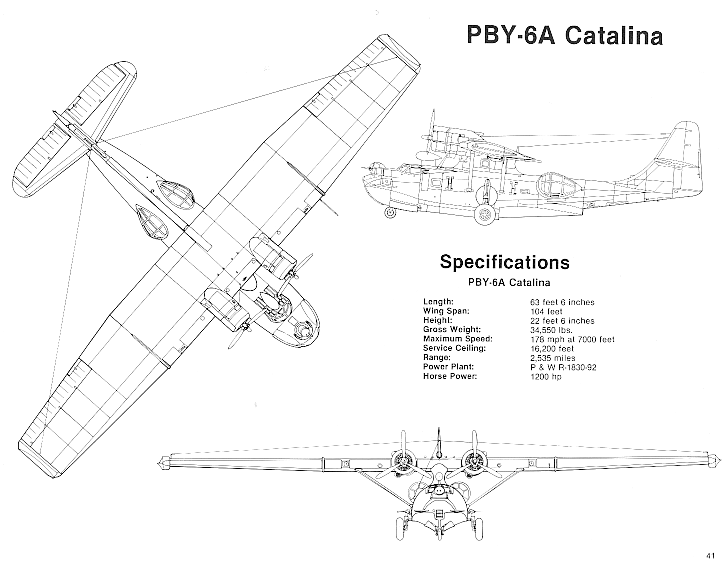
| PBY6A �Catalina� Flying Boat. Base statistics for original vehicle: Length: 63� 6� (19.35m) Wing Span: 104� (31.7m) Height: 22� 6� (6.85m) Gross Weight: 34,550lbs (15704kg) Maximum Speed: 178mph at 7,000� (284.8km/h at 2133m) Cruise Speed: 100mph (160 km/h) Stall Speed: 58 mph (93 km/h) Service Ceiling: 16,200� (4937m) Range: 2,535 miles (4056km) Power plants: P&W R-1830-92 Horsepower: 1200hp Cyberpunk statistics: Top Speed: 178mph Crew: 10 (Can be flown with two crew) Passengers: 0 (9 possible) Manoeuvre: - 3 SP: 10 (15 from rear) (Armour 0/1) Mass: 15704kg Acc/Dec: 10/25mph Range: 2,535 miles Cargo: 5000kg (9.5 spaces) SDP: 156 (Body: 7) Type: Medium Aircraft Cost: 591,275eb (obsolete) Special Equipment: Added Structure, lowered speed, additional range, amphibious modification, fire extinguisher, fold-down bed x 4, radio (civilian, long range = 500km), military radar = 50km (obsolete), searchlight. The hull has 8 mounting points for JATO (Jet Assisted Take Off) rocket bottles; two bottles are required for each use. Weapons: 3 x M2HB 50. Cal HMG in pintle mounts, 1 in each blister and 1 in �tunnel� hatch. 2 x .30 cal MMG in pintle mount, forward turret in twin mount. Mounting points for 4 x 500lb bombs outboard of the wing struts, 2 x 1,000lb bombs inboard of the wing struts, 2 x aerial torpedos between 500lb bomb mounts and wing strut. 500lb bomb mounts can be changed to mount 12 shot 2.75� rocket pods (for anti-submarine use). 30 underwing spaces are available. Those are the stats for a standard PBY6A at the end of WW2 and the early 50�s in military service. The plane is very roomy, and most of the crew positions are obsolete so even more stuff can be sandwiched in. The crew positions are: pilot, co-pilot, bombardier/forward gunner, navigator, radioman, radar-man, flight engineer, waist-gunner x 2, tunnel-gunner. |
 |