Solar System Formation
Solar System Formation |
|
Our solar system started out as a large cloud of gas and dust. This cloud is known as a nebula. Most of the gas came in the form of hydrogen and helium, but there was a tiny portion of the heavier, rocky elements that would eventually make up the planets. This cloud had a mass slightly larger than the mass of the sun, was much larger than the orbit of Pluto, and was probably roughly spherical in shape.
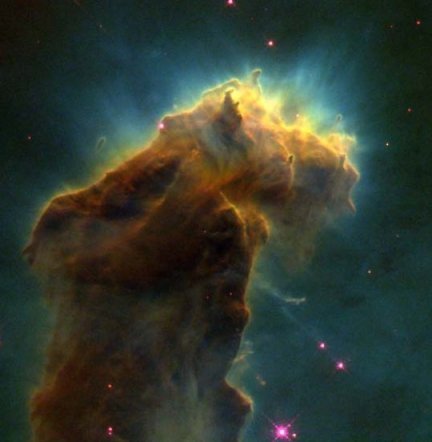
More than one star can form in a nebula. A star forms in a dense area of the nebula where gravity continues to collect particles. This is a close up view of part of the Eagle Nebula. Each of those little protrusions sticking out from the main part of the cloud is a place where a star could form. Each protrusions is slightly larger than our solar system. The entire nebula is being slowly eaten away by radiation from other nearby stars.
Over time, and we're talking tens of millions of years here folks, this gas cloud slowly collapsed under the force of gravity. Gravity is an attractive force. It is what gives you weight and pulls a ball thrown up in the air back to Earth. Gravity started the collapse of the nebula because the particles in the nebula were attracted to each other. They began to fall towards the center of the nebula. There was also a slight rotation to the nebula. It was slowly spinning around itself, but as the nebula collapsed the rotation became faster.
As the rotating cloud collapses it flattens into a disk with a central bulge. The disk is where the planets form. As the gas in the cloud collapses it heats up. After about maybe 100 million years the center of the bulge has become hot enough for nuclear reactions to occur. Nuclear reactions are what gives energy to a star, what make a star shine. The particles fall faster as they get closer to the center of the nebula. They have a lot of energy when they finally collide with the rest of the particles in the center. This energy from the collision is translated into heat. That is what heats up the center of the nebula. The center of a star must reach a few million kelvin for hydrogen to fuse to helium, and helium to fuse to make heavier elements. (Kelvin is just a different temperature, like Farenheit or Celsius) The surface of the forming star stays at a fairly constant temperature while the core heats up. At this point a star is called a protostar because it hasn't fully formed.
Why does the rotating cloud collapse into a disk instead of a smaller spherical shape? And why does it spin faster as it collapses? We need to look at the physics behind the particles' motion and the conservation of angular momentum. Let's look at just two particles falling toward each other. Each particle is falling toward the other but they are also moving sideways. As the particles come close together their up and down motion cancel out but their sideways motion does not. Let's put some math to it. For simplicity, think of the particles moving only in the x-y plane. One particle has a motion of say -1m/s in the y-direction and 1m/s in the x-direction. The second particle is moving at 1m/s in both the x and y-directions. When you add the motions of the particles together the y-direction adds to zero while the x-direction adds to 2m/s. So those two particles, now that they are together, are moving faster in the x-direction, which you can think of as the direction they are rotating.
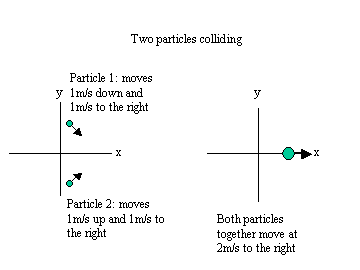
This simple example gives you some idea as to why the cloud rotates faster as it collapses. You can also think of it in terms of the conservation of angular momentum. As a rotating thing gets smaller it must rotate faster. One well used example is that of a figure skater. If you've watched figure skating before you've noticed that when a skater wants to spin faster she brings her arms in close to her body. She makes herself smaller. This is an effect of the conservation of angular momentum. The protostar and its surrounding disk spin faster as they get smaller. The disk is known as a protoplanetary disk because that is where the planets form.

Not everything has fallen to the center of the nebula. There are many heavier elements in the disk which are constantly colliding with each other. As the gas and dust collides some of it sticks together, forming larger chunks of dust and rock. The large chunks attract all the smaller chunks and collide with other large chunks. In this way planetesimals form through a process called accretion. Material builds up after the many collisions.
The heavy, rocky elements are at the inner, warmer part of the disk. The terrestrial planets, Mercury, Venus, Earth, and Mars form from this inner part of the disk. The outer part of the disk is very cold and filled with light gas such as hydrogen and helium. When nuclear reactions began in the core of the protostar the energy released blew many light elements to the outer reaches of the disk. The heavier elements stay closer to the core. Jupiter, Saturn, and the other outer planets do not have much rock, but they do have a lot of gas. Most of the stuff in the outer part of the disk was hydrogen and helium. The big gas giants live up to their name, with a lot of hydrogen and helium surrounding very tiny, rocky cores.
So, as the nebula collapses it also spins faster and forms a disk. The
core collects most of the material and gets hot enough for nuclear reactions
to begin. The planets form through accretion, like giant vacuum cleaners
sweeping up everything in their path. Still, the star ends up with most
of the mass. In our own solar system Jupiter is by far the largest planet
but it still only has one-one thousandth (.001) the mass of the sun. Astronomers'
only model for solar system formation comes from observing our own solar
system. Some of the planets found orbiting other stars are hard to explain
using the current model, but that is another topic for another page.