Extrasolar Planets
How do astronomers find planets orbiting other stars?
There are four ways to find a planet around another star. One is by direct
observation, that is actually looking at the planet. This is impossible
to do with today's technology. The luminosity, or brightness, of the star
obscures anything we might see, and planets don't shine very well. Another
method uses the phenomena of microlensing. I will not discuss that here
but there is a link at the bottom of the page which will take you to a
page about microlensing. You can also detect a planet as it crosses the
star by looking at the luminosity of the star. As the planet passes in
front of the star it blocks some of the light and we measure it as a drop
in the star's luminosity. This method has been used to confirm the presence
of an extrasolar planet. The last method deals with analyzing the radial
velocity of a star and looking for the Doppler effect. This is the method
I will focus on for most of this page.
Stars and their motion
Star are not stationary points of light in the sky. Just as the planets
move about the solar system so to do the stars move about the galaxy. We
can analyze and measure their motion. Stars are also affected by the planets
orbiting them. In our own solar system the sun is not a stationary object.
It makes a small orbit about itself. The planets are kept in orbit by the
sun's gravity, but the sun is also attracted to the planets. The sun dominates
the system because of its much higher mass. This gravitational interaction
does make the sun move in its own little circle about itself.
Let's break this phenomena down into a simpler system. Think of a star
with one Jupiter-sized planet orbiting it. The planet and the star are
always attracted to each other through gravity. The center of the orbiting
system is not the star but a point outside the star. The planet orbits
around this center point, but so does the star. Another way to explain
this is to think of two people holding hands an spinning in a circle. If
the people are two children about the same size the center of the circle
they make will be their hands. But if there is an adult and a child spinning
then the adult doesn't move much while the child makes a large circle around
the adult.
The Doppler effect
So astronomers are looking for this circle, or wobble, made by the star.
They find it by looking at the light we receive from the star. They are
looking for a phenomena known as the Doppler effect. Think back to when
you've been at a railroad crossing waiting for the train to pass. As the
train comes toward you its whistle is high-pitched, but after the train
passes the whistle is lower. This is an example of the Doppler effect.
Light and sound travel in waves. Waves can be described by their wavelength
or their frequency. A wavelength is just the length of one wave, like the
distance between two crests of an ocean wave. Frequency describes how many
wave crests pass a certain point every second. Sound or light with a shorter
wavelength has a higher frequency, which means that more crests pass a
point every second, and a long wavelength gives a lower frequency, fewer
crests passing that point every second. As the train moves toward you the
sound waves emitted by the whistle get bunched up. The wavelength gets
shorter and has a higher frequency. After the train passes and is moving
away from you the wavelengths get stretched out, they get longer, and the
frequency is lower.
| The Doppler effect also affects light. If any object emitting
light is moving away from us the light gets stretched to a longer wavelength.
Imagine you are watching a blue flashlight move away from you very quickly.
Since it is moving away its light is being stretched to a longer wavelength.
By the time you see the light from the flashlight it might appear red to
you. Red light has a longer wavelength than blue. This is an extreme example,
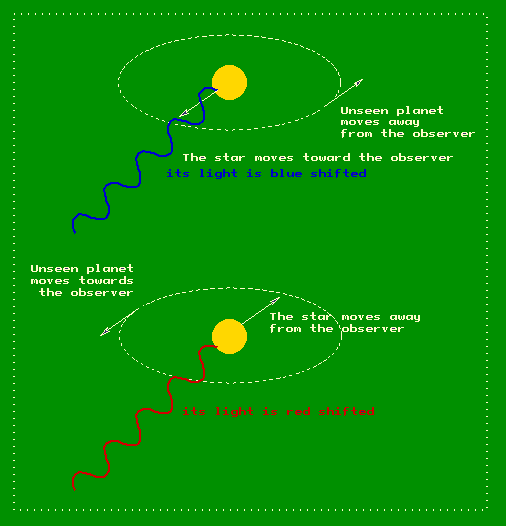
but this is exactly what happens to star. The star is pulled toward or
away from Earth as the planet orbits around it. As the star moves toward
Earth its light is shifted to a shorter wavelength, known as a blue shift.
If the star is moving away from Earth we see the light as red shifted because
the light from the star has been shifted to longer wavelengths. Astronomers
can measure how much the light from the star has shifted. This is not a
dramatic shift, like from blue light to red light, but it is enough for
astronomers to measure. |
 |
Astronomers find extrasolar planets by looking for this wobble in stars
and looking for the Doppler effect. They can tell a lot about the planet
simply by studying the shift in light from the star. A star with a big
shift must have a very large planet orbiting it. Earth does not pull on
the sun very much but Jupiter, which is much larger, does. The period of
the planet's orbit can also be detected. If 2 years time passes between
one blue shift and the next then the planet must have a period of 2 years.
(Earth's period is one year)
This technique has been used to find all of the extrasolar planets found
so far. Most of those planets don't fit into our version of the solar system.
They are extremely large planets, much bigger than Jupiter but they orbit
very close to their star. In some cases the planet orbits closer than Mercury
does in our solar system and the planet completes its orbit in only a few
days. The challenge for astronomers is to explain how these planets formed
and to try and find Earth-sized planets around stars similar to our own.
Links to other sites on extrasolar planets
Microlensing Planet Search Project
Catalog of Extrasolar
Planets
Other Planetary Systems?
Last updated: Jill Jacobs, 19 August 2000