Stellar Evolution
There are many different stars in the universe, from ones that are much
smaller than the sun to ones that are much, much larger. Before we talk
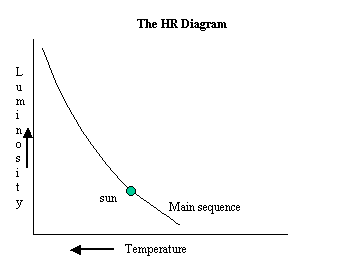
about the lifetimes of these stars we should first define the HR diagram
and the main sequence. The HR diagram is a graph that shows the relationship
between the temperature and luminosity, or brightness, of a star. It is
named after Hertzsprung and Russell, the two astronomers who first made
the connection. You should note that a star with high luminosity does not
necessarily appear bright in our sky. The star could be very far away and
look dim to our eyes.
The Main Sequence
| Very massive stars lie at the upper end of the main sequence.
These stars are extremely bright and hot. (Temperature increases to the
left on this graph) They are known as blue giants, because they shine blue-white,
and can be as much as 100 times as massive as the sun. The smallest stars
have as little as a tenth the mass of the sun and are very cool and dim.
All stars burn hydrogen in their core, which fuses to helium. As a star
evolves off the main sequence it burns helium in its core and more massive
stars burn carbon and heavier elements. (More on that later). |
|
Let's break our talk about stellar evolution into three categories;
very low mass stars, intermediate mass stars like the sun, and massive
stars. Then I will talk about the various end states of stars.
Low Mass Stars
Low mass stars are extremely boring. They basically burn all the hydrogen
they can then cool down into a white dwarf. (More on that later) However,
cool red stars are the tops when it comes to longevity. It will take these
stars tens of billions of years to die.
Intermediate Mass Stars
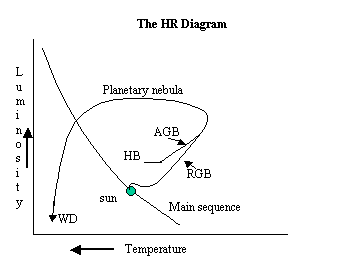
Stars like the sun are more interesting. While on the main sequence the
sun burns hydrogen into helium through nuclear reactions. Once all of the
hydrogen in the core has been used up the sun becomes a red giant. During
this phase the star burns hydrogen in a shell around an inert helium core.
The core is being compressed and heated. When the core is hot enough nuclear
reactions will begin again and the helium burns into carbon. This is known
as the helium flash, and the star falls to a place on the HR diagram known
as the horizontal branch. The sun is more luminous and larger, but cooler,
on the red giant and horizontal branches than on the main sequence. As
the helium in the core is used up the sun begins moving up the asymptotic
giant branch. The sun now has an inert carbon core and is burning hydrogen
and helium in shells around the core. Just like on the red giant branch,
the core is compressed and heated, but with stars like the sun the core
cannot get hot enough to burn carbon. Instead, the sun begins to throw
off its diffuse outer layers, which becomes a planetary nebula surrounding
the dying star. As the sun runs out of nuclear fuel it cools down into
a white dwarf. All of this action off the main sequence only takes up a
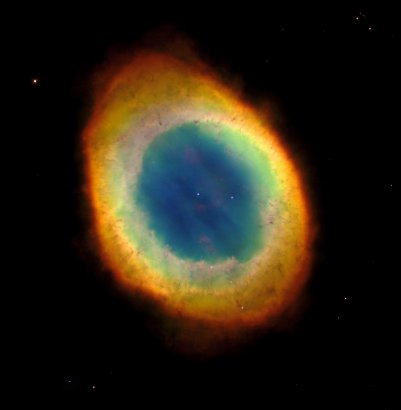
tiny fraction of the star's total lifetime. The picture below is of the
Ring Nebula, a planetary nebula that has been ejected by the dying central
star. The central star will eventually become a white dwarf.
Massive Stars
Massive stars follow the same kind of lifetime as the sun but they do it
in fast forward. They have much shorter lifespans than other stars because
they burn their fuel so fast. The most massive stars only live for a few
million years while the sun will live for 10 billion years. Massive stars
differ from smaller stars like the sun in that they can get hot enough
to burn carbon and other heavy elements. These massive stars explode at
the end of their lives as supernovae, but they throw off almost all of
their outer layers before they go. Supernovae are the main source for elements
heavier than iron. The end state for a massive star after a supernova depends
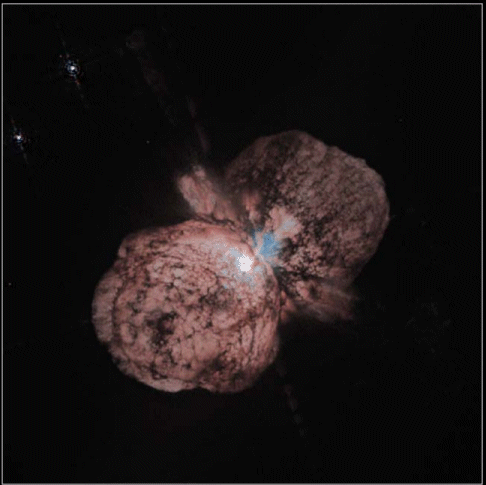
of the mass of the remnant star. The picture below is of the star Eta Carinae,
which is in the process of dying. The ejected matter is the planetary nebula.
This star will go supernova within the next million years.
End States
| A white dwarf is at a state called electron degeneracy.
What this really means is that the material in the star has become so compressed
that the atoms in the star are no longer their normal distance apart. The
nuclei, the center of the atom, are at a distance of an electron's orbit
from one another. The electrons have essentially disappeared, have been
squeezed out of the picture. All that is left are a bunch of protons and
neutrons extremely close together. The maximum mass for a white dwarf is
1.4 solar masses. (1.4 times the mass of the sun) They are also extremely
small, measuring about the size of the Earth.
A white dwarf is the end state for many stars. They have exhausted their
fuel and there are no more nuclear reactions occurring inside the star.
The light you see from a white dwarf comes from its thermal radiation.
The star is still hot, and hot things glow.
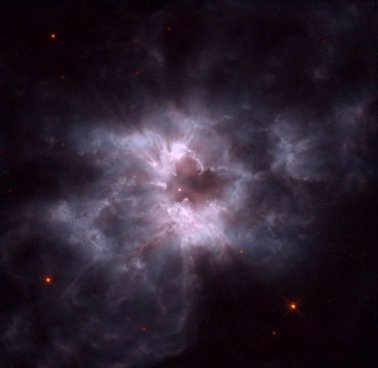
The star at the center of the image is a white dwarf along with its
planetary nebula that has been ejected. |
 |
Neutron stars and Black Holes
Neutron stars and black holes are the end states for stars that explode
in a supernova. Whether or not the star becomes a neutron star or a black
hole depends on its mass. Stars that have at least 8 solar masses during
their main sequence lifetime will eventually explode in a supernova.
Whereas a white dwarf is electron degenerate, a neutron star has neutron
degeneracy. It has been compressed so much that even the protons don't
exist anymore. The star is just a bunch on neutrons crunched together like
one large atom. Neutron stars are even smaller than white dwarfs. They
have a radius of only about 10-20 km, or 6-12 miles. Imagine packing something
bigger than the sun into a large city. The upper mass limit for neutron
stars is 3 solar masses. Neutron stars are very interesting and exotic.
They are spinning very rapidly, usually once a second or less, have very
strong magnetic fields, (like a really, really large magnet) and are emitting
lots of radiation.
Extremely massive stars collapse to form black holes. The remnant star
is 3 solar masses or more. Black holes are named because nothing can escape
from them, though they sometimes emit high energy radiation like X-rays.
If you were to go beyond the event horizon, the "edge", of the black hole
you would be pulled into it. Black holes are incredibly tiny but incredibly
powerful. The black hole is only a few kilometers across.
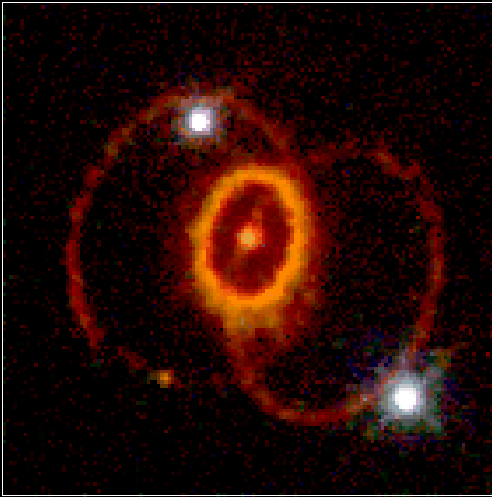
Below is a picture of supernova 1987A, which is located in the Large
Magellanic Cloud visible in the southern hemisphere.
Great sites about stellar evolution
Stellar
Evolution and Death A site maintained by NASA
Falling into a black
hole
The Naked
Singularity A really great site created by two high school students
Last updated by Jill Jacobs, 19 August 2000