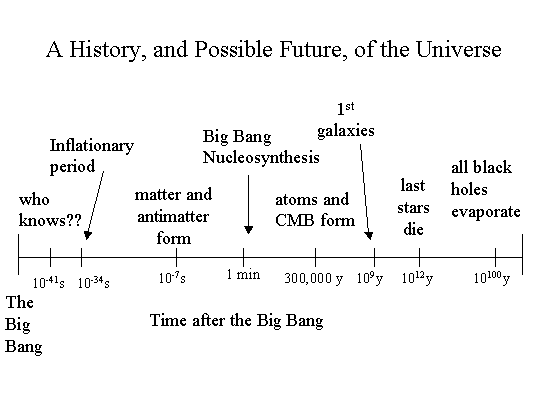
We actually don't know what happened at the beginning of the Big Bang. Physics can not currently describe what happened. Physicists who study a field called quantum mechanics can only explain things back to a time of 10-43 seconds after the Big Bang, which is known as Plank time. We don't know anything before that.
A lot happened in a short amount of time at the beginning of the Big Bang. At a time of 10-34 seconds after the Big Bang the universe underwent a very short period of extremely rapid expansion that lasted for 10-32 seconds. During the inflationary period the universe went from the size of an atom to the size of a galaxy! It is this inflation period that is believed to have given the universe the right conditions to exist as it does today. Matter and antimatter, in the form of protons and antiprotons, were created around 10-7 seconds. The universe was extremely hot at this time. A process known as Big Bang Nucleosynthesis occurred only a few minutes into the beginning of the universe. All of the light elements on the periodic table were created during this time, mostly hydrogen and helium. All of the matter that you see around you today started out as hydrogen and helium made during the Big Bang. However, only the nuclei, the protons and neutrons, of these elements were created. It took 300,000 years for the universe to cool down and atoms to form. When this happened the cosmic microwave background formed. The universe was now transparent, which means that photons were free to move about the universe. Prior to this the universe was a cloudy opaque mess. Now it had some structure, and if you were alive then you could have seen it. But the first stars and galaxies did not form for one billion years.
That is a short and condensed version of the Big Bang. I don't want to get into the physics of everything because, frankly, that would take pages and pages to cover. I just wanted to give you an overview and a sense of what happened at the beginning of our universe.
So what does the future of our universe look like? Assuming that the universe will expand forever here is one possible future. The universe is already about 15 billion years old, but it will take 1012 years, or a thousand billion years, for all the stars in the universe to die out. After that the universe will slowly die out and evaporate. The last things to go will be the really massive black holes which won't evaporate for 10100 years.
Introduction to Cosmology A site run by NASA