Some of the basics
This page isn't really about the basics of astronomy. It's really just
an eclectic mix of topics that interest me. On this page you will find:
Eclipse
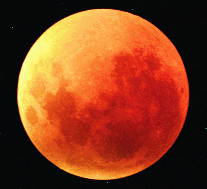
We have two varieties of eclipses - lunar and solar eclipse. An eclipse
happens when one object passes through the shadow of another. Let's look
first at the most common eclipse, the lunar eclipse.
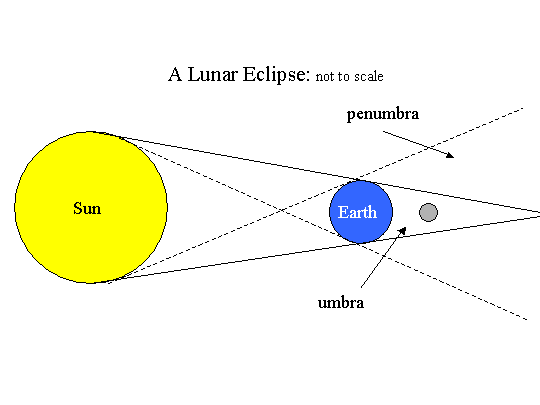
A lunar eclipse happens when the moon passes through the Earth's shadow.
The light from the sun is blocked. The moon is so bright because it reflects
the sunlight that shines on it. During an eclipse that light doesn't reach
the moon. The reason that the moon often looks red during an eclipse, like
the picture above, is because some sunlight does reach the moon after being
refracted (bent) through the Earth's atmosphere.
There are two parts to the shadow, the umbra and the penumbra. The umbra
is a total shadow whereas only some of the light has been blocked in the
penumbra. We can hardly notice when the moon passes through the penumbra.
A partial eclipse happens when only part of the moon passes through the
umbra. Everyone on the night side of the Earth can see a lunar eclipse.
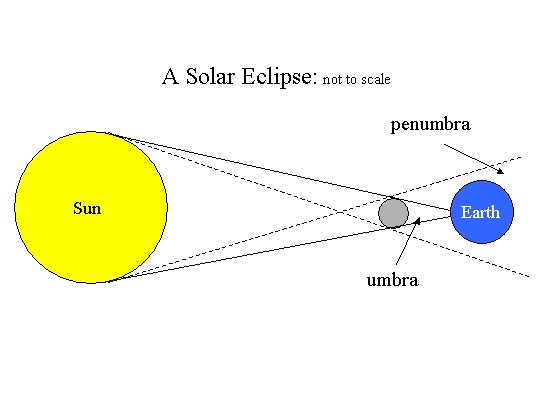
A solar eclipse occurs when the moon passes in front of the Earth, but
it requires much more precise alignment. As you can see in the diagram
below, only a small part of the Earth can see the total eclipse because
the umbra of the moon is so very small. There is also an eclipse known
as an annular eclipse. This happens when the moon doesn't quite cover the
sun and you can still see an outer ring of the sun. By looking at the diagram,
the point of the umbra would actually fall above the Earth's surface rather
than one the surface.
Kepler's Laws
Before we talk about Kepler's Laws we need to first go over some of the
basics of an ellipse.
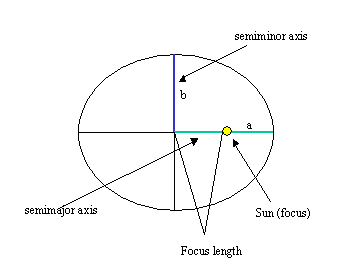 |
The major axis of an ellipse is the long axis, and the
minor axis is the shorter axis. A circle is a special case ellipse, with
both foci in the center of the circle. The foci are special points in an
ellipse. The distance from one point on the ellipse to a focus plus the
distance from the same point to the other focus remains constant no matter
where you are on the ellipse. In astronomy, we talk about the semimajor
and semiminor axes and the eccentricity of the ellipse. The semimajor and
semiminor axes are just half the major and minor axes. Eccentricity is
a measure of the elongation of an ellipse. |
Kepler's 1st Law: The orbit of a planet is an ellipse
with the sun at one focus
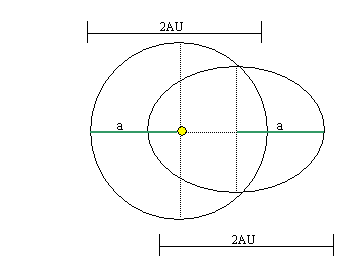
| Both orbits have a semimajor axis a = 1 AU (half the long
axis of the orbit), but one orbit is circular and the other is very elliptical.
The eccentricity, e, equals 0 for the circular orbit while the elliptical
orbit has an eccentricity of about 1/2. Note that a more eccentric (elongated)
orbit has a much smaller semiminor (b) axis. The other focus in an elliptical
orbit is empty; there is nothing there. |
 |
| Here are some orbits that have the star as its focus and
the same semimajor axis. The circular orbit stays at the same distance
from the star while the highly elliptical orbit approaches extremely close
to the star then travels far from the star. |
 |
Kepler's 2nd Law: A line joining the sun and the
planet sweeps out an equal area in an equal time.
The explanation for this law centers around the fact that a planet close
to the sun orbits faster than one far from the sun. The closer a planet
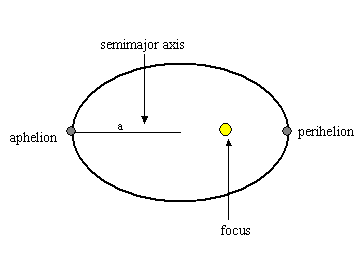
is to the sun the faster it travels. Since orbits are ellipses a planet
has a close approach to the sun (perihelion) and a point where it is farthest
from the sun (aphelion). When the planet is at perihelion it is traveling
faster than average because it is closer to the sun. Conversely, when the
planet reaches aphelion it is has a slower than average velocity. A planet
travels at different speeds depending on where it is in its orbit. If the
planet is moving much faster at perihelion than at aphelion it covers more
distance around its orbit when it is close to perihelion than it does near
aphelion. This is where Kepler's 2nd Law, also known as the law of equal
areas comes in. If you draw an imaginary line between the planet and the
sun you find that it sweeps out an equal area in an equal amount of time
regardless of where the planet is in its orbit.
Kepler's 3rd Law: The square of the sidereal period
of a planet is directly proportional to the cube of the semimajor axis
of the orbit.
Well, so what the heck does that mean? It really means that the time it
takes a planet to orbit the sun is related to how far away the planet is
from the sun. Makes more sense stated that way, doesn't it. :)
Kepler's 3rd Law comes down to one equation........P2 = a3
But
only if the period (P) is measured in years and the semimajor axis (a)
is measured in astronomical units (AU). Otherwise there is a constant in
the equation.
Kepler's 3rd Law does make some logical sense. The farther out a planet
orbits from the sun the longer it takes that planet to orbit. It takes
longer for two reasons: (1) It is farther out and so has a longer orbit
to travel than a planet closer in, and (2) the gravitational pull on the
farther planet is not as strong and it moves slower through its orbit relative
to the closer planet.
Why do we have seasons?
The changing of the seasons has nothing to do with how close the earth
is to the sun. It all comes down to how much energy is received per area
on the earth, and that is determined by the position of the sun in the
sky. In the winter the sun is far south in the sky (for us in North America).
It does not rise very high overhead and does not stay up for a very long
time. With the sun so low, its energy gets spread out over a larger area
(a smaller energy per area ratio). The sun always puts out the same amount
of energy but in winter it is more spread out, so each individual place,
or unit area, receives less energy. Adding to the decreased energy is the
fact that the sun is not out very long in the winter, consequently it does
not get very warm in the winter. The summer is the opposite situation.
During the summer the energy from the sun is more focused because the sun
is high in the sky. It rises in the northeast, instead of the southeast,
and travels high overhead. Say that during the winter the energy we receive
from the sun is spread out over a unit and a half of area. Then in the
summertime that same energy could be spread over less than one unit of
area. So each unit of area receives more energy in the summer than in the
winter.
Today we know that the earth moves, not the sun, and the seasons are
controlled by the earth's tilt. The tilt is what makes it look like the
sun is moving north and south in the sky. Earth's orbit is nearly circular,
so it's not significantly closer to the sun at any time. However, as the
tilted earth orbits the sun different parts of the earth are leaning toward
the sun, and that is what influences the seasons. During the winter, the
northern hemisphere is tilted away from the sun so the energy per area
is spread out. Again, the summer months are just the opposite, with the
northern hemisphere tilted toward the sun and the energy more focused.
Also, the day is much longer in the summer which increases the heating.
You can convince yourself of this by using a flashlight for the sun
and a basketball, or other large, round object, as the Earth. Shine the
flashlight sun down onto the basketball Earth and tilt the earth at different
angles. Notice how the beam that falls on the basketball will spread out
or contract as you tilt the basketball.
One
of these things is not like the other
Uranus is a strange planet, and my favorite. Uranus is a fairly typical
gas giant, bigger than Neptune and smaller than Saturn. But something happened
during Uranus' early life that really knocked it off-center. All of the
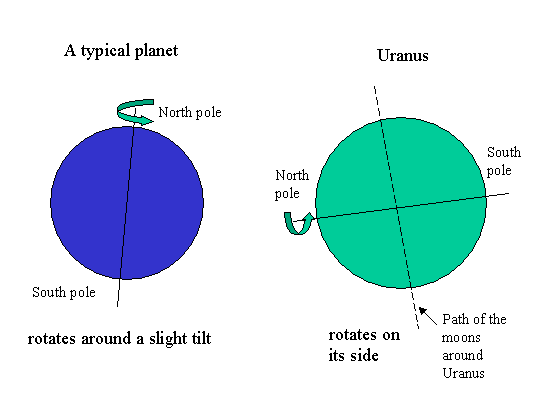
planets rotate standing up, but Uranus rotates on its side. Somehow Uranus
got pushed over and its rotation axis is tilted 98 degrees. To put this
into perspective, Earth has a pretty good tilt to its axis but its tilt
is only 23 degrees. This means that for much of the year either the north
pole or the south pole of Uranus faces the sun. So Uranus is on its side,
and so is everything else in that system. Uranus does have thin rings,
which look like they run around the north-south pole line. The moons of
Uranus also orbit along this line. While the rest of the solar system is
standing up Uranus is lying down on the job. How could this have happened?
Well on idea is that some large asteroid type object hit Uranus while it
was still forming. It was not big enough to break the planet apart but
was big enough to knock it over.
Is Pluto a Planet?
Do you consider Pluto to be a planet? Whether or not Pluto is a planet
really comes down to semantics. How do you decide what is a planet and
what isn't. Personally, I don't think Pluto is a planet. I would call it
the largest object in a class of objects contained in the Kuiper Belt.
Let me make my case.
-
Pluto's moon, Charon, is a significant size of Pluto itself. Charon is
one-sixth the size of Pluto. No other moon in the solar system even comes
close to that size compared to the planet it orbits. It is really more
like a two body system. Charon does not orbit around a stationary Pluto,
Pluto moves a little itself.
-
Pluto's orbit is extremely eccentric (elliptical). At some points in Pluto's
orbit it is closer to the sun than Neptune. This is similar to, but not
as extreme, as comets. A comet's orbit is very elliptical with the comet
coming very close to the sun at perihelion and very far from the sun at
aphelion.
-
The orbit of Pluto comes way out of the plane of the solar system. When
the solar system formed the all the planets were contained within a disk,
but Pluto comes way above and below this disk.
-
As the solar system formed chunks of matter were thrown to the outer reaches
of the solar system to an area known as the Kuiper Belt. These objects
are chunks of rock and ice. They are very different in composition compared
to the outer planets. Pluto has the same composition as the objects in
the Kuiper Belt.
-
Pluto is extremely tiny. It is much smaller than many moons.
It is most likely that Pluto and Charon are captured items from the Kuiper
Belt. Whether or not you want to call Pluto a planet is up to you. It does
orbit the sun but it is not similar to any other planets. If you'd like
to take that route you could call Jupiter and its moons a mini solar system.
Some of Jupiter's moons are so big that if they were orbiting the sun rather
than Jupiter we would gladly call them planets. Where do you draw the line?
Last updated by Jill Jacobs, 19 August 2000