Electoral College Reform
Does the Electoral College system work? In the 53 elections that it has been used, only 4 elections have had problems. Is this too much? I don’t think so, but I do believe there are some problems with it. I’m not for totally trashing the Electoral College, but for merely fixing and updating it.
It has been taught that the original intent of the Electoral College was to take the power to elect the President out of the hands of the people, who were seen to be ignorant to political issues. How they voted would have some effect, but the electors, the guys who really knew who the candidates really were and what their stances were, they would cast the final and deciding ballots.
If this was the original intent, then it could be said that it has been outmoded. The people are, or at least, for the most part, have the ability to be, informed about the candidates running for office. This is no longer the time where people travel by carriage and letters take weeks to deliver, but of air-travel, express mail, and the Internet. Technology has changed the way people communicate. Candidates can use television, radio, mass mailings, and the Internet to get their stances on the issues and their campaign promises out to the people; far easier than traveling state to state and speaking. Helpful, too, is the advent of political parties. People can look at a candidate’s party affiliation and get a rough idea of his ideology. And it is the party that usually disperses the information about their candidate. Times have changed. The people can be informed.
Of course, that doesn’t mean that they actually are informed. The Electoral College serves an important purpose. It disjoins the votes of the people and the actual election of the President. This role shapes the election and how campaigns are run. It is a better system, I believe, than that of popular election. Here’s why: the public at large can usually be swayed by factors irrelevant to politics. They are prone to bandwagoning and mobocracy. They elect people for who they are, people like Sonny Bono, John Glenn, and Jesse “The Body” Ventura, and not what they stand for. They are not informed about the issues or don’t care. This is not the way the most powerful person in the world should be elected. Cooler heads should prevail, and they do when the election is nationalized as it is. Another problem with popular election is how the candidates would campaign. They would only focus on the densely populated areas, even more so than they do now. A large portion of the country, essentially from the Rockies to the Western Appellations, could be forgotten. 31.868% of the nation’s population lives in California, New York, Texas, and Florida. Add in Pennsylvania, Illinois, Ohio, and Michigan and you’ve got 48.210%. Almost half of the population lives in eight states, and I would believe that they would get almost all of the focus for the campaign. The Electoral College keeps everyone at least somewhat involved in the election, and that is the point, to elect someone that would do something for the good of the entire country.
So, how do you fix it? You can’t eliminate the college unless and go for popular election unless you want to deal with the aforementioned problems. You can’t go for a one state, one vote system because then a person’s vote in Wyoming is worth 68.596 times that of a person’s vote in California. These numbers will be off, because I’m using the straight population numbers from the 2000 Census, but I figure that the amount of registered voters is about the same, proportionally, everywhere, so it should work. So, 68.596 times that of a person in another state, that’s no good. We’re about equality here in America, and that would be just plain wrong. But under the current system, using the quotient of the state’s electoral votes divided by its overall population, the amount of weight carried by a person’s vote in some states varies. And we’re not talking about a small variance; we’re talking about 2 or 3 times more worth. A person’s vote in Wyoming is worth 3.742 times that of a person’s vote in California. Is this acceptable? It possibly counteracts the fact that Wyoming is completely ignored and California gets lots of attention during campaigns. I don’t necessarily believe that this sort of compensation is acceptable. I have a proposal that equalizes the vote worth for every American, and also forces a candidate to cater to more of the nation.
It goes without saying that no proposal will have an impact on the practice of campaigning in high population density areas. Candidates go where the most votes are; you can’t change that. However, you can try your hardest to limit that practice. So, I propose that we redistrict the United States into five electoral districts, equal in population. The candidate with the most votes in a district wins the one electoral vote for that district. No more of this casting ballots for the “electors for” nonsense. There are no electors, just five electoral votes, and three are needed to win the Presidency. Each part of the nation gets it’s voice heard, every part of the country will have an impact on the policy decisions. The best for everyone, that’s the point. That’s why we have the Electoral College, to make sure the 84% of the country with 51.890% of the population gets some say in how things are handled. Greater catering to a greater number of people means the best for the people as a whole.
I would split the nation up like this:
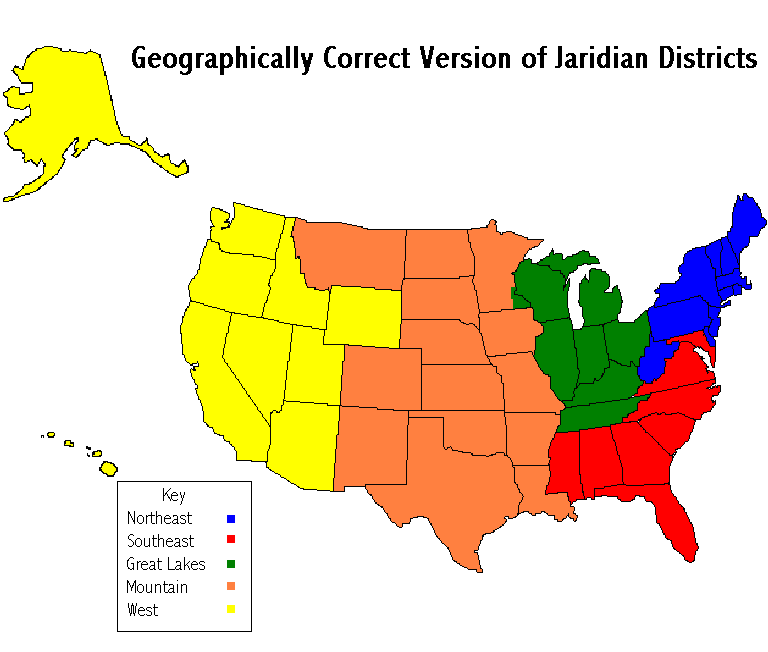
Or, to be more easily implemented and as not to cut Minnesota off from it’s capital:
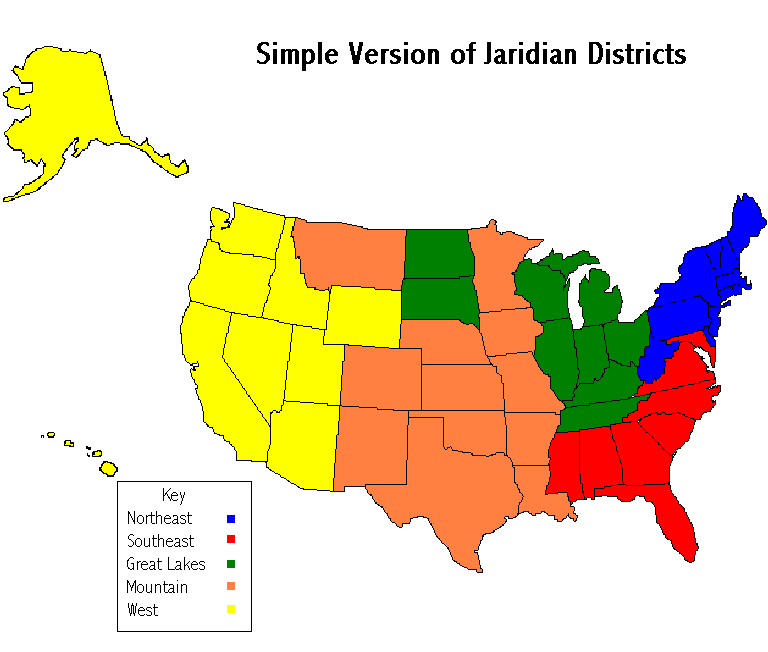
These five districts are all within .04% of 20% of the population. That means that the greatest amount of difference in vote worth is that a person’s vote in the West is 1.0052 times that of a person’s vote in the Southeast. This is far from almost 4 times more worth as seen in the extreme of the old system. What impact will this have on the party system in America? I don’t know yet, I have to research it further. It would seem likely that the two party system will stand, since a third party candidates likelihood of winning more than 1 electoral vote is slim, and even smaller is the chance of getting a majority of the House. Does this system open itself up to letting candidates like Ben Affleck win? Possibly, but the people who would vote for Ben don’t usually vote anyways, and it would be hard for a celebrity to win an election nationally because the educated are the ones who vote, and they would most certainly not vote for him.
What I can tell you is how the campaigns are likely to change. You no longer have powerhouse districts to try and woo because they have 54 electoral votes, you have five, each with one vote. Let’s look district by district at how someone will campaign there. In the West, California has 60.296% of the district’s population, and it will continue to be a key place to get voters. Washington has 10.482%, Arizona has 9.133%, and Oregon has 6.094% of the district population. These three states will play a larger role in the election, and may get more notice. The other 6 states have less than 4% each. They still have little say, but they still count the same as everyone else. In the Northeast, Massachusetts, New York, New Jersey, and Pennsylvania make up 11.300%, 33.774%, 14.976%, and 21.858% of the district population respectively, making a total of 81.908% of the population in those four states. Connecticut has around 6% and the other 6 states have 3% or less of the population. Again, four states dominate the region, but they may get more attention than they normally would. In the Southeast, Virginia (12.535%), North Carolina (14.254%), Georgia (14.497%), and Florida (28.303%) make up 69.590% of the district’s population. However, the only state in this district with less than 5% of the district’s population is Washington, D.C. with around 1%. This district still has four states dominating, but there is a greater amount of importance to the others. In the Great Lakes and the Mountain districts, the Dakotas and southeastern Minnesota are interchangeable and practically equal. The Great Lakes district has five states with over 10% of the district population: Illinois (22.066%), Michigan (17.658%), Indiana (10.803%), Ohio (20.171%), and Tennessee (10.108%). Wisconsin has 9.530% and Kentucky has 7.181% of the population, giving 7 of the 8 or 9 states in this district a percentage above the 6% benchmark of importance. The Dakotas amount to 2.482% combined, so being geographically correct or not seems irrelevant. Lastly, the Mountain district has one dominant state, Texas with 37.032% of the population, and all the rest are under 10% each. Kansas, Iowa, and Arkansas are around 5% each, OK has 6.128%, Colorado and Louisiana have around 8%, Minnesota has about 9% if it is intact, 7% if it isn’t, and Missouri has about 10%. This district looks to be the most dispersed district. All the states will have an impact and will more than likely catered to.
There is my proposal. Everyone is equal and everyone counts the same. Sure, the bigger states will still get more attention, but the people in the smaller ones count just as much.