 |
|
|
|
|
|
|
|
|
|
|
|
|
|
|
|
|
|
|
|
|
|
|
|
|
|
|
|
|
|
|
|
|
|
DNA Testing and Its Uses |
|
|
|
 |
|
|
|
|
Testing of human deoxyribonucleic acid, or DNA, was introduced into for commercial use in the 1980's mostly by police and other institutions to combat crime. There have been mainly two types of DNA testing used by these groups to combat crime. Restriction fragment length polymorphism, or RFLP, testing is sometimes called DNA fingerprinting as it is considered to be the more accurate of the two tests. This type of testing requires large sample cells of undamaged and recently dead cells. It also takes from three weeks up to two months to complete the testing. Polymerase chain reaction, or PCR, testing uses a much smaller sample which does not have to be recently collected and can have slight degradation. It is not as accurate as RFLP, but it is much faster to complete as results are finished in a week at most. This test is helpful when there is little evidence that can be collected. |
|
|
|
|
|
|
The Mitochondrial Genome |
|
|
|
|
|
 |
|
|
|
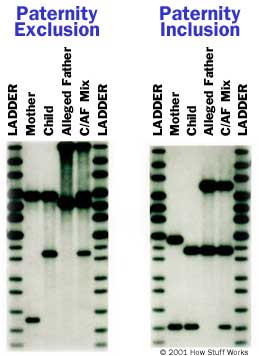
One of the greatest uses of DNA testing is genetic fingerprinting. Besides being used in criminal cases to match suspects to evidence collected at crime scenes, genetic fingerprinting can be used to study populations of wild animals, identify bodies, and to establish paternity. The most famous paternity test occurred in 1998 when researchers tried to determine whether Thomas Jefferson fathered children with one of his slaves. Some scientists are now using DNA samples extracted from early human remains to determine how they may have migrated and evolved into different races. Other scientists are also using genetic fingerprinting to study inherited diseases in hopes of determining what genetic differences predispose individuals to certain diseases. |
|
|
|
|
|
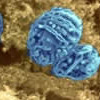
When there is a sample that has been degraded or is not large enough to get a complete profile to test the nuclear DNA it is possible to use mitochondrial DNA testing. Mitochondrial DNA, mtDNA, can be used to test highly degraded samples as there are many copies of this compared to one to two copies of nuclear DNA in a cell. Mitochondrial DNA is maternally inherited making it easy to use directly linked maternal as match references. This makes mtDNA very useful in determining identities of missing persons when a maternal relative can be found. Scientists have successfully made a powder out of the skull of a murdered woman that had been in the weather for 15 years and extracted enough mitochondrial DNA to get a positive identity match with her daughter. |
|
|
|
|
Example of DNA Paternity Test |
|
|
|
|
|
|
Mitochondrial and Y-chromosone testing are the most popular test methods used in genealogical genetic testing. Genealogical testing has no informative medical value and are used mainly in determining distant ethnic and geographic origins. Y-DNA testing traces a man's paternal origins, while women who wish to trace their paternal lineage must find a male family member willing to give them a sample to have tested. The Y-DNA is passed from father to son and only allows one to match DNA with their father, their father's father, and so on. Mitochondrial DNA can be used to test maternal lineage of both men and women as mitochondria are passed from mother to child regardless of sex. |
|
|
|
 |
|
|
|
|
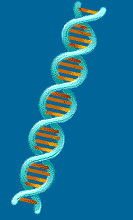
There are four nucleotides, often called building blocks, that make up the double-helix of DNA, adenine, thymine, cytosine, and guanine. These proteins appear in pairs on opposite sides of the helix with adenine and thymine always paired and cytosine and guanine always together. Each set of three nucleotides corresponds to one of the twenty amino acid that produce our bodies different proteins. The three billion total DNA bases that are split up into twenty-four chromosomes make up the human genome. The human body is made up of approximately 100 trillion cells each containing one nucleus which contain the chromosomes. Each chromosome contains a selection of genes which tell the cells what their function is in the human body. The human genome contains approximately twenty to twenty-five thousand genes. |
|
|
|
|
|
|
The DNA double-helix |
|
|
|
|
|
When testing DNA in a lab it is sometimes necessary to replicate the sample to make it large enough to test it accurately. This is achieved by extracting the DNA, sorting the fragments, and denaturing these fragments to form single-strands. Scientists then use a process called nucleic acid hybridization to pair these fragments with specific complementary DNA strands. The strands used in hybridization are labelled with a radioactive isotope so they can be visualized as images on an x-ray film. These samples can then be compared with other samples to find a DNA match. This technique is also used to create a sample large enough to retest at a later date or to put into a DNA bank as well as the forensic analysis. |
|
|
 |
|
|
|
|
|
|
The technologies developed in DNA testing since their advent in the 1980's has made it easier to determine ancestry, paternity, and accountability of criminals. DNA testing has also exonerated innocent people who have been wrongly convicted of previous crimes. Mankind now has the ability to distinguish one person's genetic code to a mathemitical computation of one in billions. |
|
|
|
|
|
References:
http://en.wikipedia.org/Mitochondrial_DNA
http://genome.wellcome.ac.uk/
http://en.wikipedia.org/wiki/DNA
http://www.archaeology.org/9609/abstracts/dna.html
http://www.columbia.edu/cu/21stC/issue-1.3/dna-mitoch.html
http://science.howstuffworks.com/dna-evidence6.htm
http://www.geneticorigins.org/geneticorigins/mito/mitoframeset.htm
http://en.wikipedia.org/wiki/Genealogical_DNA_test
http://en.wikipedia.org/wiki/DNA_testing |
|
|
|
Home
Resume
Personal
|
|