 |
|
|
|
|
|
|
|
|
|
|
|
|
|
|
|
|
|
|
|
|
|
|
|
|
|
|
Updated December 26, 2000 |
|
|
|
|
|
|
|
|
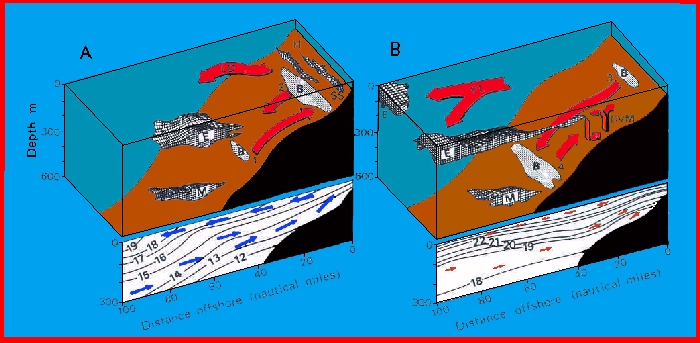
The conceptual life cycle of the red crab
Pleuroncodes planipes along Baja California |
|
|
|
|
|
|
TheAnomuran biology link |
|
|
|
G�mez, G.J., S�nchez, O.C. 1997. Larval drift and population structure of the pelagic phase of Pleuroncodes planipes (Simpson) (Crustacea: Galatheidae) off the southwest coast of Baja California, M�xico. Bull. mar. Sci. 61(2): 305-326. |
|
|
|
Abstract
Reproductive areas, larval and postlarval drift, and population structure of the red crab Pleuroncodes planipes (Stimpson) are described using samples obtained off the southwest coast of Baja California in May, June, August, and November 1986, July 1988, and September 1993. The highest abundance of larval and postlarval stages was found in May. Based on the ages of the most abundant postlarval stages, the most intense reproductive period was probably in January and February. The larval production recorded June to November indicated sporadic reproduction. We confirmed that the nearshore regions located near Bahia Magdalena 24 N and Punta Eugenia 28 N are the primary nursery areas. Seasonal hatching areas were in the vicinity of upwelling regions. Major production of larval stages starts in the south. At the end of the reproduction season, the highest abundance is in the north suggesting this species have a seasonal reproduction cline keyed to the normal upwelling cycle along the west coast of Baja California. From the hatching areas, a larval drift caused by offshore surface transport, in turn caused by the upwelling, was seen. A one-celled cross-shelf circulation is proposed to explain the offshore larval drift at the West Coast of Baja California. This process could play an important role in the recruitment of postlarval stages to the adult epipelagic population. Two size groups of adults were found along the water column. Both groups were found simultaneously only inshore and during the seasonal reproductive months (spring). The group of largest size found inshore is individuals of the benthic phase that may have migrated into the pelagic zone for reproduction. Using data of this study and the current available information, a conceptual model of the life history of P. planipes along the West Coast of Baja California is proposed. |
|
|
|
Conclusions. -We propose that the space-time variations of seasonal distribution and abundance of the planktonic stages of the red crab along the west coast of Baja California are a consequence of two important processes. First, the season and hatching areas showed a reproductive cline associated with regional oceanography. The most intensive reproduction starts along the southern part of the peninsula of Baja California (Bahia Magdalena). At the end of the reproductive season, reproduction is most intense in the northern area (Punta Eugenia). Second, a larval drift from the hatching areas caused by offshore Ekman transport of the coastal upwelling is an important mechanism for the recruitment of postlarvae into the epipelagic adult population. |
|
|
|
Advection phenomena as offshore transport, moving pelagic fish larvae away from their favorable habitats, was considered one of the most important factors in larval mortality. Dense offshore postlarvae swarms suggests offshore transport is a favorable factor for survival of P. planipes and plays an important role in the recruitment of postlarvae to the offshore pelagic aggregations. The spatial separation of the different life stages (planktonic, pelagic, and benthic phase) of these species may decrease the intraspecies competition for food and avoid a strong cannibalistic behavior. The particular life cycle of the red crabs, where its different larval stages remain spatially segregated, could explain how P. planipes is able to develop high concentrations within the southern Baja California upwelling system. |
|
|
|
 |
|
|
|
Figure 1. Conceptual model of the inshore-offshore movements during the life cycle of Pleuroncodes planipes along the West Coast of Baja California. (A) reproductive season (cool period, Jan-May) and (B) non-reproductive season (warm period, June to November). H = Hatching area, SS = Surface swarms (adults), LD = Offshore larval drift, PD = Offshore postlarval drift, EP = Epipelagic population (0 to 200 m), MP = Mesopelagic population (475 to 600 m) (Alvari�o, 1976), BP = Benthic population, DVM = Diel vertical migration. Benthic population: 1 = Offshore-inshore movement (Dec-Apr), 2 = Start of inshore-offshore movement (May), 3 = Inshore-Offshore movement (Jun-Nov), 4 = Start of offshore-inshore movement (Dec) (Aurioles, 1992). (figure taken from Gomez and Sanchez, 1997. Bull. Mar. Sci. 61(2): 305-326. |
|
|
|
 |
|
|
|
 |
|
|
|
|
|
Back to the euphausiid home page |
|
|
Back to the main red crab homepage |
|
|
|
|