- Components of DNA molecule
- Diester linkage between nucleotides
- Hydrogen bonding between two strands
- Twist in DNA strand and its causes
- Additional points
- Questions and their Answers

DNA molecule is made up of repeated units called nucleotides. It may also be called Polymer of nucleotides or poly-nucleotide chain, in fact there are two such chains joined by hydrogen bonding in one DNA molecule and each chain is called one strand of DNA.
Each nucleotides is made up of these units
- Pentose sugar
- Nitrogenous bases
- Phosphate
Pentose sugar
Pentose sugar is the name given to a sugar with 5-carbon and the sugar in DNA is deoxy-ribose. It is in the form of a 5-cornered ring but keep in mind that all five corners of ring are not occupied by the five carbon atoms but one is occupied by oxygen atom and so one carbon atom is out of ring.
The pentose sugar (de-oxy ribose) has two hydroxyl groups attached to carbon atoms.
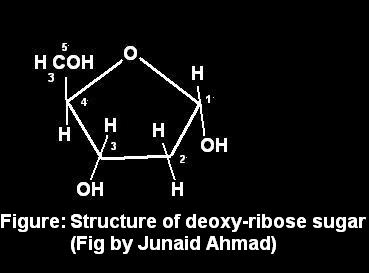
- Deoxy-ribose (with one less oxygen atom compared with ribose)
- Furanose (with five cornered ring)
- Pentose (with five carbon atoms)
Nitrogenous bases
There are four types of nitrogenous bases in DNA molecule which are Adenine,
Guanine, Cytosine, Thymine represented as A, G, C & T respectively.
These are arranged into two groups Purines and Pyramidines.
Purines are larger and composed of double rings. They include Adenine and Guanine.
Pyramidines are smaller, comprising of one single ring. They include Cytosine, Thymine & Uracil.
Uracil is not found in DNA.
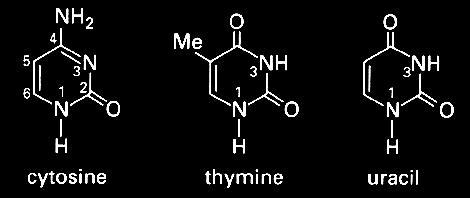
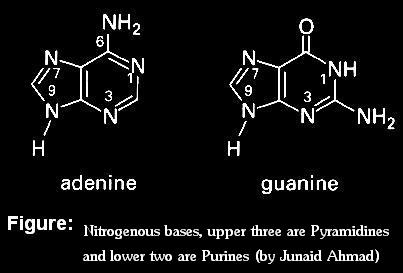
The structure having nitrogenous base attached to carbon number 1 (C1) of one deoxyribose sugar (which is a pentose sugar) by N-glycosidic bond, is called a nucleoside. If a phosphate is also attached to deoxyribose sugar then structure is called a nucleotide.
Names of different nucleosides present in DNA are given in table below
| Nitrogenous bases | Nucleoside |
| Adenine | Deoxyriboadeninic acid |
| Adenine | Deoxyri |
| Adenine | Deoxyr |
| Adenine | Deoxyr |
Nitrogenous bases are hydrophobic in nature and tend to stack on each other when free in solution. In DNA their direction is inward (of DNA molecule) so opposite to the watery contents of nucleoplasm (part of protoplasm present inside nucleus).
Phosphate
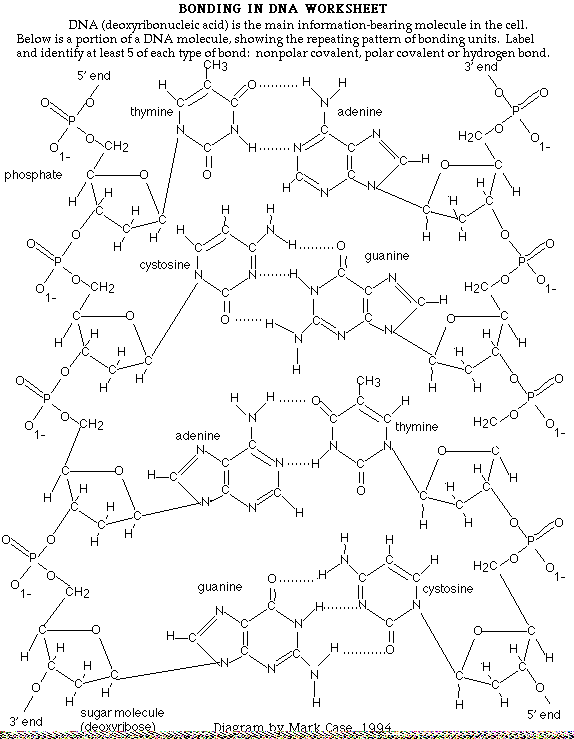
Phosphate or -PO4 links two nucleotides by diester linkage. One phosphorous (P) is attached with four oxygen (O) atoms. It has one double covalent bond with one oxygen atom and three single covalent bonds with three oxygen atoms (acidic in nature).
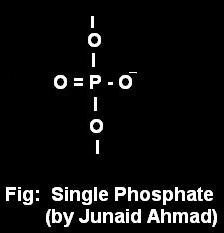
Free nucleotides contain either mono, di or triphosphates and represented as mono-, di-, or triphosphate forms of the nucleotides.
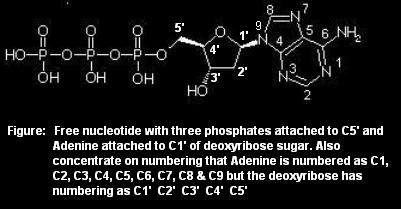
Numbering of Carbon chain in nucleotides
See the numbering of carbon atoms in deoxyribose sugar is C1, C2, C3, C4 & C5 but this numbering is changes in nucleotide to C1', C2', C3', C4', & C5' and read as "C1 prime" where as in nucleotide 1 is referred to the 1 of nitrogenous base.
Term Di mean two and ester is a group of organic chemicals in which two alkyl chains (-R) are attached to one oxygen atom.
Similar is the case in polynucleotide chain in which two adjacent nucleosides share same phosphate and are attached to the two oxygen atoms of same phosphate.
If we concentrate on one nucleotide (one nucleoside attached to one phosphate) in one poly nucleotide chain then we will see that C5' of pentose sugar is attached to one side of one Oxygen atom (O) and to the other side is present one phosphorous atom (P). Now consider the arrangement
| In esters | R-O-R |
| In a nucleotide | C5'-O-P |
The ester linkage is similar in both of them so the link between pentose sugar (in nucleotide) and phosphate is ester linkage.
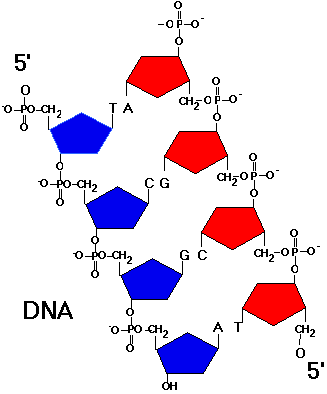
Now we consider two nucleotides in a polynucleotide chain. Both are attached to the same phosphate. The first nucleotide is attached to the phosphate by C5'-O-P ester linkage and second is attached by P-O-C3' ester linkage so the linkage between two nucleotides is diester linkage.
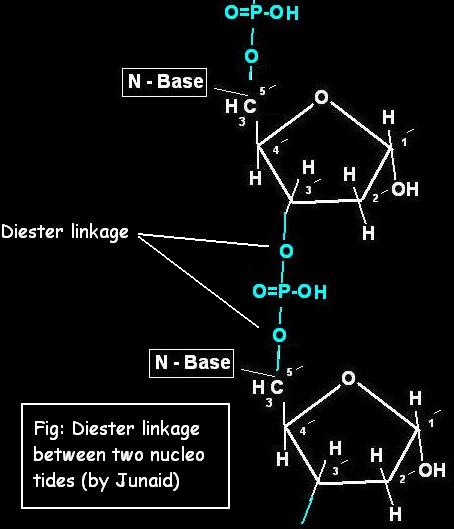
| In esters | R-O-R |
| In first nucleotide | C5'-O-P |
| In second nucleotide | P-O-C3' |
Where
R = alkyl group
O = oxygen atom
C5' = carbon number 5 of pentose sugar
C3' = carbon number 3 of pentose sugar
So in this manner a long polynucleotides chain is formed with nitrogenous bases at right angle to the direction of chain.
Two such polynucleotide chains are present in one DNA molecule held together by Hydrogen bonding
So far we have come to know the composition of one polynucleotide chain or one strand of DNA molecule. But actually DNA is composed of two such strands and they are held together by hydrogen bonding between nitrogenous bases of nucleotides.
The pairing of nitrogenous bases between two nucleotides is called base pairing and represented as bp.
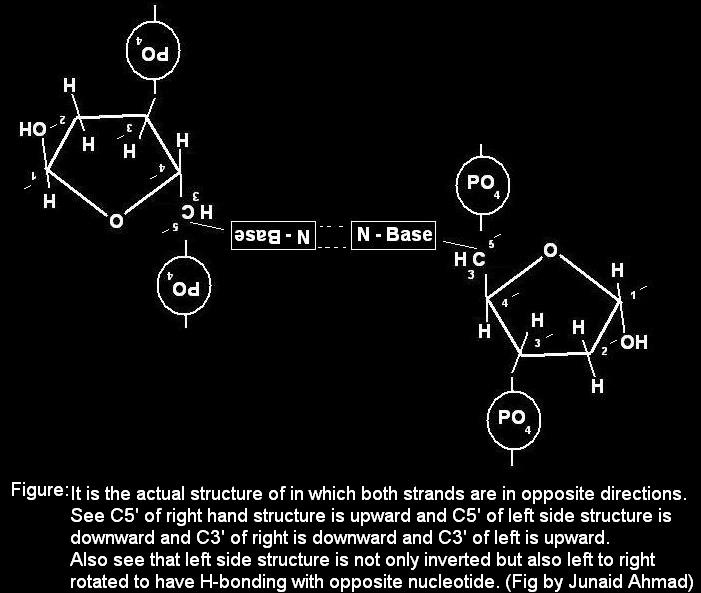
Now consider if both the nucleotides making H bonds (present in different strands) are in the same direction and the nitrogenous base is attaches on C1' of each deoxyribose sugar then they are not in close proximity to make H-bonding (see figure). So one of them must be rotated in some direction to make nitrogenous bases in contact. There are two possibilities to rotate
One is sidewise rotation, which will make nitrogenous bases in contact with each other
Second is inversion, which has no effect to make nitrogenous bases in contact with each other
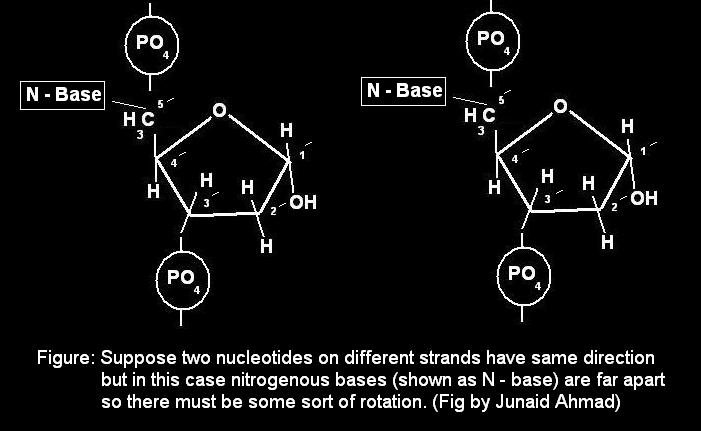
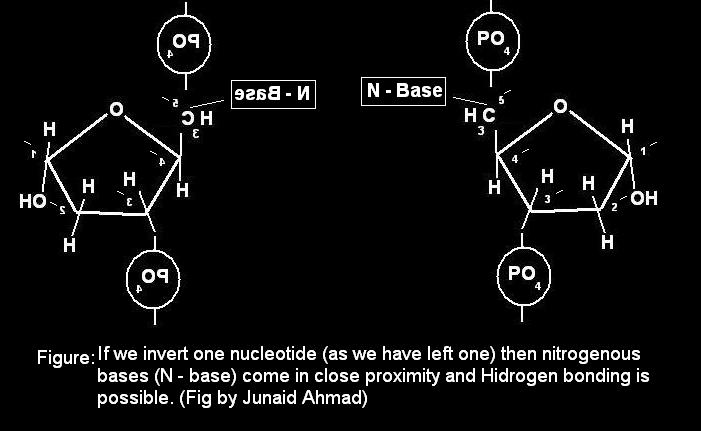
In real structure one nucleotide is not only side wise rotated but also inverted and in this way the C1' of one deoxyribose come close to C1' of other deoxyribose (present in other strand) where the nitrogenous bases are attached and they also come in proximity to make Hydrogen bonding as shown in figure.
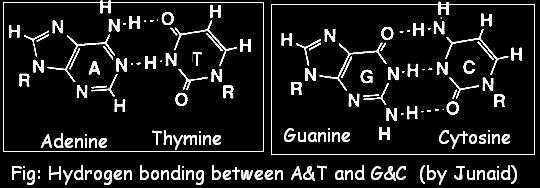
One of the base pair must be a purine and the other a pyrimidine for bonding to occur. Adenine always makes pair with Thymine by two Hydrogen bonds and Cytosine always makes pair with Guanine by three hydrogen bonds.
The hydrogen bonds are made between Oxygen & Hydrogen and Nitrogen &Hydrogen. One purine pairs with one pyramidine.
See the comlpete structure
(Torsion angle)
Now we have come to know that DNA molecule is composed of two polynucleotide chains attached with eachother by the hydrogen bonding between two nucleotides.
See another comlpete structure
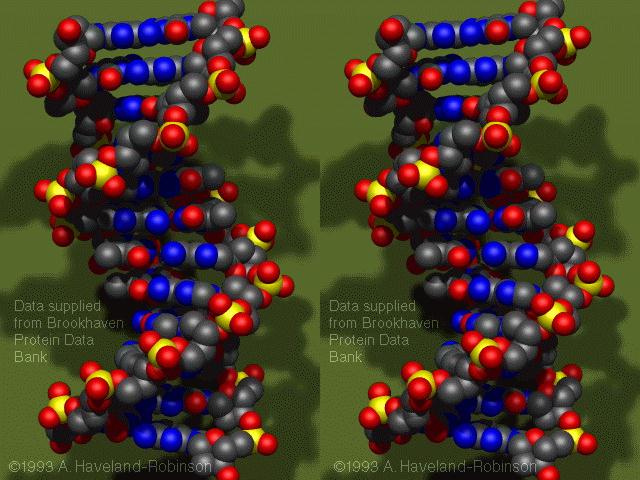
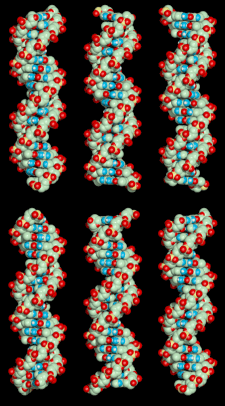
By research we have come to know that DNA double strand is twisted on its own longitudinal axis and looks like a twisted ladder. It can also be called as double helix.
Now will discuss that what is the cause of this twist and why it is not straight.
The answer is torsion angles between atoms of nucleotides.
Torsion angles are the angles between different planes of same molecule. If there are three atoms then we can have a plane containing all three atoms but if there is a fourth atom then it may or may not lie in the same plane. So in the case of four atoms not in same plane we can draw at least two (there may be more than two) planes to describle position of these four atoms and angle between these planes is called torsion angle.
Look in figure below that atoms of deoxyribose sugar (pentose sugar of DNA) do not lie in same plane so many torsion angles.
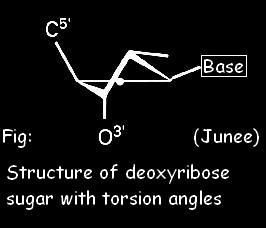
In this way there is a bit rotation in each nucleotide which is equal to 34 degree and we know that a complete circle has 360 degrees so after 10.5 nucleotides there completes one twist in DNA.
Here are some important points.
- The rotation in DNA molecule is right handed just like the a -helix structure of proteins.
- Each nucleotide has nearly 34 degree of rotaion so one twist completes after 10.5 nucleotides.
- Due to twis two stands of DNA are coiled like twists in a two ropes and cannot be simply separated.
See atomic model of DNA
- Supercoiling during replication
The replication of DNA is not easy due to coiling of two strands and before separation of two strands uncoiling is brought about by the help of special enzymes but this uncoiling makes more coiling in remaining strand i.e. supercoiling. This supercoiling is relaxed by some other enzymes which cut one or both strands and then seal them again after relaxation most of them use no extra energy. - Hydrogen bonding in RNA
RNA unlike DNA makes hydrogen bonding with itself between apropriate nitrogenous bases ( A&U and C&G) and make tertiary structures and looping around itself.
Q. Are the DNA molecules of all human beings exactly alike?
No! they differ in the sequence of nucleotides e.g. one has sequence CGAA and other may have CGAC and these differences bring difference in individuals like face, habits, etc.
Q. Who discovered structure of DNA?
'Watson and Crick model of DNA' is best to explain DNA structure.
Question me at [email protected]
My other topic SARS an RNA virus