| Before my nephew decided to quit
the cruising life and return to the frozen North, turning me into a solo
sailor, he asked if I could handle the boat alone. In what I hoped
was a confident and off-handedly casual way, I said I could.
Actually, I had only run the boat alone twice before, for a grand total of maybe 5 miles, all on inland, protected waterways. I had also managed to 'touch bottom' for about an hour one of those times. I was not going to tell him that. If he wanted to quit, fine; let him quit, I would go on alone. A bit more experience and preparation would probably have been preferable before undertaking a fifty-eight mile open ocean crossing as my first attempt at handling a 34 foot sloop alone. But I had a record of such foolishness. Remember, the first time Cynthia and I had ever sailed on the open ocean had been a midnight crossing of the Gulf Stream.... But I had been in the Abacos too long, and my buddy boat for the crossing, Querro II, was ready and the weather forecast was as good as it gets for such a crossing in the winter months. Everything was ready but me, so I became ready, too. So one early January morning I
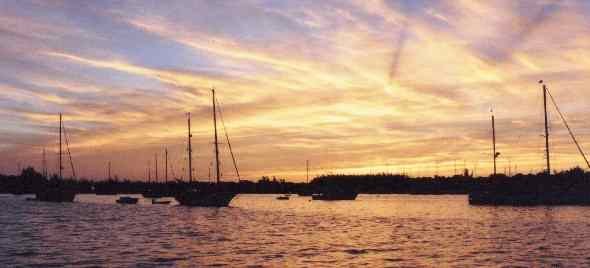
awoke, alone on the boat, bobbing gently at anchor in Marsh Harbor.
It was early and I lay in bed staring at the bulkhead trying to figure
out how I would go about weighing anchor alone without
And if I managed that, how was I going to dock alongside the fuel pier without crashing? How could I get the sails up alone? And on and on... The only decision I came to that seemed to make sense was to do it, to go about my tasks in a deliberate and controlled manner. Not to rush, not to panic; not to look like an out-of-control first time solo sailor. Not to panic. Eventually I got up, made pancakes and coffee as usual, raised the anchor and motored over to the fuel dock, tossed them my lines, tied up and jumped ashore. No problems yet.
After we had chatted a while Dave said he was impressed that anyone (me?) could or would handle "such a big boat" alone. This gratified me. It also worried me. Dave is far more experienced a sailor than I. I decidedly did not want to do anything that would in the least impress him.
I chose not to try the narrow and shallow channel (charted at 3 feet, mean low tide) and anchored out along Lyman Cay. I spent a couple of hours sipping scotch and watching range markers ashore before I believed the anchor would hold, then made supper, listened to the weather forecast, and went to bed. At seven the next morning we met up just inside the bar to the inlet and headed out the cut and South towards Royal Island, 58 miles and about nine hours away. The weatherman's promise of winds at 10 to 15 knots from the Northeast and 4 to 6 foot swells met us along with full daylight. A lovely, promising day for our run South. There was no reason then to suspect that the weatherman had lied yet again and that things would deteriorate as the day wore on.
By the times the winds backed to the North, dead astern, and began to pick up towards 15 knots apparent (twenty knots true) Querro was a couple of miles ahead. The swells running in from the northeast were now being topped with little foothigh wind waves running diagonally across them. This was the beginning of what is known in the business as a confused sea. The swells themselves are building,
the outfall from a cold front a hundred or more miles away, yesterday,
last night. The ride is becoming clearly an up and down ride as I
cut across the swells at a 45 degree angle.
In the early afternoon the winds rise to a bit over 20 knots apparent, and gusty. The seas are now 10 to 12 feet and still building.
It's rhythmical. This sort of thing causes some people digestive problems. I cannot see Michael's sails any longer, nor raise him on the radio. The up and down of the swells is large enough now to hamper communication and vision. It's hard to see much beyond the last swell and the one coming on. At the crests the horizon is defined as a wavy carpet spread out forever. A huge dark piece of wide wale corduroy, or the Allegheny mountains seen from an airplane.
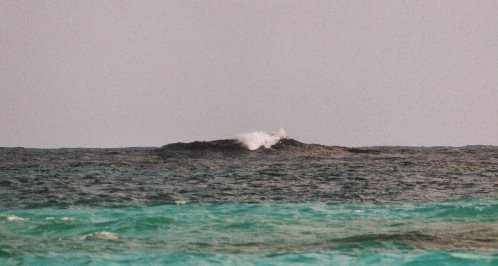
A little after 2 PM a sharp gust makes a tear in the center reef point on the main. I immediately head up and luff. The seas toss us about as the jib flaps back and forth and the boom makes short little boxer jabs at my head. I try to figure out what to do to save the mainsail without placing the boat in danger. The autopilot comes to mind and is discarded. It had become somewhat more than a little temperamental back in November, but we were sailing the short, flat, protected runs of the Sea of Abaco then, and it was no big deal. I had looked at it halfheartedly one day, but found nothing particularly wrong with it. It just seemed inhabited by a demon which liked company. In mild winds the autopilot would hold as long as someone was in the cockpit, actually sitting behind the wheel. As soon as you went on deck to tighten a line, or went below for a drink, it would cease to hold and the boat would begin to slew around. The problem had not cured itself. I try it, but every time I start out of the cockpit the autopilot goes crazy and the boat tosses me about. But I have to do something or else the wind will shred my mainsail. I try wedging the autopilot's drive wheel, but it torque's out. I try tightening down the steering wheel's lock to ad resistance to the wheel's turning. No joy. Every time I get one foot on the coaming the boat comes about and either swings wildly or just sits broadside to the waves. Wandering aimlessly about in 12 foot seas is not a particularly inviting idea. Sitting broadside to them invites serious problems involving calculations of the righting moment of the 7000 pounds of ballast and estimates of how long it would take for the boat to right itself if it went over. I've dropped the main and now am trying to figure out how much water they would scoop up if the boat were knocked down... Finally I remembered reading about 'heaving to,' in which you backwind the jib and turn the rudder the opposite way and lock it in place. The wind tries to force the boat to turn one way and the rudder tries to turn it the other way and you are supposed to end up facing more or less into the wind and jogging sideways across the waves. It works exactly as advertised. It took some experimentation and a bit of loosely controlled wandering about before I got the jib adjusted to offset the rudder, but eventually we were riding about 25 degrees off the wind and about that off the seas, just sort of bobbing there like a cork. I put on a second tether (on the open ocean I wear my life vest, harness, and tether at all times -- there's no-one to come get me if I fall off) and crab-walk forward with a handful of bungy cords. I wrestle the main into a lumpy package and bungie it up and am back in the cockpit in five minutes. Five fairly slow and long minutes. A few new bruises, no injuries. The rest of the crossing is just plain work. motoring and trying to maintain a decent course over the swells, one that will get me past the shoals and coral reefs and into safe anchorage before dark. I stand and hand steer for the better part of ten hours. I keep the rhythm of the waves much better when I stand. The only diversion in the gray day came about an hour out of Royal Island. In the distance - and I cannot guess how far or near - I see a whale sound and flip its tail and disappear. I silently urge it to be going the other way. Any other way. I've had enough excitement for my first day of solo sailing on the open ocean. I do not need a close brush with a nearsighted, amorous whale. Royal Island crawls up out of the sea ahead and its immense bank of off-lying coral reefs become of more immediate concern. The seas lay down to a very polite three or four feet, but become sharper and choppier. Then I run into an unexpected counter current that feels like suddenly putting on the brakes. My speed over the ground goes from six knots to about two. At two knots I will still be out here when the moon comes up, if it comes up.
I get into Royal at about dusk, with the wind up strongly now and nasty cold. The harbor is a huge elliptical pond with a narrow entrance. We are protected from the nastiness outside. There is no development at all in this nearly perfect harbor. There are a handful of old moorings. Querro II has picked one up but has also dropped an anchor of its own to go with it. I anchor nearby, do some general tidying up and get the dingy down. Michellene has a drink and supper ready when I dingy over. I down the one and then the other, glossing over my delay and hiding my dismay at their performance in the role of buddy boat. I eat with one eye on C's Choice. The anchor has not been down long enough for me to be convinced it is going to hold. It generally takes me about 12 hours to gain any great measure of confidence in an anchorage. After agreeing to confer in the morning about heading out further south, to Current Cut and beyond to Hatchet Bay, I get into Lucky Runner, putt putt over to C's Choice and go to bed.
Around midnight I am awake and on deck. There's a full moon. The eight or ten boats bobbing in the harbor with us are quietly lit. The wind has clocked around to the East and is dying off. Ragged bits of cloud come and go across the moon. It is peaceful and pretty and
by damn I just made the longest and hardest crossing of the trip.
Alone. A couple of problems, sure. But looking back it does
not seem a big deal. The anchor is holding. I finish my scotch, nod
my head a couple of times, then go to bed.
|
 While
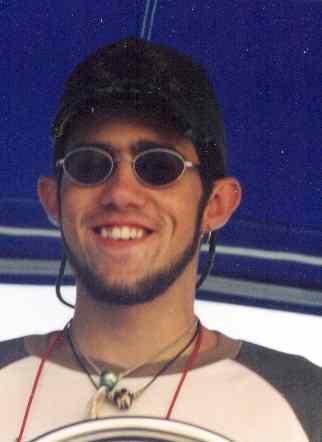
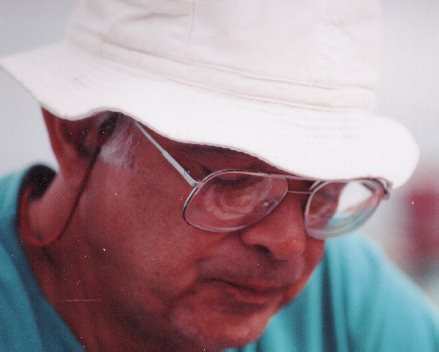
fueling up and taking on fresh water, Dave Fleming, the bearded single-hander
on Cloud Nine, wandered up the dock for a chat. Dave had sailed his
26 foot sloop alone from Niagara-on-the-Lake, Ontario, down the Atlantic
seaboard and across the Gulf Stream to Marsh Harbor, alone. He has
all my
While
fueling up and taking on fresh water, Dave Fleming, the bearded single-hander
on Cloud Nine, wandered up the dock for a chat. Dave had sailed his
26 foot sloop alone from Niagara-on-the-Lake, Ontario, down the Atlantic
seaboard and across the Gulf Stream to Marsh Harbor, alone. He has
all my
 I
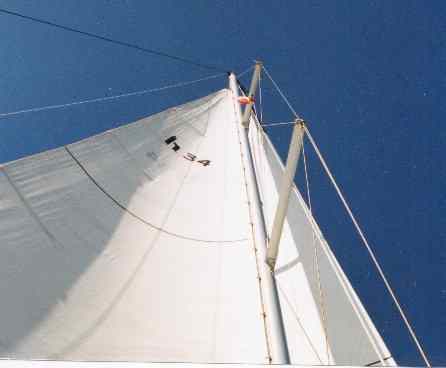
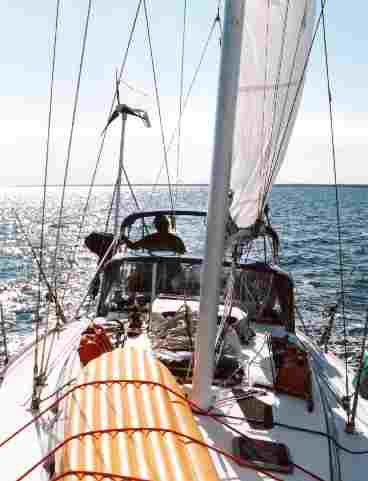
had the same sailset as the day before, a reefed main and the working jib
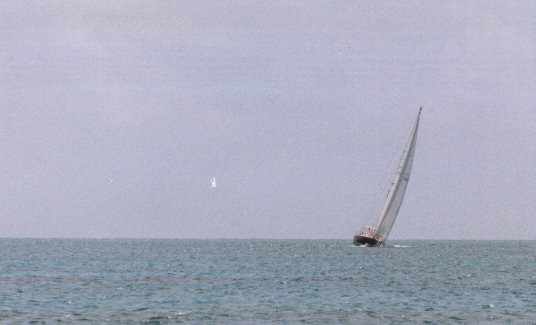
full out and sheeted wide. Querro II and C's Choice bobbed along
at 6 knots or so, side by side a couple of yards apart. I drank my
coffee and chatted with Michael. Once we got out onto the open sea
the waves got up a bit more and Querro pulled slowly ahead.
I
had the same sailset as the day before, a reefed main and the working jib
full out and sheeted wide. Querro II and C's Choice bobbed along
at 6 knots or so, side by side a couple of yards apart. I drank my
coffee and chatted with Michael. Once we got out onto the open sea
the waves got up a bit more and Querro pulled slowly ahead.
 For
those who don't sail, imagine you are sitting in a chair in the middle
of an average living room. Look to your left where the wall meets
the ceiling, then to your right. That's about what a 12 foot wave
looks like from the deck of the boat. The deck is about 4 feet or
so above the waterline. The swells are a bit farther apart than your
walls, maybe twice that. You just ride up and down that high in that
length of time and space. Don't worry, the waves are not breaking.
We are swaying pretty much side to side, but it's still pretty smooth.
For
those who don't sail, imagine you are sitting in a chair in the middle
of an average living room. Look to your left where the wall meets
the ceiling, then to your right. That's about what a 12 foot wave
looks like from the deck of the boat. The deck is about 4 feet or
so above the waterline. The swells are a bit farther apart than your
walls, maybe twice that. You just ride up and down that high in that
length of time and space. Don't worry, the waves are not breaking.
We are swaying pretty much side to side, but it's still pretty smooth.
 Some
buddy boat, I think. Good thing there's no problem, I think.
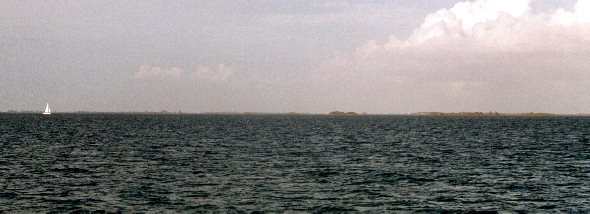
There's a ketch about two miles back, under full sail and headed more or
less along my trail; help, if I need it. Maybe.
Some
buddy boat, I think. Good thing there's no problem, I think.
There's a ketch about two miles back, under full sail and headed more or
less along my trail; help, if I need it. Maybe.
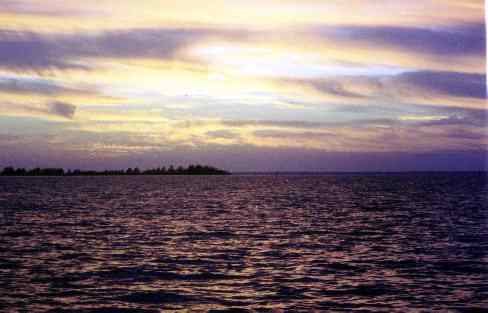 In
ten minutes I am free of the current and back up to speed and into the
rhythm. Markers appear, and lobster pot buoys. Chart in one hand
and binoculars in the other I pick my way around to the sheltered southern
side of the island. About half an hour out of the harbor I call Querro
and check in. They are at anchor, awaiting me.
In
ten minutes I am free of the current and back up to speed and into the
rhythm. Markers appear, and lobster pot buoys. Chart in one hand
and binoculars in the other I pick my way around to the sheltered southern
side of the island. About half an hour out of the harbor I call Querro
and check in. They are at anchor, awaiting me.