Naomi Quiñonez
anthologies/journals
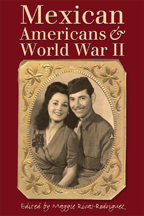
Mexican Americans & World War II
Up to 750,000 Mexican American men served in World War II, earning more Medals of Honor and other decorations in proportion to their numbers than any other ethnic group. Mexican American women entered the workforce on the home front, supporting the war effort and earning good wages for themselves and their families. But the contributions of these men and women have been largely overlooked as American society celebrates the sacrifices and achievements of the "Greatest Generation." To bring their stories out of the shadows, this book gathers eleven essays that explore the Mexican American experience in World War II from a variety of personal and scholarly perspectives.
The book opens with accounts of the war's impact on individuals and families. It goes on to look at how the war affected school experiences; how Mexican American patriotism helped to soften racist attitudes; how Mexican Americans in the Midwest, unlike their counterparts in other regions of the country, did not experience greater opportunities as a result of the war; how the media exposed racist practices in Texas; and how Mexican nationals played a role in the war effort through the Bracero program and through the Mexican government's championing of Mexican Americans' rights. As a whole, the collection reveals that World War II was the turning point that gave most Mexican Americans their first experience of being truly included in American society, and it confirms that Mexican Americans of the "Greatest Generation" took full advantage of their new opportunities as the walls of segregation fell.
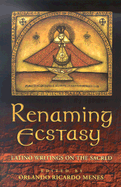
Renaming Ecstasy
"Renaming Ecstays brings together poets who have explored experiences of the sacred in ways that are unique to Latin American culture and highlights the richness and complexity of Latino spiritual life. Because of Latin America's "mestizaje of cultures, traditional Catholicism exists alongside other practices of African or indigenous origin. In their invocation of the divine, poets of Caribbean origin draw inspiration from the myths and practices of Santeria. Others write devotionally about topics that engage Latino Catholics: the matter of religious vocation and those devotional practices that connect individuals to the community and give shape to their daily lives. The collection features poetry by Naomi Quiñonez , Benjamin Alire Saenz, Victor Hernandez Cruz, Demetria Martinez, Orlando Ricardo Menes, and Virgil Siarez, among others.
From Totems to Hip-Hop
Ishmael Reed, an accomplished and prolific poet, novelist, essayist, playwright, and editor, as well as a teacher and MacArthur fellow, rejects the idea of a narrow and calcified canon of American literature, asking, "Can you imagine where science would be had scientists refused to budge from accepted theories?" Indeed, American poetry is always a work-in-progress, and Reed's in-touch and open-minded approach in From Totems to Hip-Hop yields a dynamic and original anthology, an unprecedented amalgam of poets representing many facets of American culture and society. Even Reed's organizing categories are pertinent and stimulating: nature and place, men and women, family, politics, and heroes and sheroes, anti and otherwise. Within these arenas, readers will find poems by Sylvia Plath, Yusef Komunyajaa, Thulani Davis, Bob Holman, Jayne Cortez, Diane Glancy, Garrett Hongo, Charles Simic, Al Young, Naomi Quiñonez, Nellie Wong, Tupac Shakur, and many others. Reed then sagely concludes with an invaluable selection of eloquent and challenging manifestos and poetic commentaries. Donna Seaman
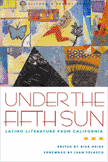
Under the Fifth Sun: Latino Literature from California
Here is a fresh, vigorous body of work, ranging from Jaime de Angulo’s visions of Spaniards and Indians to the classic Chicano novels of José Antonio Villarreal and Raymond Barrio, and from the nineteenth-century childhood memories of Ygnacio Villegas to the contemporary poetry of Michele Serros.
Under the Fifth Sun collects stories of love, family, work, exploration, politics, history, culture, and survival—fiction, poetry, memoirs, commentary, and drama—covering more than two centuries of Latino presence in California, from missionaries and soldiers to gold miners, farmworkers, and political refugees. Most of these well-crafted and vivid works remain outside the mainstream of popular literature—yet anyone who reads them will gain a better understanding of our collective history and present-day culture.
A celebration, an outcry, a revelation, and a powerful reading experience, this anthology ranges from naturalism to magical realism, from lyric poetry to detective fiction, with works by Francisco X. Alarcón, Isabel Allende, Lorna Dee Cervantes, César Chávez, Francisco Jiménez, Graciela Limón, Juan Marichal, Pablo Neruda, Naomi Quiñonez, Gary Soto, Luis Valdez, Alma Luz Villanueva, and many others.
Decolonial Voices
Decolonial Voices offers a range of interdisciplinary essays that discuss racialized, subaltern, feminist and diasporic identities and the aesthetic politics of hybrid and mestiza/o cultural productions. In doing so, this volume brings together a body of theoretically rigorous interdisciplinary essays that articulate and expand the contours of Chicana and Chicano cultural studies.
Essays on transnational Chicana and Chicano cultural studies, examining a range from music, feminist historiographies, poetics, digital art, and popular cultures.
The interdisciplinary essays in Decolonial Voices discuss racialized, subaltern, feminist, and diasporic identities and the aesthetic politics of hybrid and mestiza/o cultural productions. This collection represents several key directions in the field: First, it charts how subaltern cultural productions of the US/ Mexico borderlands speak to the intersections of "local," "hemispheric," and "globalized" power relations of the border imaginary. Second, it recovers the Mexican women's and Chicana literary and cultural heritages that have been ignored by Euro-American canons and patriarchal exclusionary practices. It also expands the field in postnationalist directions by creating an interethnic, comparative, and transnational dialogue between Chicana and Chicano, African American, Mexican feminist, and U.S. Native American cultural vocabularies.
Infinite Divisions
An Anthology of Chicana Literature
Given the explosive creativity shown by Chicana writers over the past two decades, this first major anthology devoted to their work is a major contribution to American letters. It highlights
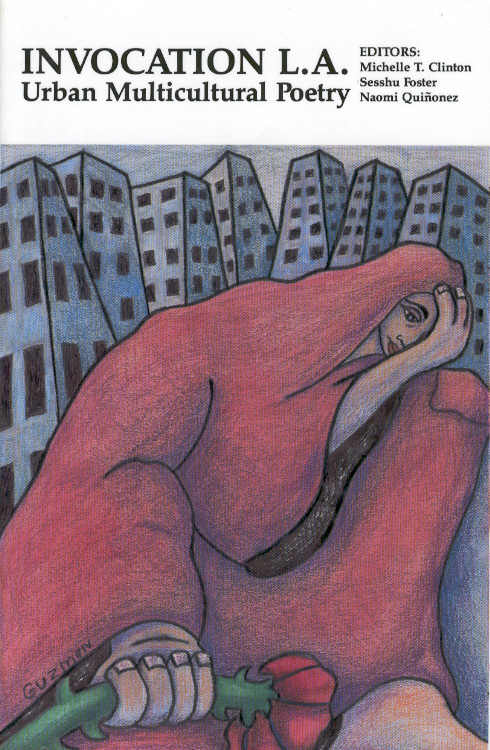
Invocation LA
Edited by Michelle T. Clinton, Sesshu Foster, and Naomi QuiñonezAs Ryzsard Kapuscinski reported in the New Perspectives Quarterly, "Los Angeles is the premonition of a new civilization. Linked more to the Third World and Asia than to the Europe of America's racial and cultural roots, Los Angeles will enter the 21st century as a multiracial and multicultural society.”
If this thesis is correct, the young poets in this anthology are the voices of the future, voices of an entirely new, Western but Eurocentric, culture.
LA has a poetry scene that never quits, and while this anthology was not edited to be entirely representative of that literary scene, this is the first anthology that truly represents the multicultural character of the city.
These poets are thus poets with a future. Their grasp of the incandescent and often bitter present moment propels them towards it. Their velocity won’t leave you unmoved.
More than half of this work is written by women, who, urged on the feminist movement of the seventies, speak confidently and clearly to indict patriarchal cultural assumptions.
These poets are thus doubly grounded in tough conditions, and their poetry will not be denied.
As one would expect of urban poetry, the images are not always pretty or painless, but there is a metaphor o hope etched in these pages by women and men who are not afraid of contradiction or struggle.
These poets make bold statements of survival, not so much in celebration, but in challenge. The book is a testimony to America’s growing multicultural literary talents.
In short, this is “Our America,” and America whose poets do represent that vital, resonant wave that’s coming at you.