This page is a translated archive of the original Académie des jeux oubliés, created on July 1, 2026, from the French original at salondesjeux.fr.
|
This page is a translated archive of the original Académie des jeux oubliés, created on July 1, 2026, from the French original at salondesjeux.fr.
|
|
Toutes tables, or Toute table, is the old French name for backgammon. Mentioned by Rabelais, its rules were written down in 1699 in a sequel to a treatise on trictrac published in Paris by Charpentier. Since the fall of Napoleon Bonaparte in 1815, the English name backgammon has prevailed. What makes backgammon such a strong game is the starting position of the checkers, which allows players to be immediately in the action. Because of this situation, a good knowledge of all the possible openings following the first dice rolls is necessary if one wants to have an advantage over a player who does not know them, or at least hold one's own against another who has studied them. Bobby Fischer, in order to offset the excessive importance of openings in chess, but above all the standardization of the opening moves brought about by their being well known to seasoned players, invented a variant called Chess960, in which the starting position of the pieces is chosen at random following a simple procedure offering 960 configurations Very humbly, and just for fun, it seemed interesting to me to apply this idea to backgammon, in order to give it renewed appeal through new situations for experienced players, and to give beginners a fresh chance. I took the opportunity to revive the old name Toutes tables by naming this variant Toutes tables 225 . The principle, for each game, is to randomly draw the starting positions of the checkers according to a simple rule that generates 225 different starting positions. In this way, learning the openings becomes almost pointless, and one can focus on the very essence of the game. Otherwise all the other rules of Toutes tables apply, returning to an uncompromising game as it is played in chess, checkers, or trictrac. It is of course possible to keep the full rules of backgammon while adopting the random choice of starting position for the checkers, this variant then taking the name Backgammon 225 .
Equipment
- A
board with 24 points, grouped into four quadrants of 6 points ; The board is also called a tablier. A backgammon board will do.
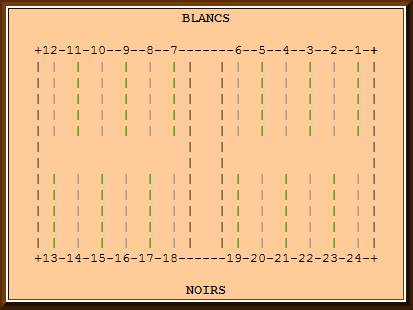
1) A player rolls the dice onto the board
using their dice cup, until obtaining a simple roll (two different
numbers) : 2) The second player does the same :
The
lower die indicates the location, within the 12-7 quadrant,
of the five black checkers, and the higher one indicates that of the three white checkers. A 1 (ace)
shown by a die corresponds to point 12 and a 6
to point 7.
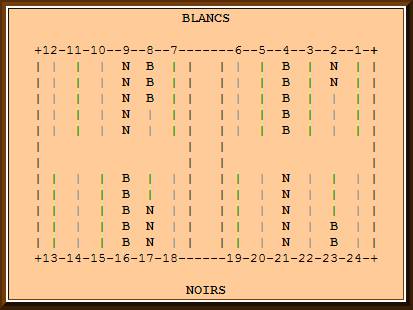
Path of the checkers
On
a point that has a square, the checkers from the third one onward
are called oversquares.
To be the first to bear all one's checkers off the board after having brought them all into one's return jan.
To
determine which player will roll the dice for the first move of the game,
If, on a roll of the dice, at least one of them lands off the board or ends up on one of the strips, the roll must be made again entirely. If a die ends up tilted and the players cannot agree on the value shown, the roll must be made again entirely. If one of the players maintains that the die is valid, he may perform a test consisting of placing another die on top of the die being tested: if the test die slides off, the dice must be re-rolled, otherwise the roll is deemed valid. This test may be carried out only by the player claiming that the die is valid, and not by the one disputing it. If one die ends up resting on the other, the roll must be made again. Dice lying flat on top of checkers are valid.
1. On a simple roll (the 2 dice show different numbers) one may : - either move one checker by the value of one die and a second checker by the value of the other die,
-
One
plays the value of a die 4 times, which allows one to move from one to four checkers.
3.
« Touched checker:
played checker »
If one can play either of the two dice but not both, one is required if possible to play the higher one. This is the reason why, after rolling the dice, one announces the dice starting with the higher one (for example « 4 and 2 » rather than « 2 and 4 »). The « 1 » is not called « one » but « Ace ». Announcing the dice is, however, not compulsory. In the case of a double one must play the maximum number of points possible (while remaining, of course, within a whole multiple of the value of a die.
A checker may never stop or even rest on a point occupied by more than one opposing checker.
When a checker rests or stops on an isolated opposing checker (half-square), it is hit. It is taken out of play and placed on the middle strip of the board (bar) on the opponent's side, by the attacker.
Checkers sent to the bar must all re-enter through the small jan before one can continue playing those which have not been hit or those which have just re-entered. The rules for moving and hitting checkers remain applicable when re-entering checkers.
Once all 15 checkers have reached the return jan, checkers are borne off the board according to the following rules : In this phase, the outer edge of the board is treated as an additional point. One is required, if possible, to play one's checkers onto the points of the return jan and the outer edge.
If
it is impossible to play as above, one plays with the checkers furthest
from the edge, bearing them off
the board.
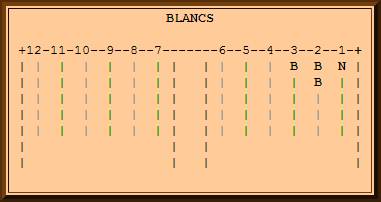
How one plays in backgammon
White
plays his ace with the checker on the third point, stacking it onto
the second point (forming an oversquare), then he plays his six by bearing off a checker from the second
point.
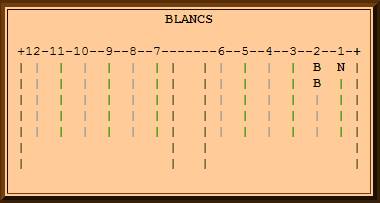
By
playing this way, White avoids exposing himself. He has granted himself
a privilege consisting of not playing the maximum possible number of points
shown by the dice, in order to obtain a favorable position. This is not
allowed in Toutes tables.
White
plays his ace with a checker from the second point, hitting the
black checker, then he plays his six by bearing off a checker from the second point.
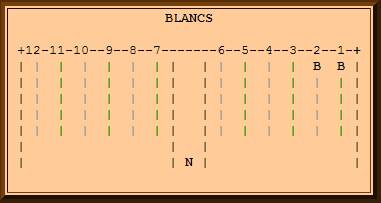
A player who has borne off their fifteen checkers while their opponent has all their checkers in their return jan, or has already borne off at least one, scores a single game (1 point). A player who has borne off their fifteen checkers while their opponent has not borne off at least one checker, or does not have all their checkers in their return jan, scores a double game (2 points). The players must agree at the start of play on the number of points a player must reach in order to win. Until this point total has been reached, each player will begin a game with the same starting position, then a new starting position will be drawn at random and used by both players. The starting position will therefore be redefined every two games.
References for the game of Toutes Tables
s.n., Suite du jeu de Trictrac, règles du Toute-Table, Charpentier, Paris, 1699
P.M. Lepeintre, Cours complet de Trictrac avec un abrégé du Gammon, du Jacquet et du Garanguet, chez Guillaume, Paris, 1818
Guiton l'aîné, Traité complet du jeu de Trictrac, chez Barrois l'aîné, Paris, 1822
Information about this page
Published
online on 6 February 2008 Le Salon des jeux - Académie des jeux oubliés

|