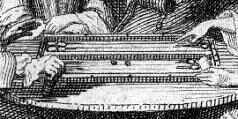
The Tourne Case


The
game of Tourne Case, like that of Dames Rabattues, is a small table game whose rules were published in a book issued
in Paris by Charpentier in 1699. The particular use of the two dice
introduces an element of reasoning.
1. Equipment
A board with 24 points, also called
« squares », grouped into four quadrants of 6 points.
3 dark checkers and 3 light checkers.
2 dice (the players use the same dice).
2 dice cups (one per player).
The
board is called a « tablier » in the sense that it holds the « tables »
(an old name for the checkers). A Backgammon set will do.
2. Starting Position
Each player places their three
checkers outside the board, on their own side, as shown
in the figure below :
WHITE
+-1--2--3--4--5--6----7--8--9-10-11-12-+
W | | | | | | | || | | | | | | |
W | | | | | | | || | | | | | | |
W | | | | | | | || | | | | | | |
| | | | | | | || | | | | | | |
| || |
| || |
| || |
| | | | | | | || | | | | | | |
B | | | | | | | || | | | | | | |
B | | | | | | | || | | | | | | |
B | | | | | | | || | | | | | | |
+-1--2--3--4--5--6----7--8--9-10-11-12-+
BLACK
|
The dotted lines represent the points.
3. Object of the Game
Be the first to bring your three
checkers to your twelfth point.
You only play on your own side.
4. Dice
Priority
To
find out which player will roll the dice for the first move of the game, each player rolls one die;
Whoever rolled the higher number takes
both dice again to roll them and start the game.
5. Validity
of the Dice
If, on a roll of the dice, at least one of
them lands outside the board or ends up on one of the rails,
the whole roll must be taken again.
If a die ends up tilted and the players
cannot agree on the value shown, the whole roll must be taken
again.
If one of the players maintains that the die is valid, he may carry out a
test by placing another die on top of the die being tested: if the test die slides off,
the dice must be re-rolled, otherwise the roll is deemed valid. This test may only be carried out
by the player claiming the die is good, not by the one disputing it.
Dice that land flat on top of checkers are valid.
6. Different
Kinds of Dice Rolls
Simple roll: the two dice show different
values.
Doublet: the two dice show the same
value.
7. Names
Given to Doublets:
In
the old days, players used to announce doublets as follows:
Doublet
of:
6 : « Sonnés »
5 : « Quines »
4 : « Carmes »
3 : « Ternes »
2 : « Double Two »
Ace : « Bezas »
8. General
Rules
On a simple roll, only the lower die is
played. The higher die is not used. (see)
On a doublet, only one die is played, and there is no replay.
Points « 1 » to « 11 » may hold only a single checker.
The twelfth point may hold all three checkers.
Passing beyond one's own checkers is forbidden.
When a checker is brought face to face with an opposing checker,
the latter is removed from the board and must start its journey over.
A checker may only be placed on the twelfth point if the
exact number of points needed to reach it has been rolled (remember : only the lower
die is used).
If it is impossible to play, the turn is passed.
« A touched checker must be played », if this can be done legally.
Example
:
The
« White » rolls « 4 and 3 » for the first move of the game
: they bring a
checker onto their third point, and must not play the « 4 » :
WHITE
+-1--2--3--4--5--6----7--8--9-10-11-12-+
W | | | W | | | || | | | | | | |
W | | | | | | | || | | | | | | |
| | | | | | | || | | | | | | |
| | | | | | | || | | | | | | |
| || |
| || |
| || |
| | | | | | | || | | | | | | |
B | | | | | | | || | | | | | | |
B | | | | | | | || | | | | | | |
B | | | | | | | || | | | | | | |
+-1--2--3--4--5--6----7--8--9-10-11-12-+
BLACK
|
The
« Black » rolls « Bezas » (double aces): they bring a checker onto
their first point and must not play the second ace.
WHITE
+-1--2--3--4--5--6----7--8--9-10-11-12-+
W | | | W | | | || | | | | | | |
W | | | | | | | || | | | | | | |
| | | | | | | || | | | | | | |
| | | | | | | || | | | | | | |
| || |
| || |
| || |
| | | | | | | || | | | | | | |
| | | | | | | || | | | | | | |
B | | | | | | | || | | | | | | |
B | B | | | | | || | | | | | | |
+-1--2--3--4--5--6----7--8--9-10-11-12-+
BLACK
|
The
« White » rolls « 5 and Ace » : they choose
to bring a checker onto their first point. Instead of bringing in a
checker, they could have advanced the one on the third point to the
fourth. The rule forbids them from playing the « 5 ».
WHITE
+-1--2--3--4--5--6----7--8--9-10-11-12-+
W | W | W | | | || | | | | | | |
| | | | | | | || | | | | | | |
| | | | | | | || | | | | | | |
| | | | | | | || | | | | | | |
| || |
| || |
| || |
| | | | | | | || | | | | | | |
B | | | | | | | || | | | | | | |
B | | | | | | | || | | | | | | |
B | | | | | | | || | | | | | | |
+-1--2--3--4--5--6----7--8--9-10-11-12-+
BLACK
|
The
« Black » rolls « Sonnés » (double sixes): they bring a
checker onto the sixth point.
WHITE
+-1--2--3--4--5--6---------------------+
W | W | W | | | || | | | | | | |
| | | | | | | || | | | | | | |
| | | | | | | || | | | | | | |
| | | | | | | || | | | | | | |
| || |
| || |
| || |
| | | | | | | || | | | | | | |
| | | | | | | || | | | | | | |
B | | | | | | | || | | | | | | |
B | | | | | | B || | | | | | | |
+-1--2--3--4--5--6---------------------+
BLACK
|
The
« White » rolls « 3 and 2 »: they cannot bring in a checker,
since the checker occupying the first point blocks the pass.
The checker on the first point cannot move to the third
point, which is already occupied. They therefore advance their
checker from the third to the fifth point (the « 3 », of course,
is not played).
WHITE
+-1--2--3--4--5--6----7--8--9-10-11-12-+
W | W | | | W | || | | | | | | |
| | | | | | | || | | | | | | |
| | | | | | | || | | | | | | |
| | | | | | | || | | | | | | |
| || |
| || |
| || |
| | | | | | | || | | | | | | |
| | | | | | | || | | | | | | |
B | | | | | | | || | | | | | | |
B | | | | | | B || | | | | | | |
+-1--2--3--4--5--6----7--8--9-10-11-12-+
BLACK
|
The
« Black » rolls « Sonnés » (double sixes) : they cannot
bring in any checker, since their sixth point is already
occupied. They therefore advance their checker from the sixth point
to the twelfth. Having reached its goal, this checker can no longer be
sent off the board.
WHITE
+-1--2--3--4--5--6----7--8--9-10-11-12-+
W | W | | | W | || | | | | | | |
| | | | | | | || | | | | | | |
| | | | | | | || | | | | | | |
| | | | | | | || | | | | | | |
| || |
| || |
| || |
| | | | | | | || | | | | | | |
| | | | | | | || | | | | | | |
B | | | | | | | || | | | | | | |
B | | | | | | | || | | | | | B |
+-1--2--3--4--5--6----7--8--9-10-11-12-+
BLACK
|
...
and so on until the end of the game:
WHITE
+-1--2--3--4--5--6----7--8--9-10-11-12-+
| | | W | | | || | W | | | W |
| | | | | | | || | | | | | | |
| | | | | | | || | | | | | | |
| | | | | | | || | | | | | | |
| || |
| || |
| || |
| | | | | | | || | | | | | | |
| | | | | | | || | | | | | | |
| | | | | | | || | | | | | B |
| | | | | | B || | | | | | B |
+-1--2--3--4--5--6----7--8--9-10-11-12-+
BLACK
|
The
« White » rolls « Quines » (double fives) : they cannot
move the checker from the third point to the eighth,
since the latter is already occupied, and they cannot
advance the checker on the eighth point, its maximum playable move
being 4 points. They are therefore forced to pass their turn.
The
« Black » rolls « 4 and 2 » : they advance the
checker from the sixth point to the eighth, thereby sending
the white checker on the eighth point off the
board.
WHITE
+-1--2--3--4--5--6----7--8--9-10-11-12-+
W | | | W | | | || | | | | | W |
| | | | | | | || | | | | | | |
| | | | | | | || | | | | | | |
| | | | | | | || | | | | | | |
| || |
| || |
| || |
| | | | | | | || | | | | | | |
| | | | | | | || | | | | | | |
| | | | | | | || | | | | | B |
| | | | | | | || | B | | | B |
+-1--2--3--4--5--6----7--8--9-10-11-12-+
BLACK
|
The
« White » rolls « 5 and 2 » : they bring their
checker onto the second point.
WHITE
+-1--2--3--4--5--6----7--8--9-10-11-12-+
| | W W | | | || | | | | | W |
| | | | | | | || | | | | | | |
| | | | | | | || | | | | | | |
| | | | | | | || | | | | | | |
| || |
| || |
| || |
| | | | | | | || | | | | | | |
| | | | | | | || | | | | | | |
| | | | | | | || | | | | | B |
| | | | | | | || | B | | | B |
+-1--2--3--4--5--6----7--8--9-10-11-12-+
BLACK
|
The
« Black » rolls « 5 and 4 » : they advance their
checker from the eighth point to the twelfth and win
the game!
WHITE
+-1--2--3--4--5--6----7--8--9-10-11-12-+
| | W W | | | || | | | | | W |
| | | | | | | || | | | | | | |
| | | | | | | || | | | | | | |
| | | | | | | || | | | | | | |
| || |
| || |
| || |
| | | | | | | || | | | | | | |
| | | | | | | || | | | | | B |
| | | | | | | || | | | | | B |
| | | | | | | || | | | | | B |
+-1--2--3--4--5--6----7--8--9-10-11-12-+
BLACK
|
9. Winning the Game
The player who is first to bring all their
three checkers to the twelfth point wins the game. They score
1 point.
Before playing, the players may agree on how many
points the game will be played to.
10. Origin of the Name of the Game
The author
of the rules (the book cited in the reference) gave
two possibilities :
It comes from the fact that the opponent's checkers
are sent off the board.
It comes from the fact that the aim of the game is to gather
one's three checkers on the twelfth point (point) and that in the past « Trois » (three) could
also be said « Terne »
or « Tourne ».
« Tourne case » would then mean the point of three checkers.
11. Reason for Using Two Dice While Keeping Only One
The
way the dice are used in Tourne Case may seem strange
at first glance. However, on closer inspection, one realizes
that four centuries ago players carried their reasoning much further
than one might imagine.
Indeed,
if a single die were used to play, each of the six
numbers from 1 to 6 would have a one in six chance
of coming up.
On
the other hand, by using two dice and keeping only the lower one, or a single
one of the two dice in the case of a doublet, each number from 1 to 6 no longer
has at all the same number of chances of coming up:
In
this case the number of chances is: 1 in 36 for the « 6 », 3 in 36
for the « 5 », 5 in 36 for the « 4 », 7 in 36 for the « 3 »,
9 in 36 for the « 2 », and 11 in 36 for the « Ace ».
This
shows that the smaller numbers are favored over the larger
ones, making it harder to bring a checker quickly
to the twelfth point than if a single die were used.
Moreover,
it now becomes possible to develop a little tactic
in a game that at first sight would seem to call for none at all: one need
only recognize and try to exploit the fact that the closer one is to a goal,
the greater the chance of reaching it — and vice versa !
Back
to the rules

Reference
:
Règles du jeu du Tourne Case (Rules of the Tourne Case game),
published by Charpentier, Paris, 1699