This page is a translated archive of the original Académie des jeux oubliés, created on July 1, 2026, from the French original at salondesjeux.fr.
|
This page is a translated archive of the original Académie des jeux oubliés, created on July 1, 2026, from the French original at salondesjeux.fr.
|
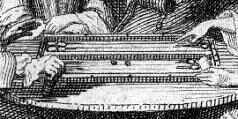
Is Tic-Tac, Tick-Tack, or Little Trictrac the precursor of Trictrac (Great Trictrac), or rather a lighter version of it? It seems that no one really knows for certain, although the first hypothesis is the more likely one. Be that as it may, this game has the advantage of being very fast, even brisk, compared to Trictrac, which calls for a certain amount of stamina. Unlike Trictrac, its rules have not been very stable, and variants, minor though they were, have existed. According to Euverte Jollyvet, who calls it Little Trictrac, it was played mainly in England and Germany, with France preferring Trictrac.
Foreword 2 dice (both players use the same dice) ; 1 die identical to the others, for the doubles ; 2 dice cups (one per player). The
board is called a tablier in the sense that it holds the tables
(an old name for checkers). 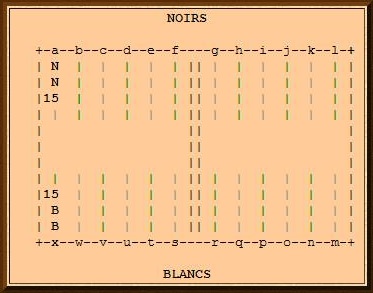
The
dotted lines represent the points, and the number « 15 » corresponds to the
total number of checkers on the point (including the two checkers marked « N »
or « B ») The die for doubling is placed in the middle of the centre bar with the ace face showing.
For White: from « x » to « m », then continuing from « l » to « a ».
Corner
: the 11th point counting from the talon. White's corner is at « m »,
Black's is at « l ». Outward
journey : for each player, the portion of the circuit running from their talon to their corner. Bearing the checkers off the board, extremely rare, is not the aim. The various ways of scoring points are described further on. To determine which player will throw the dice for the first move of a game : Each player throws one die ; Whoever scores higher throws both dice to begin the game.
If
on a throw of the dice, at least one of them falls off the board or
lands on one of the borders, the throw must be made over completely.
a) On a simple throw (the 2 dice show different numbers) one may: Either move one checker by the value of one die and a second checker by the value of the other die ; b) On a double (the value of each of the two dice is the same) A double is played exactly like a simple throw. c) « Checker touched: checker played » A
player who, after throwing the dice, takes it upon themselves to touch at least one of their checkers
may be forced by their opponent to play it if it can be played in a
legal way. One may, on the other hand, touch one of one's checkers without being obliged to play it if one has first announced « j'adoube ! » ("I adjust!"). One may, however, only adjust to arrange one's checkers and in no way to carry out a move. Since Tic-Tac is played with only a pair of dice, the following rules determine at what point a player has finished playing their checkers : Once a checker has been moved a number of points equal to or greater than the sum of the numbers thrown by the two dice, the move is complete and the player cannot go back on it. Likewise, once two checkers have each been moved a number of points equal to or less than the higher of the two dice, the move is complete and the player cannot go back on it. The outcome of this move, or these moves, is correct if it complies with the numbers thrown by the dice and with the rules governing the movement of checkers. Otherwise, the outcome is incorrect for one or both checkers. The player is said to have made a « false space ». In the event of a false space, the opposing player may, before throwing their dice, either reposition the misplayed checker or checkers correctly or leave them as they are, as suits them.
Old-time players used to announce doubles as follows
: 6 :
« Sonnés » ("Rung") If one can play either one of the two dice but not both, one is required, if possible, to play the higher one. This is why, after the dice are thrown, one must announce the dice starting with the higher one (for example « 4 and 2 » and not « 2 and 4 »). Note in passing that « 1 » is not called « one » but « ace ».
Over the whole circuit, a checker may neither stop nor even rest on a point occupied by at least one of the opponent's checkers. It may, however, do so on a point that is empty or occupied by one or more checkers of its own colour.
Points always go to the player who threw the dice, without their having to play their checkers. If, before scoring their points, the player has touched one of their checkers, they fall under the penalizing case No. 9. The following 10 ways of scoring, along with the doubles, are cited by Willughby. Cotton, for his part, mentions only what is flagged by the notation (Cotton).
This is when, on a throw of the dice, a checker is able to reach exactly an isolated checker of the opponent's. If, to reach the isolated checker, one must play a single checker using the sum of the two dice, the intermediate point, in the case of a double, or at least one point in the case of a simple throw, must not be occupied by any opposing checker. If, on a throw of the dice, one is able to hit several opposing checkers, only one point is scored.
Before throwing the dice a player may offer to double. To do so they say « I double » and their opponent may accept or refuse. If the opponent refuses they lose the game and the doubler wins 1 point, but if they accept, play continues and the points for this game will be doubled (2 points instead of 1; 4 points instead of 2). Once the double has been accepted, it is not possible to double again until both players have thrown the dice. From that point on, if one of the two players offers to double again before throwing the dice they say « I triple ». If the opponent refuses they lose the game and the doubler wins 2 points but if they accept, play continues and the points for this game will be tripled (3 points instead of 1, 6 points instead of 2). Doubling can thus continue, quadrupling, and so on... To keep track of successive doubles one can use
an extra die which, placed between the two players, will show
the face corresponding to the current multiplier; at the start of the game it will
show the ace, then the two, then the three, and so on... One may use the 10 ways of scoring points, and for doubling, the method of modern Backgammon but with an ordinary die instead of the doubling cube. The whole game will be played to 12 points.

References :
Charles Cotton, The Complete Gamester, 1674
Francis Willughby, The Volume of Plaies, mid-17th century
Information about this page :
Author : Philippe LALANNE Le Salon des jeux - Académie des jeux oubliés
|