This page is a translated archive of the original Académie des jeux oubliés, created on July 1, 2026, from the French original at salondesjeux.fr.
|
This page is a translated archive of the original Académie des jeux oubliés, created on July 1, 2026, from the French original at salondesjeux.fr.
|
Lansquenet
Lansquenet is a card game that was played mainly during the reigns of Louis XIII and Louis XIV, and at the beginning of the reign of Louis XV. A game of chance, it was subject to numerous bans, always circumvented. Fair, notably because all the players seated at the table act as banker in turn, it was studied in 1708 by the mathematician Rémond de Montmort in his Essay on the Analysis of Games of Chance. In the 19th century, Lansquenet made a reappearance in gambling houses, but was considerably simplified, to the point that it kept practically nothing of the original game but its name. The rules presented here conform to those practised under Louis XIV. A few details, not made explicit in the various old rule sets, had to be inferred from game situations described in various literary works.
See also: modern Lansquenet
I. The basic game
1. Number of players and the deck of cards
Lansquenet is a game of chance in which from 4 to 12 players may take part, with a deck of 52 cards.
The players are called cutters. Depending on the number of players involved in a game, one speaks of a lansquenet of so many cutters, for example, a lansquenet of 6 cutters, a lansquenet of 12 cutters.
The
cutters are the permanent players who alone are entitled to deal the cards in their turn. During the course of the game, occasional players may be admitted; they are called carabins. The way carabins play will be dealt with in
a section of its own.
Rémond
de Montmort, Essay on the Analysis of Games of Chance, 1708
2. The cards
In Lansquenet, the suit of the cards does not matter.
There
is no hierarchy at all, and only the rank of the card is taken into account.
3. The banker, the deal, the stake
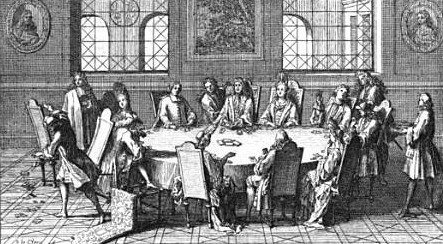
At the start of the game, the cutters sit around a table, and one of them is chosen at random – for example, whoever draws the highest card – to be the first to deal the cards to the other cutters. This cutter plays against the others; he is the banker.
The banker shuffles the cards, has them cut by the cutter seated to his left, then deals one card, face up, in front of each cutter, starting with the one seated to his right, and continuing counter-clockwise until reaching the cutter placed to his left.
These cards are called up-cards. As soon as a cutter has his up-card, he places his stake on it, the amount of which is fixed by agreement between the players at the start of the game. This base stake is called the stake of the game.
Once the deal to the cutters is complete, and the stake has been placed by the cutters on their up-card, the banker turns up the next card from the stock and places it visibly to his right. It belongs to him.
Having turned up his own card, the banker turns up the cards of the stock one after another, stacking them to his left. This is called dealing the stock, and he is also called the dealer.
Every time the banker turns up a card from the stock, he must check whether one of the cutters, or he himself, holds a matching one, such as a jack for another jack, or a seven for another seven. Three cases may then arise:
– no one holds a card matching the one drawn from the stock: the banker then turns up the next card from the stock;
– a cutter's card matches the one drawn from the stock: the banker takes the cutter's card, after having collected the chip or chips placed on it, then, provided at least one up-card remains in play, he turns up the next card from the stock;
– the banker's card matches the one drawn from the stock: he must pay each of the cutters still holding their up-card a number of chips equal to the one placed on it.
If all the up-cards have been taken by the banker, the hand is over. The banker keeps his role: he gathers up the 52 cards, shuffles them, and starts again as at the beginning. However, if he wishes, he may also give up his role as banker in favour of the cutter seated to his right. The former banker then becomes an ordinary cutter.
If the banker turns up a card matching his own, he must stop being banker and becomes an ordinary cutter again. The hand is over and the next cutter becomes banker.
The game requires that each cutter and the banker hold a card of a different rank. However, during the deal, chance may cause several players to end up with matching cards.
To solve this problem, the banker proceeds as follows during the deal:
– as long as the up-cards are of different ranks, he continues dealing;
– when he deals an up-card matching one he has already dealt, he removes the stake placed on the earlier one, and places the single card thus freed underneath the new one, so that it remains partially visible. The last up-card thus placed then becomes double. The cutter holding a double card still only places the base stake on it. The banker must place double the stake on the double card.
– when he deals an up-card matching a double card he has already dealt, he removes the stake placed on it, and places the double card thus freed underneath the new one, so that it remains partially visible. The last up-card thus placed then becomes triple. The cutter holding a triple card still only places the base stake on it. The banker must place quadruple the stake on the triple card.
– when he deals an up-card matching a triple card he has already dealt, he does not remove the stake placed on it but instead pays its cutter quadruple. The hand ends immediately: the punters still holding chips on their up-card recover them, and the cutter seated to the banker's right immediately becomes the new banker. The last up-card thus placed is called the quadruple card, but its cutter covers it with no stake and wins nothing.
Once the deal of the up-cards is complete, without a quadruple card having occurred, the banker turns up his own card and places it to his right. Three cases must then be considered:
– the banker's card is single: the banker begins turning up the cards of the stock, placing them to his left as described in the principle of the game;
–
the banker's card is double or triple: he removes the stake
placed on the corresponding cutter's single or double card, and gathers the matching cards thus freed with his own, leaving
the one(s) underneath partially visible. He then continues turning up
the cards of the stock as before;
6. Payments to cutters based on multiple cards
In the principle of the game, when dealing the stock, it was stated that a losing banker must pay each cutter who still holds his up-card visibly the same number of chips as those placed on it. This number of chips corresponds to the agreed stake.
However, this is only true for single cards. For multiple cards, the payment to the cutter concerned is as follows:
– for a double card, he pays the cutter double the stake ;
– for a triple card, he pays the cutter quadruple the stake.
7. Payments between cutters
When, after the complete deal of the cards to the cutters and the banker, one of the cutters loses his stake to the banker as a result of a card from the stock matching his own being turned up, he must pay each of the other cutters still in play the amount of the base stake, whether their up-card is single or multiple.
This way of paying the other cutters is called watering.
The first cutter to see his up-card taken is the most penalised, being required to water all the other cutters who still hold an up-card, single, double or triple, ahead of them. He is commonly called the first-taken.
Lansquenet long left behind, in everyday speech, an expression tied to this player: "as pale as a first-taken."
II. The rejouissance
8. How it works
The rejouissance is an extra chance that was added to the basic game.
To put it into practice, the dealing procedure is modified as follows:
– after the banker has dealt the up-cards to the cutters, and before he turns up his own card, all the cutters may place additional stakes in the middle of the table for the rejouissance ;
– then the banker turns up his own card, which he places to his right : if the banker's card is quadruple, he takes the stake placed on the up-cards as before, without collecting the rejouissance stakes, which the players take back; otherwise he turns up the next card from the stock, which he places in the middle of the table.
If this card matches his own, he adds it to form a multiple card, then turns up the next one from the stock.
If it does not match his own, he places it with the stakes for the rejouissance. The card thus exposed is itself called the rejouissance.
– Once the rejouissance is exposed, the banker turns up the cards of the stock one by one. The methods of payment do not differ from the game without a rejouissance, except that when the banker turns up a card matching the rejouissance, he takes the stakes placed on it. When the banker turns up a card matching his own, in addition to the usual payment for the up-cards, he pays evenly each of those who wagered on the rejouissance.
The banker may impose a ceiling on the total stakes placed for the rejouissance, but he must do so before turning up his own card. Once he has turned up his card, he is obliged to honour the stakes placed for the rejouissance.
The rejouissance is therefore the first card from the stock that differs from the banker's.
If the rejouissance matches a single or double up-card, the banker takes that card and removes the stake from it. The card taken is joined to the rejouissance to form, respectively, a double or triple rejouissance.
If the rejouissance card becomes quadruple, the banker takes the stake placed on the triple up-card, but the chance for the rejouissance is then cancelled, since it can no longer come out. Each cutter takes back the stake he had placed there, and play continues as usual, without a rejouissance.
III. The carabins
10. Their role, the reprise cards
The carabins, or carabineers, are players who join the game temporarily, but must be accepted by the banker – in other games of chance they are commonly called punters. They may wager a single time and leave. They may never hold the role of banker, and are not required to water either the cutters or the other carabins. Carabins play only against the banker.
If carabins are accepted into the game, whenever the banker turns up a card from the stock that matches neither those of the cutters, nor the rejouissance, nor his own, he places it face up on the table. It is on these exposed cards that the carabins may wager. They are called reprise cards.
A reprise card may be used by only a single carabin. A carabin may hold several reprise cards.
Carabins may also wager on the rejouissance like the cutters, but always before the banker turns up his own card. As always with the rejouissance, the banker may set an overall ceiling on the stakes placed on it.
The banker is never obliged to accept a carabin's wager, whether on the rejouissance or on a reprise card. In the case of a reprise card, he may himself set the amount the carabin must place on it in order to respect the rule of odds.
Although no old rule states so explicitly, it seems very likely that a cutter who has been dispossessed of his up-card could return to the game for that hand as a carabin, by wagering on a reprise card – the name of that card supports this reading of the game. At an equal stake, it even seems fair to give the favour to the dispossessed cutter rather than to an ordinary carabin.
This supports the idea that a reprise card can only be assigned to a single carabin, or to a dispossessed cutter – who then becomes a privileged carabin –, since otherwise every reprise card would behave like so many rejouissance cards – whereas the rejouissance is unique.
In the basic principle, valid with the rejouissance, the cards of the stock turned up one after another are stacked to the banker's left. Moreover, if a card, single or multiple, is taken by the banker, it is added to that same pile.
For carabins to be able to play, reprise cards must be exposed. For this, the following procedure is applied:
– if the card turned up differs from all the cards already exposed, it is in turn exposed on the table and forms a new reprise card;
– if the card turned up matches an already exposed card that differs from the banker's, he takes it, and the card taken is exposed on the table, forming a multiple reprise card ;
The card taken may thus be either another reprise card, a straight up-card, or the rejouissance card.
The losses and gains of the carabins are settled only with the banker.
If payments between carabins and the banker were made evenly regardless of the type of reprise card, carabins would not be inclined to wager on a single reprise card if the banker held a double or a triple one, or on a double card if the banker held a triple one, since the odds would favour the banker, and conversely the banker would refuse a wager in the opposite cases. In practice, only cards offering the same probability of winning for the banker and the carabin would be offered as reprise cards.
To remedy this drawback, the rule of odds may be applied to reprise cards: payments between carabins and the banker are no longer made evenly as a matter of course, but take into account the risk taken by the carabin relative to the banker.
– If the carabin and the banker have a card of the same rank, (single, double or triple), they have the same number of chances of winning: the losing banker pays the carabin evenly, 1 to 1. For example, if the carabin wagered 3 chips, the banker, if he loses, will pay him 3 chips.
– If the carabin has a single card and the banker a double card, the carabin has 3 chances of losing against only 2 of winning: the losing banker pays the carabin in the same ratio, 3 to 2, to compensate for the greater risk taken by the carabin. For example, if the carabin wagered 2 chips, the banker, if he loses, will pay him 3 chips ;
– conversely, if the carabin has a double card and the banker a single card : the losing banker pays the carabin at 2 to 3. For example, if the carabin wagered 3 chips, the banker, if he loses, will pay him 2 chips.
– If the carabin has a double card, and the banker a triple card, the carabin has 2 chances of losing, against only one of winning: the losing banker pays the carabin in the same ratio, 2 to 1, to compensate for the risk taken by the carabin. For example, if the carabin wagered 1 chip, the banker, if he loses, will pay him 2 chips ;
– conversely, if the carabin has a triple card and the banker a double card, the losing banker pays the carabin at 1 to 2. For example, if the carabin wagered 2 chips, the banker, if he loses, will pay him 1 chip.
– If the carabin has a single card, and the banker a triple card, the carabin has 3 chances of losing, against only one of winning, and the losing banker pays the carabin in the same ratio, 3 to 1, to compensate for the risk taken by the carabin. For example, if the carabin wagered 1 chip, the banker, if he loses, will pay him 3 chips ;
– conversely, if the carabin has a triple card and the banker a single card, the losing banker pays the carabin at 1 to 3. For example, if the carabin wagered 3 chips, the banker, if he loses, will pay him 1 chip.
In all cases, if the carabin loses, the banker simply takes his wager.
When the rule of odds is applied, one says that the odds are being played. Whoever loses under this rule loses the odds, and whoever wins wins the odds.
The odds require the carabin to wager a number of chips that may be greater than 1, so as to avoid the banker having to pay a fraction of a chip. It is therefore useful to know how much the carabin must wager at minimum for each configuration, and how much the banker must pay him based on that minimum wager.
– the carabin wagers the complement to 4 of the multiplying factor of the banker's card;
– the banker pays the carabin the complement to 4 of the multiplying factor of the carabin's card.
Example 1
The carabin has a double card, and the banker a single card: the carabin wagers 3 chips (4 - 1), and the banker pays him 2 chips (4 - 2).
Example 2
The carabin has a double card, and the banker a triple card: the carabin wagers 1 chip (4 - 3), and the banker pays him 2 chips (4 - 2).
Example 3
The carabin has a triple card, and the banker a single card: the carabin wagers 3 chips (4 - 1), and the banker pays him 1 chip (4 - 3).
Etc.
Thus each player wagers according to the risk run by the other, the complement to 4 being nothing other than the number of matching cards remaining in the stock that would cause a loss. Where the cards of the two players have the same multiplying factor, the risks run are the same and consequently the minimum wager is 1 chip paid evenly (1 chip).
If a carabin wants to wager more than the minimum wager, he must put up a multiple of it. The banker will pay him the same multiple of what he owes him at minimum.
The banker is always free to refuse or limit a carabin's stake.
IV. End of a hand, length of the game
13. End of a hand
A hand begins with the dealing of the up-cards to the cutters, and its end is tied to four circumstances of play:
– during the deal, one of the cutters receives a quadruple up-card : the hand is over, the banker loses the deal to the benefit of the cutter seated to his right, who thus becomes the banker for the next hand ;
– during the deal, the banker receives a quadruple card: the hand is over, the banker keeps the deal for the next hand ;
– during the dealing of the stock (the term used for the turning up of the cards which begins as soon as the banker has turned up his own card, if it is not quadruple), the banker turns up a card matching his own : the hand is over, the banker loses the deal to the benefit of the cutter seated to his right ;
– during the dealing of the stock, once the banker has taken all the up-cards : the hand is not over until the banker has turned up a card matching his own, or until no reprise cards or rejouissance remain in play. If the banker turns up a card matching his own, he pays the reprise cards and, if applicable, the rejouissance. The banker keeps the deal for the next hand even if he has lost the rejouissance or one or more reprise cards.
The banker who is in a position to keep the deal may, if he wishes, pass it to the cutter seated to his right, who cannot refuse it.
Although nothing is specified on this subject, it seems fitting that the game cannot be abandoned by a cutter before the end of the first round, which occurs once all the cutters have been banker a first time.
As with other card games, the length of the game may be determined either by playing time or by number of rounds. Withdrawals after the first round should be able to be accepted or refused by agreement between the players at the start of the game, but only for the losers. In the 19th century, in the game of Bouillotte, ancestor of Poker, a winning player was allowed to leave the gaming table, but he was then replaced by another who was waiting so that the game could continue. Leaving the game in this manner was called "doing a Charlemagne." This way of doing things, with a replacement, could conceivably apply to Lansquenet.
Taking an available cutter's seat during the course of the game was designated by the expression "taking colour."
V. Lansquenet in literature
Letter XXXIX from the Baron de Pöllnitz (in Paris, 1 April 1732)
" [...] It is certain that at Court people gamble more than anywhere else, and many Lords have ruined themselves for having had the honour of making up the game of the King. His Majesty ordinarily plays Lansquenet. The game has twelve Cutters, at one Louis d'or on the card. The King and the chief Players, such as the Count of Toulouse, the Duke of Antin, the Duke of Grammont, go up to two Louis d'or, and sometimes to four. The King is said to be the luckiest at this game, which is always held in the Queen's Apartment. Everyone who is well-dressed is permitted to enter, and to wager on the rejouissance. This makes for a great Court, but a very mixed Assembly. All the Ladies sit around the gaming table, and the Men remain standing. The French claim that gambling makes everyone equal. I saw a man named S. Rémi, who had been Footman to the Marshal d'Estrées, then valet to Mr. le Duc, who eventually made him his Valet de chambre, and who, upon the Queen's arrival, gave him a Position in Her Majesty's Household, which he held at the same time as that of Valet de chambre to Mr. Le Duc. This S. Rémi makes the King's game rise or fall as he pleases. It is true that he does not cut, but he covers every card and wagers heavily on the rejouissance. At Fontainebleau, I heard him offer twenty Louis from his card against the King's: the King replied coldly, No, Marquis; that is a nickname this Prince has given him, one that might well pass down to posterity along with S. Rémi, who is in any case vain enough to deserve being a Marquis.
[...]
It is certain, however, that this freedom which every sort of person has to carabine makes them insolent. Baron, that famous Actor, and the vainest of men before there were any Quinaults, found himself one day at the home of Mr. the Prince of Conti, the one who had been elected King of Poland. They were playing Lansquenet there. Baron, drawing his purse nonchalantly, said Ten Louis on the Jack, Monsieur de Conti, to that Prince. Done, Britannicus, replied the Prince of Conti, who knew that Baron had just played that role.
[...] "
End of quotation
This
letter contributes a great deal to our knowledge of Lansquenet and in particular
of the carabins' play (the verb "to carabine" is used). We see that the carabins
offer a wager on one or more cards :
The
Gambler by Regnard, 1696 (excerpts from the Works of Mr. Regnard, Brussels, 1711)
ACT I, SCENE VI
VALERE And who is this Marquis ?
HECTOR To speak to you plainly, A Marquis made by chance, through Lansquenet : Most gallant, by his own account; scheming, full of business, Who believes women owe tribute to his charms, Who wins much at play, and who, they say, once Was a Valet de chambre before being a Marquis.
ACT I, SCENE X
GERONTE If some gambler lives off his winnings, A thousand are seen every day to die of hunger, Forced to endure a long abstinence, Weeping for having wagered too much on the rejouissance.
ACT IV, SCENE XIII
HECTOR alone [...] I laugh : and yet my Master, in his death throes, Yields in a game of Lansquenet to his evil genius. Here he is, misfortunes written across his brow. He has all the look and air of a first-taken.
ACT IV, SCENE XIII
VALERE [...] Speak, have you ever seen fate and its caprice Strike a mortal down with greater injustice, Assassinate him more thoroughly? Losing every odds bet, Twenty times the cutthroat, and always first-taken ! [...]
VALERE [...] Twenty times first-taken! In my heart there rise Surges of rage. (He sits down) Come, go on, finish.
End of quotation
In these lines, Regnard evokes every facet of Lansquenet :
– the rejouissance, on which both cutters and carabins may wager ;
– the rule of odds, and hence the carabins' play on reprise cards ;
– the first-taken, who is the cutter who sees his up-card taken first by the banker, and must water all the other cutters still in play, giving them the amount of the base stake ;
– the cutthroat is an expression of the game concerning the banker who sees his own card come out, without having been able to take any of the other exposed cards (up-cards, reprise cards, and the rejouissance). Another, cruder expression was also used to describe this unfortunate situation of the banker, namely coupe-cul ("arse-cutter"), often spelled coupe-cu.
Thus Valère finds himself particularly unlucky, having lost in the worst possible ways: as a carabin – "Losing every odds bet" –, as a cutter – "always first-taken" –, and as a banker – "Twenty times the cutthroat," twenty times expressing a great number.
As in the letter from the Baron de Pöllnitz, we find again the image of the valet de chambre who becomes a marquis through his winnings at Lansquenet. There was, indeed, a pejorative expression: a lansquenet marquis.
VI. Origin of the game's name and its vocabulary
Lansquenet
takes its name from that of the mercenary infantrymen,
originally of German origin, employed
in various European armies, and particularly in France, from the 15th to the 17th
century. Some believe that the game of Lansquenet may have been introduced
into France by these mercenaries. Thierry Depaulis
holds a rather different theory, however: "the game takes its name
not directly from the German infantrymen but from the cards used to play it,
called lansquenet cards in a few 16th-century sources
– indeed, lansquenets can be seen depicted on the jacks. In fact, Lansquenet
appears to be a French game – it was not introduced into Germany
until the mid-17th century –, and the game seems to have been
particularly popular in the south-west of France, since the oldest
references come from Gascony."
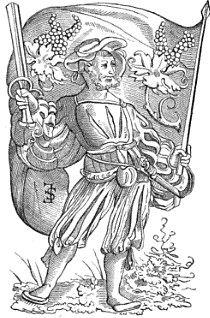
Paul Lacroix, The Arts in the Middle Ages and at the Time of the Renaissance, 1869 Fig. 207: "The two of a German deck of cards, from the lansquenet."
The term "cutter," used for the permanent players, is to be connected with the fact that they are the only ones able to hold the deal (be the banker) and thus turn up the cards of the stock one by one (after the deal). This action is called cutting, or dealing. Perhaps the name is also linked to the weaponry of the lansquenet mercenaries, notably a short sword or a two-handed one used to fend off enemy pikes.
Carabins are not entitled to cut, and it is because they can wager on a card and leave after having lost or won, then return to the game in the same way, that they bear the name carabin. The carabins were horsemen armed with a short single-shot musket, who harassed enemy troops, fleeing after having fired. They were also called carabineers.
In Lansquenet, "to carabine" means to play as a carabin. A cutter dispossessed of his up-card may carabine until the end of the hand.
|