
The
Game of the Goose is so well known that it should not really have a place on
a site dedicated to forgotten games. However, its origin is
imperfectly known: sometimes it is given a sixteenth-century Italian origin,
sometimes a different, fifteenth-century German one, but
almost everyone agrees in rejecting its Greek origin, despite
its full name "The noble Game of the Goose, renewed
from the Greeks". Already in his work Bibliothèque
curieuse et instructive... published in 1704, Father Claude-François Menestrier
expressed his doubt, writing "[...] this is the Game of the Goose,
so common, and which is claimed to have come from the Greeks, although no
trace of it appears in the ancient authors."
My purpose is
not particularly to revisit these claimed origins of the Game of the Goose
– many other sites do so, more or less well – but rather to make
known the original idea of a nineteenth-century author who
saw in this game an application of octal
numeration: in 1857, Aimé
Mariage, in his book titled Numération par huit anciennement
en usage par toute la Terre [Numeration by eight, formerly
in use throughout the world], attempts to prove that octal numeration
is not only the oldest but that it should, in his view, supplant
the more complex decimal numeration for the purposes of calculation. He even goes so far as to
send a letter to Pope Gregory XVI,
dated 13 March 1842, to "submit to him a new system
of calculation, by 8, offering the advantages of decimal calculation without its drawbacks."
Aimé
Mariage devotes 6 of the 243 pages of his book to a study of the Game of the Goose,
concluding that this game "is a living monument of the ancient
octoval [sic] numeration".
For
my part, without vouching for this claim, I find this way
of looking at the Game of the Goose interesting for teaching, in a playful
and effortless way, the octal system compared with the decimal system,
the board lending itself particularly well to this.
Aimé Mariage's observations on the Game of the Goose
"The first observation one can make about
the Game of the Goose concerns the numbering of the squares, which runs from 1 to
63. Some count 64 squares by including the starting square, which would then be
square number 0; others think that the extra square is the
one in the centre, called in the game "the goose's garden".
Implicitly, by insisting on seeing 64 squares instead of 63, everyone links it
to something other than the decimal system, from which one
would rather expect a number of squares equal to several dozen,
or even a hundred.
The
numeral system that best matches the number 64 is the
octal system, which uses 8 digits – from 0 to 7
– instead of 10 for the decimal system.
We
also observe that the finishing square, called the "gate
of the goose's garden", is numbered 63, and that a
first series of geese is placed every 9 squares, starting
with the ninth, the board thus being divided
into 7 sections of 9 squares.
However,
9 seems to be an arbitrary number for numeration compared to
10 – the ten fingers of both hands –, or 8 – only eight
fingers, with the thumbs used to count the four other fingers
of each hand – or even 12 – the twelve phalanges of the four fingers
other than the thumb, which is used to count them.
If
we now number the squares of the Game of the Goose in octal, we get a
run of squares going from 1 to 100 (64 expressed in octal).
We
can then place the first series of geese every 8 squares,
which divides the run into 8 segments of 8 squares. The last
square of the run is now the goose's garden square itself, and not its gate. As
a result, the numbers of the squares where the geese of the first
series are found are now multiples of 10 (8 expressed
in octal).
As
can be seen, this way of proceeding gives a much better
harmony to the board of the Game of the Goose."
Aimé
Mariage also points out that the rules of the Game of the Goose stipulate
that if on the first throw one obtains a total of 9 points by rolling the two
dice, in order to avoid winning immediately, a player who threw
6-3 is required to go to square 26, and a player who threw 5-4 to square 53. One might have
thought they would be sent to square 36 and square
45 or 54 respectively, but since all these squares are already
occupied by a goose, that was not
possible, hence the necessary shift.
It
is precisely in the numbers of the two chosen squares, 26 and 53, that Aimé
Mariage believes he sees a trace of an ancient Game of the Goose – he genuinely believes
it to be a game from ancient Greece – functioning according to
octal numeration. He notes, indeed, that if one places the geese
starting from the eighth square, every eight squares along the run, two
dice throws (2-6 and 5-3) near the start of the run require
a redirection which can, without any problem, be made to squares
26 (octal) and 53 (octal), which correspond digit for digit to the 26 and 53 of the
Game of the Goose in decimal numeration.
Aimé
Mariage, however, fails to mention that in octal the throw 4-4 must also be
redirected, since placing the geese every 9 squares eliminates
the problem of the double.
I
will not comment further on Aimé Mariage's reasoning, except
to say that the Game of the Goose may have been inspired by Mehen,
a game of ancient Egypt played on a tablet carved with a
variable number of squares which together form a serpent coiled
in a spiral, but whose rules are unknown. Many people today
seek to assign rules to Mehen and, like Aimé
Mariage, present them as THE rules of Mehen, when
they are merely their own.
The
Game of the Goose was very probably what is called a prearranged game,
commercial even down to its name, which was attractive for the period, of
"renewed
from the Greeks".
Be that as it may, I have amused myself by giving concrete form
to the Game of the Goose as revisited by Aimé Mariage.
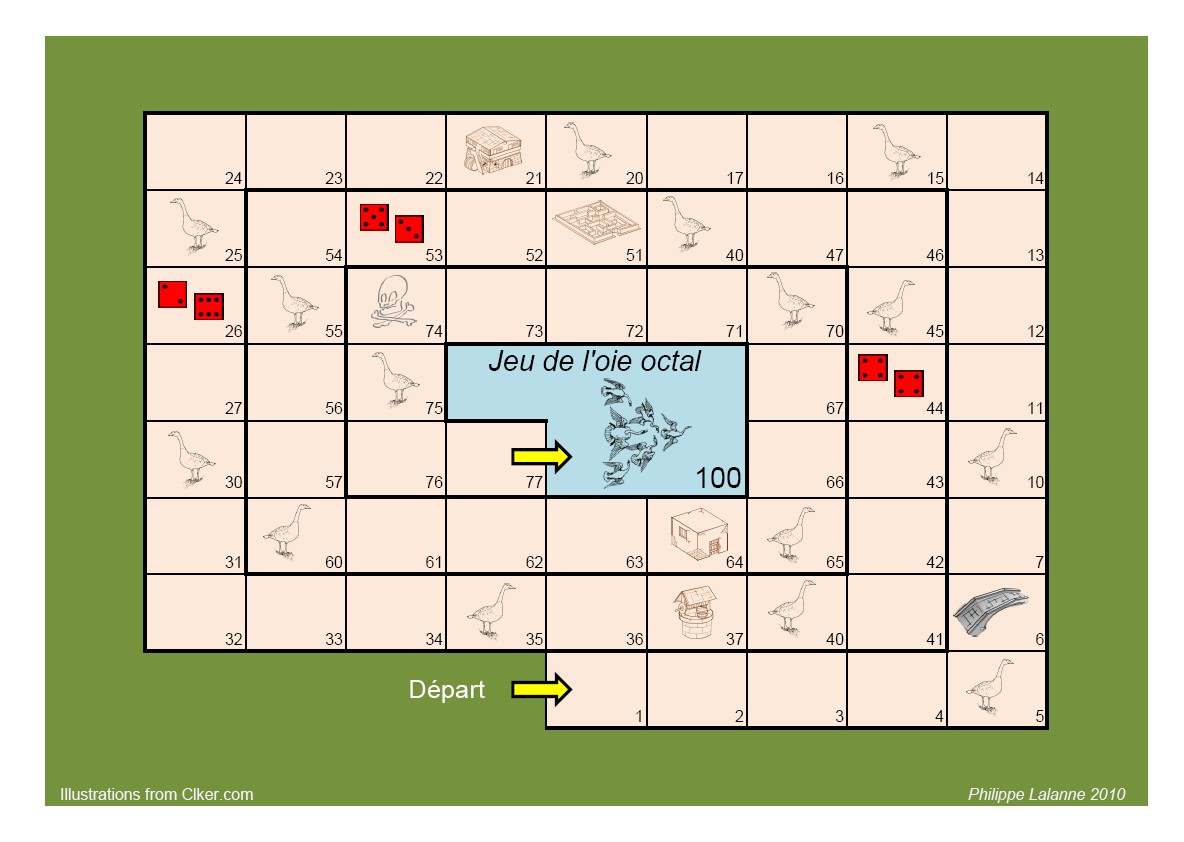
Adaptation of the Game of the Goose to octal
In
everything that follows, numbers are expressed in octal, and one may refer
to the representation of the board.
The
run goes from 1 to 100, and a first series of geese is found
on squares 10, 20, 30, 40, 50, 60, 70, and 100, which is the goose's garden, the
finishing square.
On
squares 26, 53 and 44 I have shown two red dice, which
indicate where a player who throws 2-6, 5-3 or 4-4 respectively on the first
throw of the dice must be placed.
The
Game of the Goose has a second series of geese, which I
deliberately chose to start at square 5, the geese of this
series thus being found at 5, 15, 25, 35, 45, 55, 65 and 75.
The
temptation was to start the series at 4 rather than 5, but
that created quite a number of additional redirections:
throwing 4 (3-1, 2-2) would immediately bring a player to square 100, requiring
two further redirections (for example, 31 and 22); throwing 14 (6-6)
would lead directly back to the start, goose by goose; likewise, throwing 4-4 would lead
directly back to the start following a redirection to 44. Choosing to
start the series at 5 eliminates all these peculiarities.
It
remained to decide on the placement of the special squares, which
was done while broadly keeping the same layout
as on the board of the decimal Game of the Goose:
–
the bridge remains at 6, and whoever lands there moves to 12. Thus
the rule does not change, except that here 12 is expressed in octal. Note the similarity
with the decimal Game of the Goose, the goose placed at 10 being
halfway between square 6 and square 12.
–
the inn is at 22, and whoever stops there must miss their
next two turns.
–
the well is at 36, and whoever falls into it must wait for another player to come
and replace them. Whoever gets out takes the starting place of
whoever replaced them.
–
the labyrinth is at 52, and whoever enters it comes straight back out through
the well, to be placed just before it, at 35.
–
the prison is at 62, and whoever enters it remains a prisoner until
another player takes their place. Whoever gets out takes the starting place
of whoever replaced them.
–
death is at 72, and whoever stops there returns to the start of the run,
which they will resume on their next turn.
–
the goose's garden is at 100; whoever arrives there without going over
has won the game. On the other hand, whoever reaches it with an
excess of points moves back that same number of squares. If, in
moving back, they land on a goose, they continue to move back
by the total number of points of the two dice. On the next turn they will set off
forward again.
When a
player finishes their move on a square occupied by another
player, that other player takes the starting place of the one who has just arrived.
Playing with tokens
The
Game of the Goose was a game played for stakes, in the
following way:
–
at the start of the game, each player puts one or two tokens in a basket.
The tokens placed there make up the pool. The pool
grows (fattens) over the course of the game.
–
whoever lands on a special square puts a token in the pool.
–
whoever is joined on a square by another player puts a token in the pool.
–
whoever wins the game takes the pool.

