This page is a translated archive of the original Académie des jeux oubliés, created on July 1, 2026, from the French original at salondesjeux.fr.
|
This page is a translated archive of the original Académie des jeux oubliés, created on July 1, 2026, from the French original at salondesjeux.fr.
|
The Game of Ombre
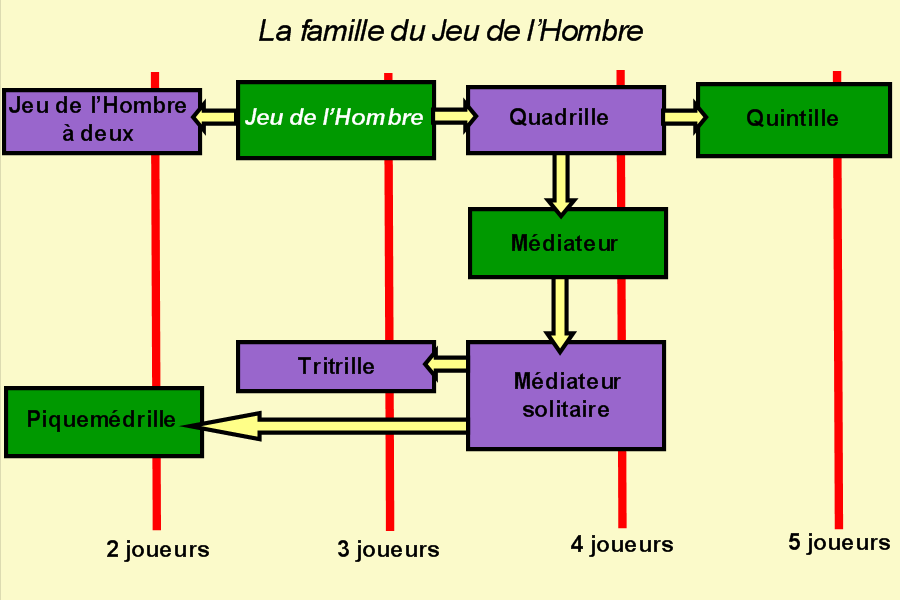
The game of Ombre, of Spanish origin, was played mainly in France during the second half of the 17th century and the beginning of the 18th century. It subsequently fell out of favour with players, being replaced, to put it briefly, by its descendants the whist and then the bridge. It is probably the first trick-taking game with bidding known in the history of card games. It continues, more or less, to be played with very similar rules in other countries, under the name tresillo in Spain, l'Hombre in Denmark, rocambor in Peru and Bolivia, and tridge in England – tridge is in fact an adaptation of rocambor. The rules set out here are those found in the earliest treatises on the game of Ombre, to which I have tried to bring the greatest possible clarity. The game of Ombre is the origin of a family of card games including the quadrille, the quintille, the piquemédrille, the médiateur, the tritrille and the solitary médiateur.
I. Players
and cards 1. Number of players and deck of cards
The game of Ombre is played by three players, with a deck of 40 cards obtained from a deck of 52 cards from which the tens, nines and eights have been removed.
Red
cards in descending order: K, Q, J, A, 2, 3,
4, 5, 6, 7 Black cards in descending order: K, Q, J, 7, 6, 5, 4, 3, 2
Two things can be observed: in red, the order of the low cards is reversed; in black, the ace is absent.
The reason for the disappearance of the black aces from the natural order – by natural we mean outside of trumps – will be explained in the next chapter. As for the reversal of the order of the low red cards, it is purely arbitrary – to remember it, one need only note that the red ace comes right behind the jack, with the low cards following it in the order 2, 3, 4, 5, 6, 7, thereby making the 7 the lowest red card.
The trump suit is chosen by one of the players following a bidding system. Depending on the suit chosen (spades, hearts, diamonds or clubs) , the order of the cards changes relative to the natural order.
Regardless of the suit chosen, the black aces are always trumps.
Two cards are always trumps: the ace of spades, named Spadille, and the ace of clubs, named Basto, and this is the reason why the black aces do not exist in the natural order.
Spadille is the highest trump, and Basto the third.
The second trump, which ranks between Spadille and Basto, is called Manille. When a suit is chosen as trump, the lowest card in the natural order of that suit becomes Manille. Thus, if the trump suit is red (hearts or diamonds), Manille will be the seven, and if it is black (spades or clubs), it will be the two.
These three trumps (Spadille, Manille and Basto) are called the matadors.
Under certain conditions, the matadors enjoy privileges which will be detailed in the rules for play of the cards.
When the trump suit chosen is red, the corresponding ace leaves its place behind the jack to move ahead of the king.
This ace thus becomes the fourth trump, behind the three matadors. The ace thus promoted takes the name Ponto.
In a red suit, trumps in descending order : [S, 7, B], A, K, Q, J, 2, 3, 4, 5, 6
In a black suit, trumps in descending order : [S, 2, B], K, Q, J, 7, 6, 5, 4, 3
We
see that, due to the presence of the Ponto, there are 12 trumps in a red suit,
whereas in a black suit there are only 11.  II. Seating of the players, dealing the cards
4. Choosing seats, the deal, and the eldest hand
The players are seated around the table by placing, face up, in front of each of the three chairs a card of a different suit, and by drawing three more cards of the same suits from the deck; one of the players shuffles these and then presents them face down to each of the other two, who each draw one. The players take their seats in front of the card of the same suit as the one they hold.
To determine which player will deal the cards first – will make the first deal – a card is drawn from the deck and turned face up in the middle of the table, then another card is dealt, face up, in front of each player, and whoever obtains the highest card, in the natural order of the suit of the card in the middle of the table, will be the first to deal (give out, distribute). Spadille and Basto are excluded from this procedure, and if either of these two cards were to turn up in the middle of the table or in front of a player, another would be drawn from the deck to replace it.
The first dealer thus designated gathers up all the cards, shuffles them, gives them to the player on his left to cut, then deals nine cards to each player, three at a time, counter-clockwise, beginning with the player on his right. Once this deal is complete, the dealer places the remaining thirteen cards in a pile, face down, between him and the player to his right. These thirteen cards make up the stock.
The player to the dealer's right is called the eldest hand : he leads the first card of the hand – a hand is the phase of play in which the three players play out their nine cards.
The eldest hand of a given hand becomes the dealer of the next hand, and so on.
In
the case where a hand was not actually played after the deal – as
will be seen later, this happens when none of the players wants to
play, believing they have no chance of winning – the hand is still
considered to have been played, and the new dealer is whoever would have
been the eldest hand had the hand really been played. In other words,
the same player never deals twice in a row. III. Object of the game and play of the cards
5. The object of the game, tricks
The game of Ombre is a trick-taking game. The winner of a hand is whoever has taken the greatest number of tricks out of the nine possible. To take a trick, a player must have played a card stronger than those played by the other two players, following the rules of play of the cards.
Throughout a hand, the player who has just taken a trick leads first for the next trick – he is said to have the lead.
Players are required to follow the suit led (spades, hearts, diamonds or clubs, played by the eldest hand for the first trick, or by whoever has the lead for the following tricks).
If a player does not hold the suit led, he is not obliged to trump.
There is no obligation to head the trick in any suit whatsoever, including trumps.
If the first player has played a trump other than one of the three matadors, the following players must follow suit in trumps, but they are not obliged to play a matador, even if they hold none of the other trumps.
If the first player plays a matador, the others must play a trump if they hold one. They may play a matador if they wish, but nothing obliges them to, with one exception: they must play a matador if the first player has played one higher than the one they hold, and if they have no other trumps – the higher matadors, played by the first player, only force the lower ones if they are alone left in hand. Consequently, if the first player plays Manille and one of the following players holds as trumps only the two other matadors, he will not be obliged to play his Basto, but he must then win with his Spadille, and if he does not do so he must then play his Basto, which is forced by Manille. If a matador is not forced, and a player has no other trump, he may discard any card in order to keep it. A matador played by the second player does not force the lower matadors of the third. Basto, being the lowest matador, can never force the other two.
Any
player, when it is his turn to play a card, has the right to turn over
his tricks as well as those of the other two players to examine them, but outside
of his turn he is not allowed to do so. It is good practice
not to abuse this privilege, for the sake of keeping the game flowing smoothly.
IV. Contracts and bidding, the Ombre
7. Contracts and bidding
There are three types of contract, ranked from lowest to highest: 1. Ask Leave: to win by discarding 2. Sans Prendre : to win without discarding 3. The vole: to win without discarding and by making the vole – that is, taking every trick.
A player who does not want to commit to any contract passes and can no longer take part in the bidding for that hand.
Once the cards have been dealt, each player looks at his hand and commits, in turn, to a contract, or else passes, beginning with the eldest hand and continuing to the right.
If all three players pass, the hand is deemed to have been played and the eldest hand becomes the dealer. He gathers up the cards, shuffles them, has them cut and deals them.
As soon as the bidding is opened by a player committing to a contract, whoever has not yet passed may overbid by committing to a higher contract, or even by matching the last contract. Matching a previous contract is only possible for a player who has priority over the one who proposed the last contract. The eldest hand has priority over the two other players, and the second player over the last. The player who has been matched can, in turn, overbid, if the highest possible contract has not been reached.
When two of the players have passed, the one who remains committed must take on his contract without changing it. This player is called the Ombre ; the other two are the Allies. The Allies seek to bring down the Ombre, while each also looks after his own interest.
“Ask Leave”: the player undertakes to win by discarding – He must : 1. name the suit that will be trump ; 2. place the stock in the centre of the table, and put, in the place thus left empty, the cards from his hand that he does not want to keep, face down, announcing their number – this is the discard, which must always be at least one card; 3. take from the top of the stock a number of cards equal to that of his discard, so that he always has nine cards in hand. This done, the next player, to the right, discards if he wishes to – he may choose not to discard – in the same way, then the last player, if any cards remain in the stock, may do likewise. In addition, the last player has the option, after his discard or even if he does not discard, of looking at the remaining cards of the stock, but he must then show them to the other players, and if he decides not to look at them, no one is allowed to see them. Finally, the last player, if any cards remain in the stock, adds them to the discards placed to the left of the eldest hand – this location thus makes it easy to remember who the next dealer will be. No one is allowed to look at the discards before the end of a hand.
“ Sans Prendre ”: the player undertakes to win without discarding – He must : 1. name the suit that will be trump ; 2. place the stock in the centre of the table, without discarding ; 3. let the other two players make their discards if they wish to, as previously – the first allowed to discard is the player seated to the right of the Ombre.
“Vole”: the player undertakes to win without discarding and to make the vole, that is, to take every trick – The procedure is the same as for Sans Prendre, with one very important difference: the two Allies may look at each other's hands and decide together on the discards to make.
“Pass”: the player passes his turn, not wishing either to commit right from the start of the bidding, or to raise the contract, or match it if he has priority. It is not possible to pass if a player has made the best bid.
(1 : eldest hand, 2 : second, 3 : last)
“ 1 Ask Leave ; 2 Pass ; 3 Pass ” : The first player is the Ombre; he plays Ask Leave.
“ 1 Ask Leave ; 2 Pass ; 3 Sans Prendre ; 1 Pass ” : The last player is the Ombre; he plays Sans Prendre.
“ 1 Ask Leave ; 2 Pass ; 3 Sans Prendre ; 1 Sans Prendre ; 3 Pass ” : The first player is the Ombre; he plays Sans Prendre, having taken advantage of his priority over the last player. The first player, who had a borderline hand for playing Sans Prendre, was led to overbid in order to be the Ombre – that is what is called a forced Sans Prendre.
“ 1 Sans Prendre ; 2 Vole ; 3 Pass ; 1 Pass ” : The
second player is the Ombre; he plays Sans Prendre and must make the vole –
when a player commits to the vole it is clear that no one else can
do the same. V. How the Ombre wins or loses
8. How can the Ombre win?
In Ask Leave or Sans Prendre, to win the Ombre must take more tricks than each of the Allies – the Allies' tricks are never added together. The total number of tricks in a hand being 9, if the Ombre takes 5 he wins; but he can also win by taking only 4 if one Ally takes 3 and the other 2.
In the vole, to win the Ombre must take all 9 tricks.
It is worth noting, before bidding, that the Ombre is only the first to play a card if he is also the eldest hand. One can therefore very well be the Ombre and yet be second or last to play.
The Ombre loses by remise if, at the end of a hand, he has the same number of tricks as the Ally who has the most – 4 for the Ombre, 4 for an Ally, and 1 for the other Ally – or if the tricks are shared equally among the three players – 3 tricks each. When there is a remise, the Ombre loses but there is no winner.
The Ombre loses codille if, at the end of a hand, one of the Allies has more tricks than he does; that Ally wins codille.
The Ombre
who has announced he will make the vole loses by failed vole
as soon as one of the Allies takes a trick; both Allies are then winners. VI. The two types of vole
10. Announced vole and committed vole
Up to now we have only spoken of the announced vole declared during the bidding, and we have noted that the Allies could, from the moment it is announced, show each other their hands visually, and decide together on the discards to make; this vole is contractual.
The committed vole only applies to Ask Leave and Sans Prendre contracts. It occurs during play when the Ombre has taken the 5 first tricks and plays a sixth card. Having succeeded in the first 5 tricks means the Ombre has fulfilled his Sans Prendre contract, and he must lay down his hand to be paid. The simple act of playing a sixth card automatically commits him to going on and succeeding in the vole.
Failure of the committed vole does not mean that the Ombre has lost entirely – unlike the announced vole – but it does subject him to significant penalties. As soon as the Ombre has committed to succeeding in the vole by playing a sixth card, the Allies come together and play while showing each other their hands, as with the announced vole.
Whether
in an announced vole or a committed vole, the Ombre has
failed as soon as one of the Allies takes a trick; the players lay down their
hands and payments are made. VII. Communication between the Allies
11. Communication rights granted to the Allies outside of the vole
There are two ways of communicating granted to the Allies during the game – outside of an announced or committed vole – namely the gano and the appel (call).
Gano : an Ally asks the other Ally not to take the trick and to thus leave him the lead. To do this, he simply says “Gano!” as he plays his card, which is equivalent to “Let it through!”. For example, an Ally plays the queen of a suit in which he does not hold the king, and calls gano to the other Ally, who, if he holds the king together with at least one other card of the same suit, and if it is in his interest to do so, does not play it and leaves the trick to his companion for the occasion.
Appel : an Ally encourages the other to trump with a high trump in order to force the Ombre. To do this, he taps briefly on the table as he plays his card, as one knocks on a door.
The Ombre may neither call gano nor make an appel. Gano and appel may not be addressed to the Ombre.
Even
though the rules do not forbid it, it has always been morally
out of bounds to call gano purely to win codille when, without
this, one would otherwise have had the means to bring down the Ombre by remise.
Should this happen, the Ally who would win codille thanks
to a gano could – and morally should – give up
his winnings, so that the Ombre would only have lost by remise, but
the second Ally would not be shortchanged. VIII. The Ombre's winnings
12. What are the Ombre's winnings?
When the Ombre succeeds, his winnings are of two types : systematic winnings and occasional winnings.
In Ask Leave or Sans Prendre, the Ombre takes the pool and is paid the possible beast in play.
In announced vole as in committed vole, the Ombre takes the pool, the beast in play, and all outstanding beasts. If there is no outstanding beast, the Ombre takes the pool and the beast in play, and each of the two Allies pays him in addition half of that same amount.
The notions of pool and beasts will be detailed further on.
In Ask Leave, in Sans Prendre, or in announced vole, the Ombre is paid for the matadors by each of the two Allies at a rate of 2 counters per matador. As we have seen, the matadors number three (Spadille, Manille and Basto) ; however, when it comes to the payment for matadors, the trumps that follow Basto without a break are also added in. For example, if the Ombre held in his hand – at the start of the hand and not through acquisition during the tricks – the three matadors plus the Ponto, the king and the queen of trumps but not the jack, then each of the two Allies would pay him 12 counters for the six “matadors”. The “matadors” do not have to be announced by the Ombre at the start of the hand, but he must ask for payment for them at the end of the hand and before the start of the next hand, otherwise he would not be paid.
The matadors are only paid if the Ombre holds in his hand the three true ones (Spadille, Manille and Basto), which validate the following ones then counted along with them.
In
Sans Prendre and in announced vole, the Ombre
is paid, by each of the two Allies, the Sans Prendre payment which
amounts to 12 counters.
In
committed vole, the Ombre is paid by each of the two
Allies the Sans Prendre payment only if that was his contract.
If it had been Ask Leave the Ombre would not be paid
the Sans Prendre payment. IX. The Ombre's losses, the notion of beast
13. What are the Ombre's losses?
When the Ombre fails, his penalties are of two types : the beast and occasional losses.
Whether he loses by remise or codille, whether in Ask Leave or in Sans Prendre, or fails to make his announced vole, the Ombre makes the beast.
In the case of an unsuccessful committed vole, the Ombre does not make the beast.
The beast is not an immediate payment but a debt equal to the amount that the Ombre would have received had he won – see systematic winnings.
This beast will be put into play later – by adding it to the pool – following a procedure that will be determined in a dedicated chapter.
Only the Ombre can make the beast.
In Ask Leave, in Sans Prendre, or in announced vole, the Ombre pays the matadors to each of the two Allies at a rate of 2 counters per matador – as before, the matadors are extended to the trumps immediately following the Spadille, the Manille and the Basto (all of them in the Ombre's hand at the start of the hand).
Only in Sans Prendre and in announced vole, the Ombre pays each of the two Allies the Sans Prendre payment which amounts to 12 counters.
In the case of committed vole, the Ombre pays the two Allies neither the Sans Prendre payment nor the matadors, since he fulfilled his bid contract by taking the first 5 tricks.
In Ask Leave, or in Sans Prendre, the Ally who wins codille takes the pool and is paid the possible beast in play.
If
the Ombre does not succeed in the announced vole or fails
in the committed vole, the Allies share the pool and any
beasts – the one that may be in play and the others
outstanding. If there is no outstanding beast, the Allies are not paid
double, unlike the Ombre would have been had he won.
X. The stake, the wager, the pool
14. The stake, or buy-in at the start of the game
At the start of a game of Ombre each player receives 20 counters (round) and 9 chips (long rectangles). Each chip is worth 20 counters.
Thus, at the start of the game each player has the equivalent of 10 chips or 200 counters. This amount makes up the stake. When, during the game, a player no longer has enough counters, he is cleaned out ; since he cannot leave the game before its agreed end, he takes an additional stake – he buys back in – to continue.
The main wager of the game of Ombre is, as we have seen previously without going into detail, made up of the pool and the possible beast – and, in the case of a vole, the outstanding beasts.
16.1 How it is built up, the 2-and-1 system
At the start of the game, each player lines up 2 counters horizontally in front of himself. Each of these counters is worth 3 at settlement – this simplified marking makes it possible to quickly see the exact number of counters actually in play. Each player's wager is therefore 6 counters and the pool then contains 18 counters – the pool being the total number of actual counters put into play by all the players together.
Every time all three players pass during the bidding, each adds in front of himself 1 counter for an actual amount of 3 counters. The total addition to the pool is therefore 9 counters.
At the start of a hand, before the deal, if the pool has been won (taken) by the Ombre and there is no beast to put into play, each player – as at the very start of the game – puts in front of himself 2 counters.
At the start of a hand, whether the pool has been won or not, if there is a beast to put into play, each player puts in front of himself 1 counter – as in the case where all three players pass during the bidding.
This marking system is called 2 and 1.
Given
that the marker counters – 2 and 1 – represent only a third
of each player's actual wager into the pool, and that the 3 players
mark the pool in the same way, to know at any time
the true total amount of the pool, one need only multiply by 9 (3 x 3)
the number of marker counters that are in front of any one of the players. Thus,
if there are 3 counters the pool is 27 counters, if there are 7 it is
63 counters...
XI. The beast within the 2-and-1 marking system
17 The beast
The beast is a gaming debt incurred by the Ombre, and only by him, when he fails in his undertaking. The term beast, and its original principle, was frequently used in card games during the 17th and 18th centuries then it was abandoned, having gone out of fashion or perhaps judged too complex ; so at first the word beast continued to be used incorrectly before being dropped altogether. Yet the beast mechanism gave the loser hope of seeing it wiped out by winning while it was in play.
The amount of the beast is equal to that of the total wager, which is made up of the pool and, where applicable, a beast if a player has one to add to it. At the very start of the game the wager contains only the pool, the beasts being generated in the course of play.
At each hand, a new beast may be made by the Ombre if he loses. Whichever beast happens to be put into play may be won together with the pool by the Ombre if he wins, or by an Ally if he wins codille. Moreover, all the beasts that were made in previous hands may be won all at once by the Ombre if he makes the vole, or by the two Allies if the Ombre fails in his attempt at the vole.
There are two methods for keeping track of the beasts made in the course of play. One can either use a sheet of paper and a pencil, or use a set of beast counters marked with the possible beast amounts.
On the sheet three columns are drawn, labelled with the names of the three players, and when the Ombre makes a beast, the amount of the beast is written under his name. On each line under the names, only one beast should be entered ; a new beast made by the same player or by another must be entered on a new line. The beast that is due to be put into play is marked on the sheet by circling it. The beast that is put into play with the pool remains so as long as the wager has not been won either by the Ombre, or by an Ally winning codille, or shared by the two Allies if they have defeated the vole. When the beast is won, it is crossed out with an X, and just before the next hand the new beast to be put into play is circled, and it must be the highest one recorded in the table. And so on until all the beasts have been crossed out ; then one starts again with the next first beast and again with the highest one – it is best to leave fairly wide columns, so as to be able to write in several series of beasts without having to erase the cancelled ones.
If beast counters are used, when the Ombre makes a beast, the player in charge of managing the beasts – appointed by the players at the start of the game – hands him the counter marked with the amount of his beast. The Ombre places his beast counter in plain view in front of him so that all the players can see it, and when he must put his beast into play he pushes his counter forward with the pool counters. At the start of the next hand, if the beast in play has been won, whoever holds the highest beast counter puts it into play and the process continues as before.
When the wager is won and there is a beast associated with the pool, whoever it belongs to must pay its amount to the winner, but if he is himself the winner, the beast is simply cancelled. In both cases, the beast is crossed off the sheet or the counter is returned to the beast manager, who places it in a reserve containing the set of unused beast counters.
We have said that in the case of a vole the outstanding beasts are also won either by the Ombre or by the Allies. On paper, the outstanding beasts are those that are neither crossed out nor circled, and for the counter method, all the beast counters that are in front of the players, with the one at stake being with the pool counters. In this case, all the beasts are paid according to the procedure described in the chapter on the vole and they are all crossed off the table, or else all the beast counters are returned to the beast manager, who puts them in the reserve.
The sequence of potential beasts is regular in the 2-and-1 marking system and requires no exceptions, unlike the 3-and-2 system described in relatively later editions (3 counters when the wager is empty, and 2 counters otherwise) which had generated errors in the corresponding sequence of potential beasts.
Starting from no. 1, the beasts increase successively by 9 counters.
The beast counters described in the various editions have sometimes survived over time. But, to my knowledge, only the 2-and-1 system, described here, has done so.
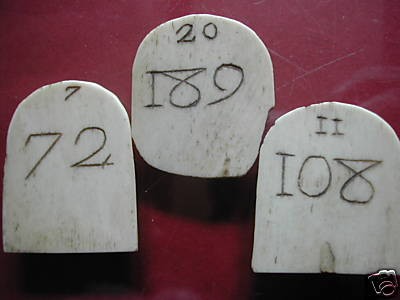
The photo on the left, which was sent to me by a collector for my opinion, shows, as can be seen in the table on the right, three beast counters from the 2-and-1 system. These three bone counters probably date from the end of the 17th century.
The adoption of the 3-and-2 system, introduced to enlarge the wager, brought disorder into the list of beasts : a single exception to the rule was mentioned by the author for codille, but inappropriately so, and the beast table present in the 1709 edition is erroneous – it is merely a simple adaptation of that of the 2-and-1 system and could only be usable if hands were never played, no one wishing to be the Ombre ! It would only be partly corrected later, but even then only dealing with the case where the Ombre systematically loses by remise !
This example shows concretely how the beasts are generated and the process by which they are put into play.
The beast incurred for this hand is equal to the amount of the wager, i.e. 18 counters.
Player A is the Ombre and loses by remise, making the beast of 18 counters, with the pool remaining in play.
Second hand : 1 additional marker counter in front of each player. The pool = 3 x 9, i.e. 27 counters, and A must put his beast into play. The wager = 27 from the pool + 18 from the beast, i.e. 45 counters
The beast incurred for this hand is equal to the amount of the wager, i.e. 45 counters.
Player B is the Ombre and loses by remise, making the beast of 45 counters, with the pool remaining in play.
Third hand : 1 additional counter in front of each player. The pool = 4 x 9, i.e. 36 counters, and A must leave his beast of 18 counters in play (the one of 45 made by B remains outstanding). The wager = 36 of pool + 18 of beast, i.e. 54 counters.
The beast incurred for this hand is equal to the amount of the wager, i.e. 54 counters.
All three players pass.
Fourth hand : 1 additional counter in front of each player. The pool = 5 x 9, i.e. 45 counters, and A must leave his beast of 18 counters in play (the one of 45 made by B still remains outstanding). The wager = 45 of pool + 18 of beast, i.e. 63 counters.
The beast incurred for this hand is equal to the amount of the wager, i.e. 63 counters.
Player B is the Ombre and loses by remise, making the beast of 63 counters (B now has two outstanding beasts, one of 45 and one of 63)
Fifth hand : 1 additional counter in front of each player. The pool = 6 x 9, i.e. 54 counters, and A must leave his beast of 18 in play (the ones of 45 and 63 made by B remain outstanding). The wager = 54 of pool + 18 of beast, i.e. 72 counters.
The beast incurred for this hand is equal to the amount of the wager, i.e. 72 counters.
Player C is the Ombre, playing Ask Leave, and wins. He takes back the marker counters he had placed in front of himself for the pool, and each of the two Allies gives him that same number of counters multiplied by 3, i.e. 6 x 3 = 18 counters and they take back the marker counters they had placed in front for the pool. In addition, A gives 27 counters to C for the beast he had put into play and has just lost. As a result: A has lost 18 + 18 for the beast = 36 counters, B has lost 18 counters, and so C has won 36 + 18 + 18 recovered = 72 counters, which correctly correspond to the wager.
At this point, the beast of 18 is crossed out, and only those of B, of 45 and 63, remain. There are no more marker counters in front of each player.
Sixth hand : 1 counter in front of each player (only 1 counter because at least one beast remains to be put into play, otherwise 2 marker counters would have to be placed as at the very start of the game). The pool = 3 x 3, i.e. 9 counters, and B must put his beast of 63 into play, it being the highest at the moment (his beast of 45 remains outstanding). The wager = 9 of pool + 63 of beast, i.e. = 72 counters.
The beast incurred for this third hand is equal to the amount of the wager, i.e. 72 counters.
Player B is the Ombre, playing Ask Leave, and wins. He takes back the marker counter he had placed in front of himself for the pool and each of the two Allies gives him that same number of counters multiplied by 3, i.e. 1 x 3 = 3 counters and they take back the counters they had placed in front for the pool. In addition, since he has won, he cancels his beast of 63, which is crossed out. As a result: A has lost 3 counters, C has lost 3 counters, and B has won 6 counters, taken back his 3 counters from the pool and cancelled his beast of 63 counters. These 72 counters of winnings for A correctly correspond to the wager which included the 3 counters B put into the pool and that he recovered and the 63 of his beast that he cancelled.
At this point, the beast of 63 is crossed out, and only B's beast of 45 remains. There are no more marker counters in front of each player.
Seventh hand : 1 counter in front of each player (because a beast remains to be put into play). The pool = 3 x 3, i.e. 9 counters, and B must put his beast of 45 into play, it being the only one outstanding at the moment. The wager = 9 of pool + 45 of beast, i.e. 54 counters.
The beast incurred for this hand is equal to the amount of the wager, i.e. 54 counters.
Player B is the Ombre, playing Ask Leave, and wins. He takes back the marker counter he had placed in front of himself for the pool, and each of the two Allies gives him that same number of counters multiplied by 3, i.e. 1 x 3 = 3 counters and they take back the counters they had placed in front for the pool. In addition, since he has won he cancels his beast of 45, which is crossed out. As a result: A has lost 3 counters, C has lost 3 counters, and B has won 6 counters, taken back his 3 counters from the pool and cancelled his beast of 45 counters. These 54 counters of winnings correctly correspond to the wager which included the 3 counters B put into the pool and that he recovered and the 45 of his beast that he cancelled.
At this point, the beast of 45 is crossed out, and there is no outstanding beast left. There are no more marker counters in front of each player.
Eighth hand : 2 counters in front of each player (there are no more beasts to put into play). The pool = 2 x 9, i.e. 18 counters, and there is no beast at all any more. The wager = 18 counters The beast incurred for this hand is equal to the amount of the wager, i.e. 18 counters.
And the game continues in the same way.
In
summary, we see that 3 beasts were made, the first of
18, the second of 45 and the third of 63, which correspond respectively
in the beast table to no. 1, no. 4,
and no. 6. XII. End of the game and settling accounts
18 Length of the game
The game of Ombre is played for an agreed number of pools won by the Ombre. Pools won by an Ally through codille, or by the two Allies through a vole missed by the Ombre do not count.
The length of a game is generally set at 20, 30 or as many as 40 pools won by the Ombre in this way. The players agree on this number at the start of the game.
To count the pools won by the Ombre, he sets aside from each pool he takes a counter which will serve as a marker, and when the total number of counters set aside by a player has reached the number agreed at the start, the game will be over. The pools won by the Ombre may also be recorded on a paper sheet, just like the beasts.
Although this way of determining the length of a game may seem strange, it is justified by the incentive it gives to keep playing rather than waiting to win codille without taking any risk against the beast the Ombre stands to incur, particularly when there is a tendency to be satisfied with a comfortable early lead. This method works against a wait-and-see approach.
After the payments for the last hand of the game, if any players still have outstanding beasts, they place in the middle of the table the sum of counters corresponding to their beasts, and these counters are then shared among the three players. One may also decide to keep playing until there are no beasts left.
Once
the game has ended, one way or another, each player counts up
his counters – a chip is worth 20 counters – from which
he deducts the 200 counters of his starting stake and, where applicable, any
counters from buying back in during the game after having been
cleaned out. The result gives the amount won or lost by each
player. XIII. Options
20. Game option: forced Spadille
To avoid too many consecutive rounds of everyone passing, it may be decided that when all three players have passed during the bidding, whoever has Spadille in hand will be the Ombre and will play Ask Leave.
If
no one then declares holding Spadille, its presence is checked for
in the stock. A player who had failed to declare it would make
the beast, but the hand would not be played.
This way of playing is called forced Spadille.
Whoever plays a forced Spadille is not allowed to attempt the vole.
This game option must be agreed upon between the players before the game. It increases the number of beasts, and it is preferable to refrain from using it, so as not to distort the game with too much randomness.
The rate of 12 counters for Sans Prendre, and that of 2 counters per matador, as set out here, was called the double payment. It was recommended in order to add more interest to the game.
It
is nonetheless possible to apply the single rate of 6 counters for Sans
Prendre and 1 counter per matador. This must be agreed upon between
the players before the game. SECTION XIV
22.
Tables summarising the beneficiaries, and the cases where
the Ombre makes the beast
(1) If there is no outstanding beast, each of the Allies adds half of the total amount of the wager. Example : if the wager (pool + beast) is 72 counters, the Ombre wins it and each of the Allies pays him in addition 36 counters. As a result, in the absence of outstanding beasts the Ombre receives double the wager. This is true only for the Ombre.
In case of a remise, the pool and the beast are won by no one.
XV. Variant, Retourne
23. Variant : an additional contract borrowed from Tresillo
As we have seen, the bidding in the game of Ombre really only applies to two contracts, Ask Leave and Sans Prendre, the announced vole being, for its part, very rare.
In order to enrich the bidding side of the game, without undermining the original rules, I think it is worth adopting a third, intermediate contract that has been added to tresillo – the current name for the game of Ombre in Spain. Called vuelta in tresillo, it could be named retourne in the game of Ombre – Danish l'Hombre uses it under the name tourné.
This contract consists of undertaking to win by discarding as in Ask Leave, but without choosing the trump suit.
The trump suit is determined by turning up the first card of the stock. The Ombre playing Retourne turns over the top card of the stock and makes his discard, the turned-up card going to him. He must discard at least two cards, one for the turn-up and one other.
Playing Retourne generates an occasional payment as in Sans Prendre, but at half its amount ; consequently, if Sans Prendre is set at 12 counters, Retourne will be set at 6 counters, and if Sans Prendre is 6 counters, Retourne will be 3 counters.
(1 : eldest hand, 2 : second, 3 : last)
“ 1 Ask Leave ; 2 Pass ; 3 Retourne ; 1 Retourne ; 3 Sans Prendre ; 1 Pass ” : The last player is the Ombre; he plays Sans Prendre.
“ 1 Pass ; 2 Ask Leave ; 3 Retourne ; 2 Retourne ; 3 Pass ” : The second player is the Ombre; he plays Retourne.
The Retourne contract increases the value of priority.
Summary
| ||||||||||||||||||||||||||||||||||||||||||||||||||||||||||||||||||||||||||||||||||||||||||||||||||||||||||||||||||||||||||||||||||||||||