This page is a translated archive of the original Académie des jeux oubliés, created on July 1, 2026, from the French original at salondesjeux.fr.
|
This page is a translated archive of the original Académie des jeux oubliés, created on July 1, 2026, from the French original at salondesjeux.fr.
|
Libro de los juegos The
Cab e Quinal is the ninth table game described
in the Libro de los juegos (the book of games) written at the
request of Alfonso
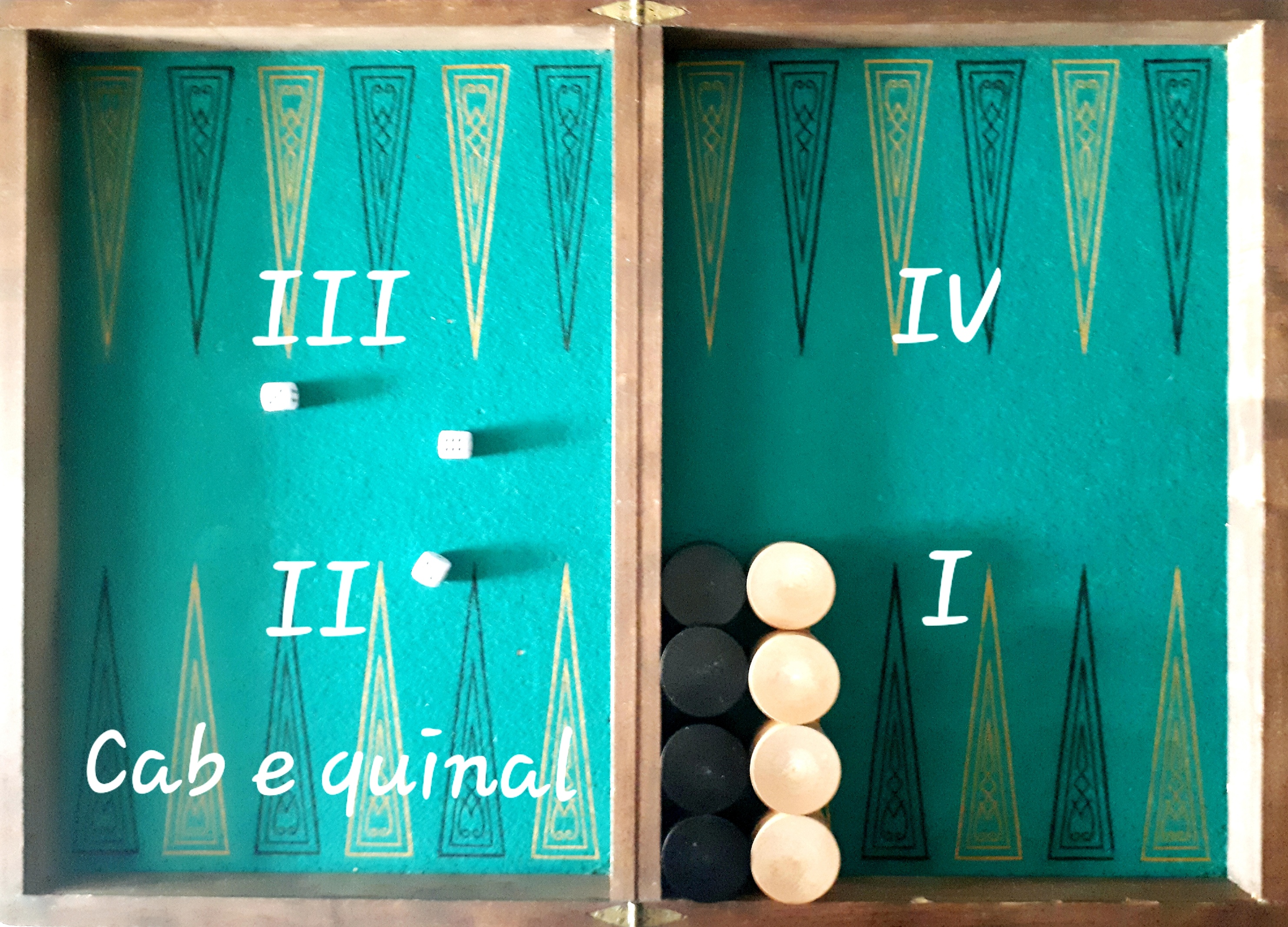
X of Castile between 1251 and 1283. It takes its name from the arrangement
of the checkers on a single quadrant of the board at the start of the game, cab
(head) designating the sixth point and quinal
the fifth. There are two versions of Cab e Quinal, the main one with three dice, and another with two dice.
The board is called a tablier in the sense that it contains the tables (the old name for checkers). The game of Jacquet is thus part of the family of table games. 2. Starting position and name of the game Each player places his checkers as shown in the figure below :
The
15 checkers on their starting point make up the talon (stack). 3. Path of the checkers 4. Object of the game 5. Priority for the dice To
determine which player will roll the dice for the first move of the game
- dice lying flat on the checkers are good. (these
rules are those of Trictrac) 7. Moving the checkers a) On a simple roll (the 3 dice show different numbers) one may : - either move three checkers, each by the value of one die ; - or move one checker by the value of one die, and another by the value of a second die, then from that position move it again by the value of the third die (it is essential to mark a brief pause on the intermediate point) ; - or
move a single checker successively by the value of each of the three
dice, always marking a brief pause between each of the three
moves. b)
On a doublet (the value of two of the three dice is
the same) c)
On a triplet (the value of each of the three dice
is the same) d) « Checker touched: checker played » - a player who, after rolling the dice, happens to touch at least one of his checkers may be forced by his opponent to play it, if it can be played in a legal manner ; - however, one may touch one of one's checkers without being obliged to play it, if one has previously announced « j'adoube ! » (I adjust!). However, one may only adjust to straighten one's checkers but in no way to test a possible move.
Any point occupied by at least two checkers of one player is forbidden to the other player, even for the purpose of resting there (this is the reason why one must mark a slight pause during a move over several consecutive segments). Any point occupied by a single checker of a player is vulnerable. The opposing player may land there or simply rest there during a move over several segments. In both cases the isolated checker is said to be hit and must be placed on the middle bar of the board. Any checker or checkers hit and placed on the middle bar must first all be brought back into the board by the player to whom they belong. The checkers are then brought back in through quadrant I, where the players' talons were located. No
checker may be moved on the board by a player who has
checkers on the middle bar until he has brought them all back
into the first quadrant. 9. Obligation to play the highest die The rule specifies nothing on this subject. The obligation to play all three dice if possible, or failing that two of them, and otherwise a single one, must however be respected.
Once the 15 checkers have entered the last quadrant, they are borne off the board following the rules below : - the constraints of the general rules for moving checkers, including that of having to bring back a hit checker first, and that of having to play the maximum number of dice, still apply ; - in this phase, the outer rail of the board is treated as an additional point ; - any checker that lands exactly on the outer rail through the value of the dice (either one or the other, the sum of two or three) is borne off the board ; - however, it is not forbidden to move another checker within the board if it is to the player's advantage (generally to hinder the passage of a delayed opposing checker) ; - in
the case where the value of a die is greater than the
farthest position of the checkers relative to the outer rail,
one bears off one of the farthest checkers (for example if the value
of the die is 5, and one has no checker at a distance of either 6 or
5, one bears off a checker at a distance of 4 or, failing that, 3, etc.) 11. Blocking the passage of the opponent's checkers When one occupies six adjacent points, one causes a block on the passage of the opposing checkers. A player who cannot play any of the three dice passes his turn.
 Two-dice variant
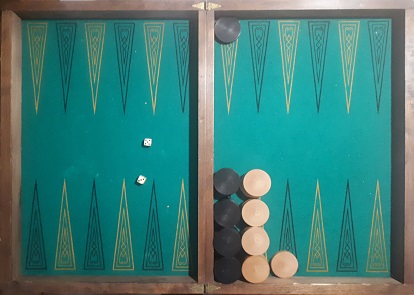
The Cab e Quinal can also be played with only two dice instead of three. However, it does not differ substantially from the version played with three dice, in the sense that if one keeps only two dice to roll, the third still exists but is virtual, its value being fixed by both players for the whole game. Most often its value is set at six. When a player rolls, for example, six and four, he will play six, four and six. Likewise after a roll of the two dice resulting in two and five, he will play two, five and six. And so on for all rolls of the two dice. The other peculiarity of this variant lies in the starting position of the checkers, which differs from the three-dice version.
A checker is taken from the talon of the black checkers to be placed on the sixth point of the bearing-off quadrant. A checker is taken from the talon of the white checkers to be placed alone next to it on the fourth point of the first quadrant (the quadrant where the checkers enter). The player with the white checkers is the one who starts the game, as in the three-dice version.
References Alfonso
X, El Libro de los juegos o Libro de ajedrez, dados e tablas, 1251 - 1283. Page information Published
on 13 January 2022 Author : Philippe LALANNE Le Salon des jeux - Académie des jeux oubliés
|