This page is a translated archive of the original Académie des jeux oubliés, created on July 1, 2026, from the French original at salondesjeux.fr.
|
This page is a translated archive of the original Académie des jeux oubliés, created on July 1, 2026, from the French original at salondesjeux.fr.
|
Brelan
Brelan is a card game of chance and bluff dating from the early 17th century. Although originally no combination in the game bore this name, the importance and rarity of holding three cards of the same rank in hand meant that players eventually came to call this grouping "brelan." However, this relatively late name was specific to the game of Brelan. In every other game, a grouping of three cards of the same rank was simply called "three of a kind" as in Piquet, or more generally a tricon. Today, the word "brelan" has definitively replaced "tricon" in players' vocabulary. Brelan, which had a poor reputation but enjoyed great success in fashionable salons under the name Bouillotte, is one of the forerunners of Poker.
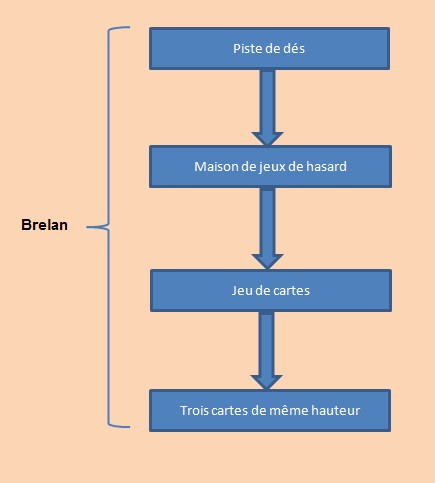
1. Etymology of the word "brelan" Brelan was a word used since at least the 13th century — before the spread of playing cards, which only took place towards the end of the 14th century — to refer to what we today call a dicing den. It was then spelled in various ways, such as brelenc, berlenc, berlens, or verlenc, and was probably borrowed from the High German bretling, meaning "small plank." Since this device must have been among the most common and sought after in gaming establishments, these establishments eventually took on, by metonymy, the name brelan, or berlan, spelled in four different ways: brelan, breland, berlan, and berland. It was not until the early 17th century that the card game of the same name appeared. Its resemblance to the game of Rafle, commonly played with three dice in dicing dens, is obvious, although it is not a game with re-raises: in short, in Rafle, players roll three dice, and whoever gets the highest number of points wins, unless another player rolls a "rafle," which consists of three dice of the same value, with the highest rafle winning in case of several rafles being rolled; in Brelan, again in short, players receive three cards, and whoever has the most points in one suit wins, unless another player holds three cards of the same rank in hand. However, the complete rule of Brelan, which is a game of re-raises, is a little more complex when it comes to calculating the points of the suit, and an extra card, the turned card, which each player may take into account, adds to the decision-making. Three cards of the same rank in hand were generally called a tricon. However, fairly quickly, some groups of players gave the name of the game to this combination. Others, while keeping the name "tricon," gave the name brelan to a tricon combined with a turned card of the same rank. For the first group, this combination of four cards of the same rank — three in hand and the turned card — was called a "fourth brelan" or "square brelan." In 19th-century literature, the expression "tricon brelan" is sometimes used to refer to the square brelan, while the simple grouping of three cards of the same rank in hand is called a brelan. The game of Brelan, of poor reputation, carried on unchanged until shortly before the French Revolution, before being durably adopted, during the 1770s, in fashionable salons under its variant "Brelan bouillotte," a name quickly simplified to Bouillotte. As a parlor game, Bouillotte gave rise to the creation of Bouillotte tables and Bouillotte lamps. The latter succeeded the Bouillotte candlesticks.
2. Deck of cards, number of players, principle Brelan is played between two, three, four, or five players, with a deck that can range from 20 to 36 cards. To make up the deck, one takes a 32-card deck and adds the sixes to make 36 cards, or removes the sevens to have 28 and, if necessary, the eights (24 cards), and the nines (20 cards). The 20-card deck, however, is only used in the variant called Bouillotte, and even more rarely the 24-card deck. The number of cards is to be agreed upon at the start of the game. The 28-card deck is the one most commonly used in Brelan. It is the one we will use in what follows. Before the cards are dealt, the players each place one of their tokens in the middle of the table. The pile of tokens thus formed is called the pool. Then the dealer, chosen at random by whoever draws the lowest card, deals three cards to each player, one at a time, starting with the player to his right and ending with himself. The deal and play proceed counterclockwise. Once the players have their three cards in front of them, face down, the dealer turns up the next card, called the turned card, in the middle of the table. The rest of the cards make up the stock, which is not used on this hand. Once the deal is complete, the players look at their three cards and begin to estimate their chances of winning, which are tied to the three valid card combinations. To win, the players in turn stake part of their tokens, either raising or matching the highest amount proposed so far. It is also possible to abandon one's stake when one fears being unable to win. If only one player remains in the game, he wins the pool and the stakes placed by the players. If several players remain in the game, it is whoever among them has the best combination who wins. In the event of a tie, the rule of precedence prevails, which gives the win to the involved player seated closest to the dealer on his right. It is therefore advantageous to be seated to the right of the dealer, and dealing is a great disadvantage.
As we saw earlier, before the deal, the players each put a token into play. The set of these tokens is called the pool. If there are five players, there will be five tokens in the pool. Once everyone has looked at their cards, the player seated to the right of the dealer must make a decision: — pass:
he says "I pass"; If the first player has passed, the second in turn has the same choice. If all players pass, the hand is over and the players add a token to the pool, which then doubles for a new hand in which the dealer will be the player seated to the right of the previous one. The cards are shuffled and cut on each new hand. And so on if all players pass, with the pool tripling, quadrupling, and so forth. Once a player has opened, the amount he has staked is called the vade. The opener is the first player in a round of speaking in which all players may take part. A player, when it is his turn to speak, now has this new choice: — pass:
he says "I pass" and lays his cards down in front of him, face
down. This is a fold; he loses everything he has staked; A round of speaking ends if a player re-raises, each re-raise beginning a new round of speaking with these same choices but only for the players who have not passed. The player who re-raises thus starts a new round of speaking, of which he is the first to have spoken. If during a round of speaking, no player has re-raised on the vade or the last re-raise, the hand is over. The opener, or the last re-raiser, may not re-raise on himself if no one has re-raised on him during the round of speaking that he initiated by opening or re-raising. Once the hand is over, two situations may arise: — only
one player remains in the game, all others having passed: this
player, without having to show his cards, takes all the tokens in
the pool and those staked by the players during the rounds of speaking; It is important to remember that precedence is determined relative to the dealer and not relative to the opener or the last re-raiser.
Brelan recognizes only three kinds of combinations, ranked in the following descending order: the square brelan, the brelan, and the point. Among the players remaining at the end of a hand, the winner is whoever can show: — a
square brelan; In the event of a tie on the point, the winner is the player seated closest to the dealer on his right, following the order of play. The dealer is the most disadvantaged. This is the rule of precedence.
A brelan is a grouping in a player's hand of three cards of the same rank. To compare two brelans, the descending hierarchical order of the cards is that of Piquet, namely: ace, king, queen, jack, ten, nine, and eight (the seven is not used in the 28-card Brelan). A brelan of aces thus beats all other brelans.
A square brelan is a brelan in hand combined with the turned card when it is of the same rank. For example, a player who has a brelan of jacks while the turned card is the fourth jack, holds a square brelan. Since there is only one turned card, there can only be one square brelan. A square brelan beats any brelan.
One must not confuse the turned-card brelan with the square brelan, although both are formed with the help of the turned card. A turned-card brelan is a brelan made up of only two cards in hand of the same rank as the turned card. This type of brelan is not valid, even though it is sometimes mentioned in the literature, but only to point out that those who claimed it — it was then ranked just below a brelan in hand — were "poor players." The turned-card brelan therefore does not count as a brelan and is not counted among the combinations. The point is the most common way to win at Brelan, since a square brelan is extremely rare, and a brelan very rare. To calculate the point, once the rounds of speaking are over, all players reveal their cards, including those who are no longer in the game, having passed during the bidding. Those who remained in contention compare who holds the highest card in each of the four suits. Whoever holds the highest card of a suit counts for himself all the cards of that suit shown by all the players, even if those held by non-contenders are higher. Likewise, he counts the turned card for himself if it is of that suit. A player can thus become master of several suits if he holds the highest card of that suit among the contending players. The sum of the point values of the cards of the same suit is called the point. Whoever has the highest point is the winner. In case of a tie on the point, it is the contender closest to the dealer on his right who wins. This is the rule of precedence, and the dealer is the most disadvantaged. To calculate the point, the value of the cards is that of Piquet: the ace is worth 11 points, each face card 10, and the others what they are marked as. After the deal, when a player holds three cards of the same suit in hand, one of which is the ace and the other two face cards, he has what is called "the 31." Since he holds the ace, he is assured of taking all the cards of that suit at the end of the re-raises. This situation is very favorable, especially if the turned card is high and of the same suit, since brelans are very rare and would be the only thing to cancel out this point.
5.1 The stake fund Before starting a game of Brelan, the players must place in front of them, on the table, the sum of tokens they are willing to play — and to lose. This sum is called the stake fund. In some games, players may have a different stake fund from one another. In others, all players start the game with the same stake fund. When a player has no tokens left in his stake fund, he is cleaned out. Depending on the conventions used, a player who is cleaned out, or whose stake fund is very reduced, may or may not be allowed to replenish it up to the amount of his initial stake fund or to a different amount. A player generally may only replenish his stake fund between hands, but according to the wishes of all the other participants, he may be allowed to do so during the rounds of speaking. A player who is cleaned out, and who is not allowed to replenish, leaves the game, which continues among the remaining players until all but one are cleaned out. It is also possible to set the duration of the game to an agreed-upon time before starting.
The pool is also a matter of convention. One may very well put nothing into the pool, in which case, when no player opens, the hand yields nothing to anyone. The purpose of the pool, then, is to encourage players to open the game more often, even with a weak hand. The number of tokens to put into the pool is likewise a matter of convention, and in certain games it happened that only the dealer contributed to the pool.
The carre is an optional mechanism that appeared later on, allowing dead hands to be avoided. The carre cannot be separated from the pool. After the cards are dealt, with each player having put, say, one token into the pool, the first to speak may buy the right to speak only last. To do this he says "I carre" and pushes onto the table a number of tokens equal to the pool — for example, with five players and one token each in the pool, he would put in five tokens to carre. These tokens are called the carre. Only the first player is allowed to carre, and he may only do so if he has not yet looked at his cards. Once the first player has carred, the game is implicitly opened for the amount of the carre. As a result, the round of speaking begins with the second player, and the carrer speaks last; if everyone passes before him, the carrer wins the pool's tokens and recovers those of the carre. Some also allowed the second player to counter-carre if the first had done so. To do this, once the first had carred, the second would announce "I counter-carre," pushing forward double the carre, that is, in our example, ten tokens. In this case, the counter-carrer would speak last, the first to speak in the round then being the player seated to his right. If everyone passed, the counter-carrer would win the pool, the carre, and would recover the counter-carre. When a player had counter-carred, the first player who had carred could over-carre by doubling the counter-carre; in our example he would put in twenty tokens. He would then be the last to speak, and if everyone passed before him, he would win the pool, the carre, the counter-carre, and recover the over-carre. The first to speak would then be the player who had counter-carred. Some players went even further, offering other possibilities, such as letting the third player triple-carre when the second had counter-carred, and even letting the fourth quadruple-carre when the third had triple-carred. However, to triple-carre, the first player must not have over-carred, and to quadruple-carre, the second must not have over-counter-carred. At each of these stages, the number of tokens was doubled. The carre could be optional or compulsory. When compulsory, it was called a "forced carre." The vocabulary used differs depending on the author of the rules. For example, instead of "counter-carre," some said "de-carre." Important: whatever its level, the carre does not affect precedence for the point, which always remains with the participating player seated closest to the dealer on his right. The carre is used today in Poker under the English name blind.
When a player, not being allowed to replenish, no longer has enough tokens in his stake fund to cover either the vade or a re-raise, he may hold by pushing forward all the tokens he has left. This is what is called playing one's "all-in." It is not possible to lose or win more than what one has staked for the pool and during the rounds of speaking. If one or more players have played their all-in, the stakes are not equal, and the distribution of winnings is made as follows: — whoever
among all the players has the best combination wins the pool, and
takes from each of the other players' stakes an amount up to his own stake; At each stage of payment, the point is recalculated among the players still holding tokens in front of them. The winner of the previous payment is then considered a non-contender. As a result the winning suit may change. This is why, when the stakes are of different amounts, one should not remove the cards of the suit from the other players' hands but only count the point. If all the stakes are equal, one may safely group the cards together to count the point.
A player who, after having put into the pool, has no more tokens left in his stake fund, is not eliminated from the game. He may open and hold by saying "tapis." A player who thus goes tapis was sometimes called a "tapissier." Once the rounds of speaking are over, if he has the best combination of all the players, he only wins the pool, the other stakes being shared among the other players according to the general payment rule described in the previous section. Going tapis is also possible during re-raises, after one's all-in, for instance to stay in the game up to the amount of one's stake. The expression "going tapis" is used today in Poker, but in the sense of playing one's all-in.
Some rules of Bouillotte provided for additional payments between the players, tied to holding a brelan. Thus, a player who was able to show a brelan, whether winning or not, was paid by each of the other players, even if they had not held, one or two tokens, and double for a square brelan.
The game ends when all players but one are cleaned out, or after playing a number of hands agreed upon at the start among the players. It may also end by mutual agreement. It is also possible to agree on the duration of the game. In a version called "Staked Brelan," all the players start the game with the same minimum number of tokens. These tokens are divided into several stake funds as the players see fit. Each player thus starts with three, four, or five stake funds, more or less, and may use one first but also several, or even all of them, as he chooses. Once he is cleaned out, he replenishes between hands with whichever stake fund or funds remain. A player may not withdraw anything from his stake fund, but he may add a reserve stake fund between hands, that is before having looked at his cards. A player who has lost all his stake funds must leave the game.
As we have just seen, a game of Brelan is limited in time. Its variant called Bouillotte is not, and that is its main distinguishing feature. The rules of Bouillotte are described in another article.
|