|
|
||
 |
||
|
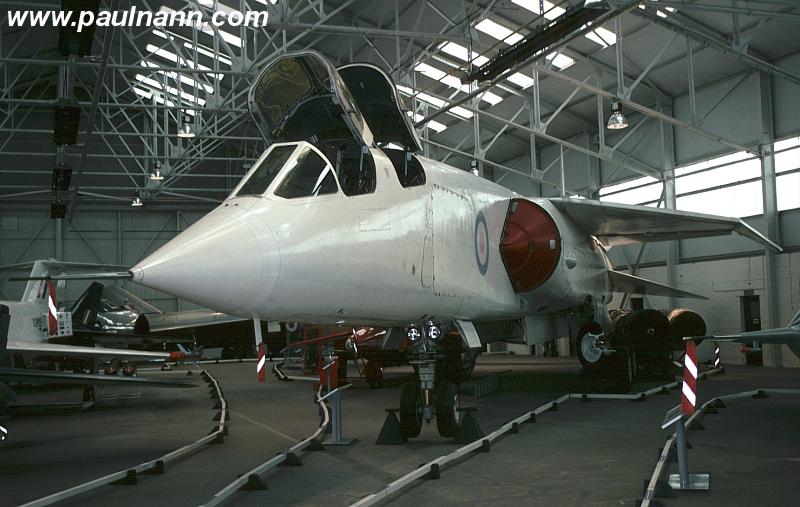
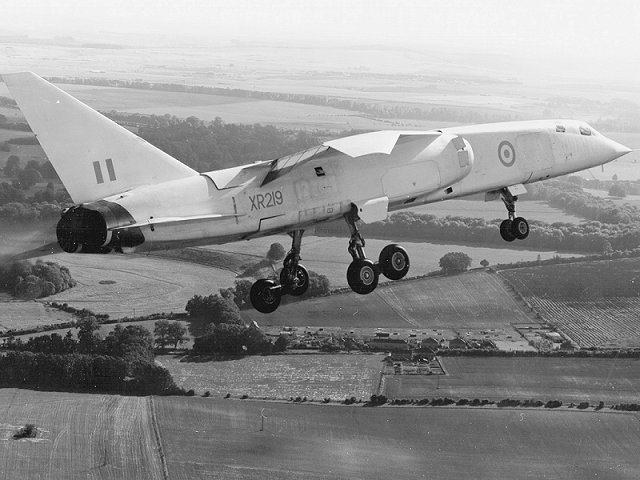
The cancellation of the TSR.2 was disastrous to the British aircraft industry. The TSR.2 was ahead of its time, & as a result most of the pioneering research carried out during the project was of great benefit to the development of the Concorde. The aircraft's intended role is described by its name (TSR an acronym for Tactical Strike/ Reconnaissance). The TSR.2's engines were the most powerful in the UK at the time. The two Bristol Siddeley Olympus 22R Mk320 afterburning turbojets were capable of producing 19,600lbs of dry power, or 30,610lbs with afterburning. Unfortunately, some major faults developed in the engines. When they were tested in a Vulcan B.1 at Filton Airfield (near Bristol), they exploded, destroying the Vulcan. The cause was finally discovered. One of the Air Staff's requirements was that the TSR.2 had to fly at a constant speed of Mach 2.2 for 45 minutes (a pointless requirement). Flying at this speed required about 99% of engine power. The engines had to be redesigned to fly at this speed, which required elaborate cooling systems to prevent the engines from overheating. One of the shafts, which drove a compressor, was tubular. The jets of air which cooled the engine caused the shaft to vibrate when the engine was at over 98.5% of full power. This vibration in the tightly-packed engine could cause fuel-tanks to rupture; the fuel could then explode, destroying the aircraft. The TSR.2 incorporated many useful features. These included blown-flaps for increased lift & manoeuvreability at low speed, a retractable IFR probe, spacious bomb-bay & under-wing pylons & both a forward-looking terrain-following attack radar & a pair of sideways looking radars (SLARs). When the TSR.2 programme was cancelled, the Government ordered 50 American F-111Ks, aircraft which were far inferior to the TSR.2. The F-111 was in every kind of difficulty; it was overweight, it was prone to wing-pivot fatigue, & its airframe & engines were mismatched. The TSR.2 project was eventually cancelled in 1965 by a new British Government, whose official policy was to buy 'cheaper, more effective' aircraft from the United States. Several major British projects were cancelled in favour of inferior American types, including the Hawker P.1154 & the Whitworth-Gloster 681 (replaced by the Phantom & the Hercules). If the Labour party would of lost the 1964 election, the TSR.2 & several other projects would of come to a successful conclusion, & the British aircraft industry would once again (technologically) lead the world. |
||
|
TSR.2 Type: Two-seat strike/reconnaissance aircraft Powerplant: two 13,884kg (30,610lb) thrust Bristol Siddeley Olympus 320 turbojets Performance: Max. speed at altitude 2,390km/h (1,485mph); Max. speed at low-level (61m/200ft) 1,345km/h (836 miles); Service ceiling 16,460m (54,000ft); Range at low-level 1,287km (800 miles) Dimensions: Wingspan 11.28m (37ft); Length 27.13m (89ft); Height 7.32m (24ft); Wing area 65.03m2 (700ft2) Weights: Average mission take-off weight 36,287kg (80,000lb); Max. take-off weight 43,545kg (96,000lb) Armament: Up to 2,722kg (6,000lb) of conventional or nuclear weapons in internal weapon bay; four underwing pylons for up to 1,814kg (4,000lb) of weapons |
||
|
[Back to Research & Development] [Home] [Jet Net UK Warzone] [Jet Net UK Photo] [Contact Jet Net UK] |
||
