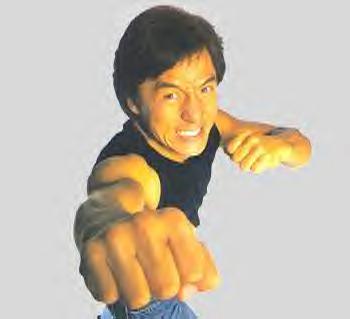
The success of Drunken Master gave Jackie more control over his films, and he directed and choreographed his next, and last, film for Lo Wei, 1979's Fearless Hyena. Following that film, Jackie realized he had to extricate himself from the meager talent of Lo Wei, and signed with Raymond Chow's Golden Harvest film company. However, this breach of contract angered Wei, who together with the Triads issued threats on Jackie Chan's life. To avoid any messy problems, Jackie was sent to America, where he was to try and break into the U.S. market. He made Battle Creek Brawl, which was a big flop, mostly because Jackie didn't get the chance to do the style he wanted. Instead of a hillarious Kung Fu artist, Jackie was a Chinese kid in America's 1930s. Jackie would also return to America in 1981 and 1984 to fill a small role as a Japanese driver in the Cannonball Run films. Jackie was bought out from Lo Wei at the amount of HK.$10 000 000 by Golden Harvest studio heads Raymond Chow and Leonard Ho. Jackie was free to return to Hong Kong
Jackie Chan's World...
Jackie's trip to America was not a total waste, as he was first exposed to early American silent film stars like Harold Lloyd and Buster Keaton. Admiring their movement and timing, as well as their stunts, he realized that movement and physical control could lead to spectacular action scenes and communicate often better than words. His 1984 film Project A, set in early 1900's Hong Kong about rivalries between the police and coast guard, took him away from the traditional Kung-Fu genre and into a new direction. The film delivers tightly choreographed martial arts and physical humor as well as stunts. Jackie goes so far as to recreate Harold Lloyd's "hanging from the clock tower" stunt, falling three stories afterward. It was around this time that Jackie's stunts begin to get more spectacular, and to connect with the audience, Jackie performs them all himself, which would eventually become his trademark.
In 1983 Jackie appeared in the Samo Hung directed comedy Winners and Sinners. Jackie, Samo, and Yeun Biao had become good friends studying at the Peking Opera together, and each achieved individual stardom in the Hong Kong movie scene. Jackie considered Samo to be his "big brother" and Biao to be his "little brother". The three would go on to make seven movies together. In 1987 after the film Dragons Forever the group had a bit of a falling out over their direction, and have not appeared together in a film since. In 1996 however, Jackie and Samo reunited to make the film Mr. Nice Guy.

From there came hit after hit, including Armour of God, Project A II, Dragons Forever, Police Story II, Miracles: Mr. Canton and Lady Rose. All these films feature fast, tightly choreographed fight scenes and dangerous stunts. While filming The Armour of God Jackie fell from a tree and hit his head on a rock causing a hole in his skull, a wound which he carries to this day.
Numerous hits followed cementing Jackie's position as Hong Kong's premier action star. In the mid 1980's Jackie formed his own production company "Golden Way", which in addition to Jackie's own movies, has produced such films as Stanley Kwan's "Rouge".
Jackie continued to make hits throughout the 90's, despite competition from more Hong Kong and American films. Jackie's films have taken on different directions, including teaming with action star Michelle Khan (Yeoh) in 1992's Police Story III: Supercop, and taking a more dramatic turn in 1993's Crime Story, based on the true story of a Hong Kong detective.
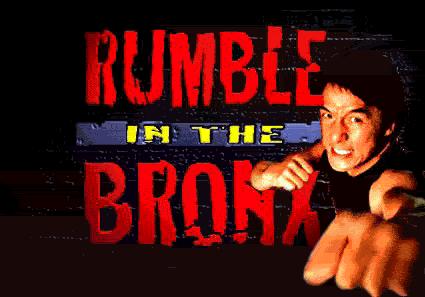
Following the success of Rumble in the Bronx, New line bought rights to Chan's successive works, while Miramax films bought up Jackie's recent 90's work to distribute in the U.S. Enjoying his newfound fame, Jackie has traveled to the United States often to promote his films, as well as continuing to promote his films around the world. After a lifetime in film, Jackie has developed his own unique style,
impossible to capture in words, and visible only in the magic of his films. Concerning his place in film history, Jackie says- "I want to be remembered like I remember Buster Keaton. When they talk about Buster Keaton or Gene Kelly, people say 'Ah yes, they good'. Maybe one day they remember Jackie Chan that way. That's all".