
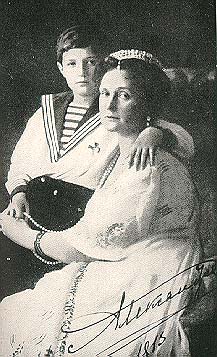

The following morning, Alexis was still alive and the swelling on his thigh had begun to dissapeared; the internal bleeding had stopped. He was still pale and weak but alive and the nightmare had at last ended. Many theories had tried to explained how this happened, but to Alexandra the fact was that Rasputin had cured Alexis with his prayers and she was sure that while he stayed by her side, Alexis would remain alive.
On Sunday, June 28 1914, the heir to the Austro-Hungarian Empire, Archduke Franz Ferdinand and his morganatic wife, Sophia Chotek, payed a visit to Sarajevo, the capital of Bosnia, a Slav province under Austrian rule. Things were not good in Bosnia; there was a great discontent and a revolutionary discord agitated the city. There was a nationalist movement that wanted to create a great Slav state under the rule of the independent kingdom of Serbia. While driving through the streets a bomb that was thrown form the crowd exploded at the rerar of the Archduke's open motorcar. Franz Ferdinand and his wife were not hurt and continued their ride through the city. Suddenly a young Serbian named Gavrilo Princip appeared within the crowd and shot the Archduke and his wife, killing them both.
The Austrian government reacted violently and claimed that the murder of the Archduke was a declaration of war from Serbia to Austria. Meanwhile in Siberia, some hours before Franz Ferdinand was killed in Sarajevo, Rasputin was also suffering an attempt against his life. A woman named Jina Guseva, disciple of Iliodor, thrust a knife into Rasputin's stomach. The starets was severely injured and during two weeks his life was in danger but afterwards, with his characteristic strenght, he recovered. The doctor who saved him received a gold watch in gratitude from Alexandra.
On July 20, 1914, Nicholas and Alexandra received the state visit of the French presidetn, Raymond Pioncare. The visit lasted five days. The morning following Poincare's departure, on July 25 1914, Austria sent an ultimatum to Serbia, claiming that the Archdule's murder had been plotted in Belgrade and that the assasin had been supported by Serb officials. It demanded that Austrian officers were allowed to go into Serbia to conduct their own investigation and the suppression of all Serb nationalist propaganda against the Austrian empire. Serbia must answer in 48 hours.
When she received the ultimatum, Serbia appealed to Russia, traditional protector of the Slav nations. Nicholas assured the Serbian Crown Prince that he would not remained indifferent to the fate of Serbia. To Nicholas and his ministers, the Austrian ultimatum to Serbia aapeared to be a direct attack against Russia. The Russian minister of Foreign Relations, Serguei Sazonov, advised the Serb minister, Pashich, to accept the Austrian demands; Serbia, indeed, answered the ultimatum in the most friendly terms. Austria expecting another answer, was shocked and on July 28 she declared war to Serbia. At five in the morning of July 29 the Austrian artillery opened fire against Belgrade. In response, Nicholas oredered the mobilization of the Russian troops along the Austrian border.
The Russain mobilization was only against Austria; the frontiers with Germany remianed the same. Nicholas tought that his cousin the Kaiser did not want the war. In fact Wilhelm tried to mediate between Austria and Russia and several telegrams were exchanged between he and Nicholas, but when he knew of the Russian mobilization, he ordered Count Pourtales, German embassador in St. Petersburg, to present an ultimatum to Russia inviting her to stop the mobilization. As Russia had not answered for the next afternoon, Wilhelm ordered mobilization. France, Russian allied, mobilized her troops that same day. The following day, August 2, 1914, Nicholas made the formal declaration of war against Germany from the Winter Palace. When he and Alexandra appeared before the crowd gathered in the square, people accalimed them, filled with patriotism, shouting. "Batiushka, take us to victory!".
On August 3, Germany declared war to France and two days later Austria declared war against Russia. When the German army crossed the neutral Belgian frontier, England entered the war against Germany and on the Russian and French side.