|
Jesus himself
foretold his death and resurrection, and these events came
about exactly as he had predicted.
John 2:19-21
"Jesus answered them, 'Destroy this temple, and I will
raise it again in three days.' The Jews replied, 'It has taken
forty-six years to build this temple, and you are going to
raise it in three days?' But the temple he had spoken of was
his body."
John 10:17
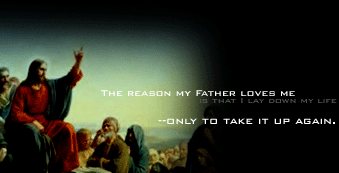
"The reason my Father loves me is that I lay down my
life--only to take it up again."
John 16:16-23
"In a little while you will see me no more, and then
after a little while you will see me.' Some of his disciples
said to one another, 'What does he mean by saying, 'In a little
while you will see me no more, and then after a little while
you will see me,' and 'Because I am going to the Father'?'
They kept asking, 'What does he mean by 'a little while'?
We don't understand what he is saying.' Jesus saw that they
wanted to ask him about this, so he said to them, 'Are you
asking one another what I meant when I said, 'In a little
while you will see me no more, and then after a little while
you will see me'? I tell you the truth, you will weep and
mourn while the world rejoices. You will grieve, but your
grief will turn to joy. A woman giving birth to a child has
pain because her time has come; but when her baby is born
she forgets the anguish because of her joy that a child is
born into the world. So with you: Now is your time of grief,
but I will see you again and you will rejoice, and no one
will take away your joy..."
Matthew 12:40
"For as Jonah was three days and three nights in the
belly of a huge fish, so the Son of Man will be three days
and three nights in the heart of the earth."
Matthew 16:21
"From that time on Jesus began to explain to his disciples
that he must go to Jerusalem and suffer many things at the
hands of the elders, chief priests and teachers of the law,
and that he must be killed and on the third day be raised
to life.
Luke 18:31-33
"Jesus took the Twelve aside and told them, 'We are going
up to Jerusalem, and everything that is written by the prophets
about the Son of Man will be fulfilled. He will be handed
over to the Gentiles. They will mock him, insult him, spit
on him, flog him and kill him. On the third day he will rise
again."
The
event is well-documented by numerous reliable, historical
sources.
Historians
such as Josephus (c.37-110 AD), Ignatius (c.50-115 AD), Justin
Martyr (c.100-165 AD) and Tertullian (c.160-220 AD) were convinced
of the authenticity of the resurrection. Their writings validate
the accounts of the Gospel writers, who, according to leading
biblical scholarship, recorded the event as soon as 37 AD
and no later than 64 AD.
In addition,
other first and second century historians including Cornelius
Tacitus, Suetonius, Plinius Secundus, and Lucian of Samosata
acknowledged the impact this incredible event had on the people
of the time.
The resurrection is the only plausible
explanation for the empty grave.
Roman soldiers
closely guarded the tomb where Jesus' body was laid. Moreover,
the grave's entrance was sealed by an enormous boulder. The
Roman guard, which was usually composed of 16 members, would
have made it impossible for the disciples--who, by the way,
were cowering in fear for their own lives--to steal the body.
If, as some have claimed, Jesus was not dead, but only weakened,
the guards and the stone would have stopped his escape. After
being beaten and flagellated, hung on a cross for six hours,
pierced by the spear of his executioners to ascertain his
death, and wrapped, as was the custom, in 100 pounds of linen
and spices, Jesus would have been in no shape to roll a two-ton
stone uphill, outwit 16 Roman soldiers and then appear radiantly
to his disciples.
The Jewish
leaders of the day could easily have refuted all claims of
the resurrection by simply producing a body, but they were
unable to do so because there was no body.
There are
numerous eyewitnesses to the resurrection.
After he rose
from the dead, Jesus appeared at least ten times to those
who had known him and to as many as 500 people at one time.
These appearances were not hallucinations; Jesus ate and talked
with his followers and they touched his resurrected body.
Luke 24:36-39
"While they were still talking about this, Jesus himself
stood among them and said to them, 'Peace be with you.' They
were startled and frightened, thinking they saw a ghost. He
said to them, 'Why are you troubled, and why do doubts rise
in your minds? Look at my hands and my feet. It is I myself!
Touch me and see; a ghost does not have flesh and bones, as
you see I have.'"
John 20:26-29
"A week later his disciples were in the house again,
and Thomas was with them. Though the doors were locked, Jesus
came and stood among them and said, 'Peace be with you!' Then
he said to Thomas, 'Put your finger here; see my hands. Reach
out your hand and put it into my side. Stop doubting and believe.'
Thomas said to him, 'My Lord and my God!' Then Jesus told
him, 'Because you have seen me, you have believed; blessed
are those who have not seen and yet have believed.'"
1 Corinthians
15:3-8 "For what I received I passed on to you as of
first importance: that Christ died for our sins according
to the Scriptures, that he was buried, that he was raised
on the third day according to the Scriptures, and that he
appeared to Peter, and then to the Twelve. After that, he
appeared to more than five hundred of the brothers at the
same time, most of whom are still living, though some have
fallen asleep. Then he appeared to James, then to all the
apostles, and last of all he appeared to me also, as to one
abnormally born."
The
resurrection is the only reasonable explanation for the beginning
of the Christian movement.
The Christian
church was born in the very city where Jesus was publicly
killed and buried. The belief in a resurrected Jesus had to
be authentic to take root in Jerusalem and grow to encompass
the whole world. The Christian church is now the largest institution
that exists or has ever existed in the history of humanity.
Clearly, this would have been impossible if the resurrection
was a story.
The
resurrection is the only logical explanation for the transformed
lives of the disciples.
They deserted
and even denied Jesus before his public trial; after his death
they were discouraged and fearful. They did not expect Jesus
to rise from the dead. Yet, after his resurrection and their
experience at Pentacost, these same discouraged, disappointed
men and women were transformed by the mighty power of the
risen Christ. In his name, they turned the world upside down.
Many lost their lives for their faith; others were terribly
persecuted. Their courageous behavior does not make sense
apart from their conviction that Jesus Christ was truly raised
from the dead--a fact worth dying for.
Throughout
the centuries, most great scholars who have considered the
proofs of the resurrection have believed, and still believe,
that Jesus is alive.
After examining
the evidence for the resurrection given by the Gospel writers,
the late Simon Greenleaf, an authority on legal issues at
Harvard Law School, concluded: "It was therefore impossible
that they could have persisted in affirming the truths they
have narrated, had not Jesus actually risen from the dead,
and had they not known this fact as certainly as they knew
any other fact." Mr. Greenleaf was a Jewish professor
who became a believer in Jesus the Messiah after studying
the facts for himself.
What are
your conclusions? Do you believe Jesus is alive? (click
here)
|