Works and
embellishments in spite of dark shadows
It was not so easy to go on with the constructions and, at the same
time, think of the outcome of the grey clouds and dark shadows which gathered
over Europe, and which could only mean war. In spite of all odds, the
Dominican fathers did not lose heart, and endeavoured to amass the "Church
Building Fund". They had long wished to see their dreams of a larger
church fulfilled. The Conventual Council decided that the financial capital
of 2,233 pounds sterling, which had been saved for the specific reason of the
works needed, was to be withdrawn from the banks and deposited in the Bank of
Tagliaferro to accrue a higher financial interest. One must admit that
both the monies saved and the financial collections were very encouraging, and
the building works could go at a fast pace. The Dominican Provincial, Fr
Louis Nolan, who showed a special interest and care for the church, would not
suffer the works to come to an end as in the case of the originally planned new
church. He helped tremendously by agreeing to financial loans from the
other Dominican convents besides securing monies from elsewhere.
As time passed, and as the war between the Allies and Germany spread
over the Continent, laws and norms to control building works were passed and
enacted. The first order of the "Building Control Board", based
on Regulation number 50 of the "Malta Defence Regulations", specified
that any process of building could be suspended, or workmen restricted as both
building materials and labourers could be needed by the civil or military
authorities . Yet, the Dominican brethren were fortunate enough not to be
affected by these laws and, at the same time, managed to secure the necessary
building force and materials.
Although air-attacks on Malta increased and grew tougher when, in June
1940, Italy went to war on the side of the Axis, construction works still
progressed. The cupola was not yet built, and much of the sculpture works
were still to be carried out when, on 27 December 1941, Fr Provincial
Louis Nolan O.P. blessed the enlarged church which then began to be used by the
faithful.
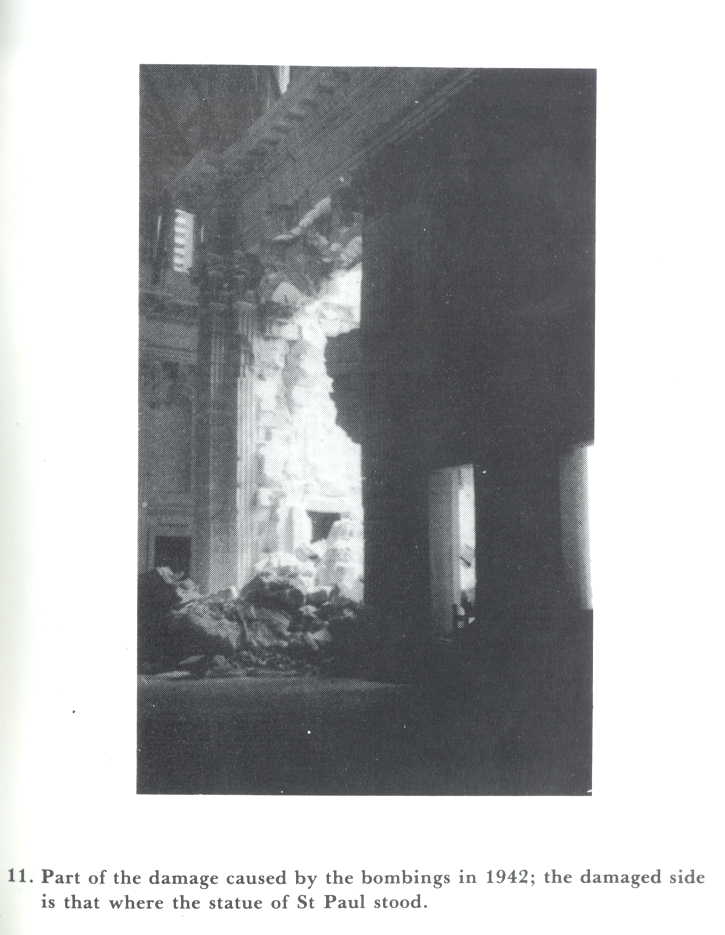
On 17 March 1942, the church was directly hit during an air-raid, and
parts of the ceiling, sections of the pillars, and the main altar were severely
damaged. The statue of St Paul, and the titular picture of Jesus of
Nazareth, the work of Attilio Palombi, were completely destroyed. For some reason or other, the needed repairs
took some time to commence, and it was only on 5 February 1945 that the works
of reconstruction could be started with high hopes that the War Damage
Commission would in time reimburse all expenses involved ; which hopes
were in fact realised some years later.
In May 1942, when Fr Dominic Borg O.P. was nominated Vicar Superior of
the Sliema community, he readily undertook to see that the church
refurbishment, and other much needed maintenance works be carried out to
completion. There were the wooden choir stalls, a job already commenced
by a certain John Mary Pirotta of Naxxar, that was to be finished. The
destroyed titular picture of Jesus of Nazareth had not yet been replaced.
Fr Dominic entrusted the painting to artist Guido Cali’; this was completed in
the first months of 1944, and was placed in the central niche of the
choir. Later on, Professor Oscar Testa was asked to portray the effigy of
Jesus of Nazareth as a copy of the one at the Roman Parish Church of St Mary in
Monticelli. Today, this painting can be seen at the Sanctuary in the
chapel of the Blessed Sacrament.
When sculptor Chevalier Vincent Apap was asked to work on the series of
figures depicting the Patriarchs and the Prophets, to be placed in the niches
around the church, that of Jesus of Nazareth was set in the centre recess of
the choir replacing Cali’s painting; the latter can now be found near the
Parish Priest’s office at the entrance to the priory.
Lack of funds, more seriously needed projects, and the urgent necessity
of building a new priory hindered the continuation of works of the
statues. It was some forty years later that work on these was
resumed. The set of six, to be found in the choir niches, were executed
between 1980 and 1983; that of the Nazarene and four others, also in the choir,
were completed in the next three years. By 1988, Chevalier Apap finished
six other statues for both the side naves, while another four were in place by
1993 together with those of Our Lady and of St Dominic which were placed in the
central niches of the naves. Our forebrethren’s dream of a chain of
effigies as symbols of and with the Nazarene as the central figure was finally
realised.
Chevalier Apap also sculptured the statue of St Paul to replace the one
destroyed during the war, and worked out the other two of St Joseph and St John
the Baptist to complete the series in the aisle niches.
The Sanctuary Basilica was further embellished by the main altar,
designed to comply with the liturgical reform, manufactured in 1968 by the
Italian Ceccotti firm of Lucca, by the construction of the dome which was
completed in 1970 by Carmel Grech of Balzan, and by the building of the upper
facade of the church in 1973.
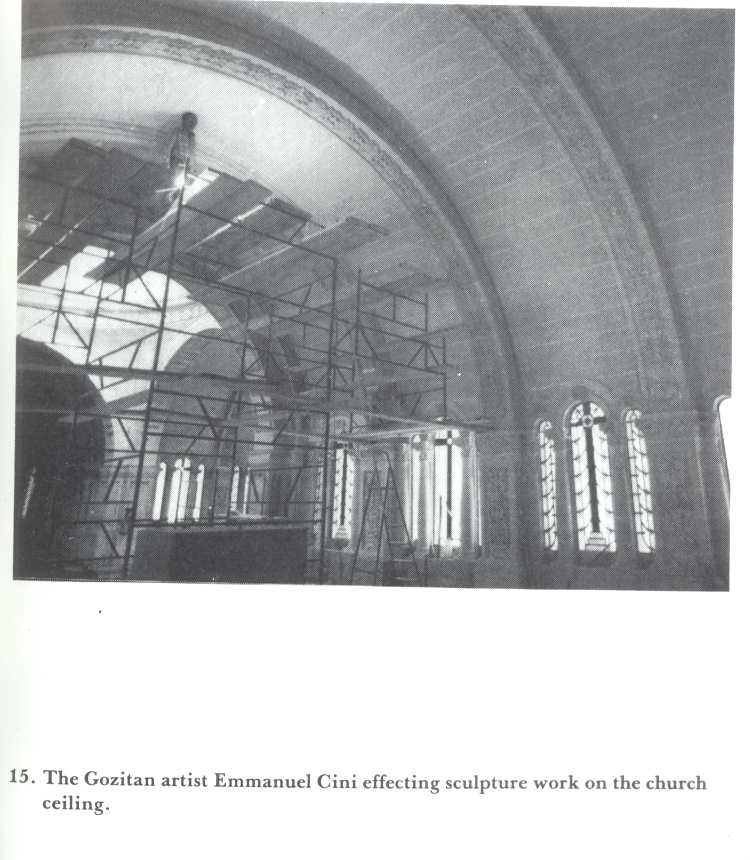
During these last years, the sculpture works, still
missing since the opening of the enlarged church, on the aisle ceiling arches
and their vertical walls, were continued and brought to an end. Similar
works in the side naves and choir will also be completed in the very near
future. When these latter embellishments are finally effected, we would
have accomplished what our older brethren had long wished for but were
unfortunate not to have achieved. It is also intended to have other major
modifications to the interior of the dome to have its stonework in line with
the architectural style of the church. All the ornamental designs and
sculptural jobs have been entrusted to Mr Emmanuel Cini, a Gozitan sculptor,
who has already done other artistic works in the older part of our church’s
aisle. Cini also happens to be a renowned stone artist.
It is worthwhile to conclude by stating that the population in Sliema, including the neighbourhood around the church, was ever on the increase especially after the Second World War. This induced the Archbishop of Malta, Sir Michael Gonzi to decree, on the 1st September 1973, that parts of Sliema known as Tigne' and Qui-Si-Sana were to be knit together as a Parish on their own, and entrusted to the care of the Dominican community with the Sanctuary Basilica of Jesus of Nazzareth as the Parish Church.