Jesus of Nazareth Choir
A singular asset to religious rites and functions has always been the presence of a choir. A group of vocalists rendering sacred hymns, chants and cantatas, and leading the congregational singing has proved to be, from time immemorial, a specific enrichment to church ceremonials.
This has been, and presently still is, the case at the Parish Church run by the Dominicans in Sliema. The Choir, its name synonymous to that of the Parish: Jesus of Nazareth can trace its roots back to some forty-two years ago when Fr Salv Galea O.P., its present Director and Choir Master, was assigned to the Sliema community in 1960. At that time, Fr Galea found fifteen young girls who eventually were scaled down to six; all that was left of a larger choir group.
Fr Salv, intending to form a suitable group of sopranos, altos, tenors and basses, embarked on a meticulous search of what, in a period of about two years, but after strenuous long months of practice, turned out to be a successful enterprise. So much so, that early in 1963, the Choir embarked on its first public show at the celebration of the Titular Feast of Jesus of Nazareth singing a solemn Mass in four voices. This was to be a herald of greater things to come.
In 1967, the Jesus of Nazareth ensemble won first prize at a choir competition, and was placed second at a similar event two years later. The coveted St Cecilia trophy can still be enjoyed in the choir’s rehearsal hall at the Sliema Priory.
Like all other groups and circles, the Choir experienced its ups and downs, its bright and dull moments; members come and go. Yet, in spite of all odds, it carried on with its musical activities at the Sliema Church, at other Dominican Priories and in a good number of parishes round the Island. The Choir was not found wanting when invited to vocal renderings at soirees, concerts, solemn Masses and similar events.
One principal occasion that calls the obvious and automatic presence of a choir is the Christmas Season. On Christmas Eve, the Jesus of Nazareth Choir renders an hour-long carol service at the Dominican Parish Church in Sliema. It then carries on with its musical service at the Solemn Midnight Mass.
It was such an auspicious performance that led the Choir to be awarded what was to turn out to be an indelible feature and a golden laurel in its long history. Fr Salv Galea O.P. and the choir members were unaware that the carol service and the vocal renderings during Mass were being followed and noticed attentively by outside forces. They only got to know a couple of months later in the new year when a formal invitation to take part in a special event in London was forwarded to Fr Salv and his choir.
The Malta High Commission in conjunction with the Malta Tourist Authority and the Maltese Community in London were, for the second year running, to celebrate Malta Day commemorating our National Day in September. The occasion was to be highlighted by a High Mass at Westminster Cathedral and the twenty-four strong Choir was to lead the congregation to a selection of Marian hymns, render a sung Mass and its relative liturgical chants.
The Choir Master and Director, Fr Salv Galea O.P., left no stone unturned in his earnest preparation for the propitious event. Rehearsals were held in full swing as Carmelo Pace’s Quddiesa tal-Poplu t’Alla for two voices was to feature for the first time in the Choir’s repertoire. Other hymns and chants included a response for four voices and a hymn to Our Lady, both composed by Fr Salv; a Marian hymn by Gruger; an English aria Salve Regina adapted on an XVIII century hymn; another tune by Moreau; Himmel’s Panis Angelicus with Fr Salv’s arrangement for a second voice for basses; Handel’s Largo, and the obvious rendering of our Innu Malti.
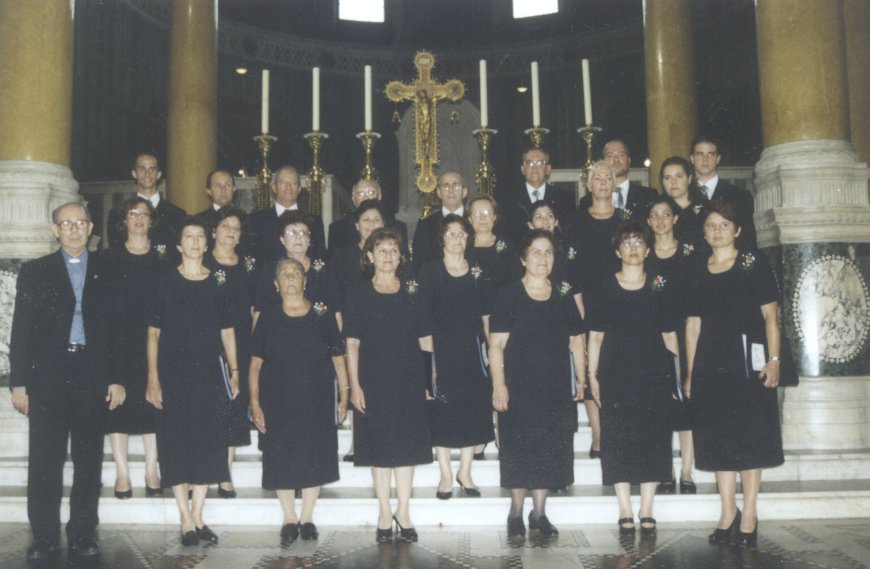
|
The Choir was accompanied by the Cathedral’s organist Gabriele Damiani who also played Schubert’s Ave Maria sung by soprano Sophie Grech.
The singing was received with a fine ovation and delightful comments at the end of the Mass. The gracious remarks were reiterated during a Dinner Dance and Variety Show held for the occasion at the Galleon Suite of London’s Royal National Hotel where the choir members were present. His Excellency Dr George Bonello Du Puis, the Malta High Commissioner, thanked most heartily Fr Salv Galea O.P. and his choristers for their contribution in making Malta Day a success. The Maltese choir, went on His Excellency, was received with a warm welcome; its musical score was superbly executed; its singing was something that would be remembered and recorded in the history of the Maltese Community in London.
“Ýou made history in that it was the first time Maltese Mass was heard in song in the primary temple of British Roman Catholicism. The Mass was excellent and much enjoyed by all present.” The clauses were put in writing in His Excellency’s letter to Fr Salv when thanking him and the Choir also on behalf of the Maltese community of the United Kingdom.
In another letter of the Maltese Ursuline Sisters working in London, a seasoned organist, Mother Eugenia Pantalleresco, expressed her admiration at the wonderful performance of the choir. She also included comments of Barbara Scerri and Fr Victor Camilleri, two of the officials at the Maltese Culture Movement in London. Ms Scerri stated that “The choir was excellent and extremely professional. They created a very moving experience in the Cathedral.” Fr Victor added that “It was a day which enthused many Maltese people who attended the Mass. The singing was brilliant and well co-ordinated. Well done to the Choir and the Conductor.” Mother Eugenia continued to state that she understood what it entailed to bring a choir up to that level. It required pains and many, many hours of practice and toil. She ended congratulating Fr Salv saying that the result was rewarding, and that the good work should be kept up.
The London event that the Jesus of Nazareth Choir experienced will surely serve to boost its courage for the future. It will be positively recorded as a golden mark in its diary of musical services given on various occasions in the different parishes in Malta and Gozo.
Dominic V. Scerri O.P.
7th October 2002
Excerpts from an e-mail by M Antoinette Dalli, resident in the U.K., sent to her brother Pio, one of our local experienced baritones. 18 October 2002
Some weeks ago, we had a fine Maltese taste of some very beautiful singing at Westminster Cathedral. I asked myself if this was the choir that someone had pointed out to me.
I sat down to listen to what the official programme indicated as “Jesus of Nazareth Choir” from Malta that was in London for the special occasion (the feast of Our Lady of Victories). They were rehearsing. Right from the start, I realized that this was a sound choir. They were very composed, without too much talk, well organised and disciplined.
At the stipulated time for the beginning of the Mass, the choir proceeded to take its place behind the altar in an orderly and disciplined manner. They sang beautifully, were in perfect cohesion and their tonality was enchanting. Apart from having been a member of choirs in Malta and in England, I heard a good number of the like in the thirty-one year span I spent in the U.K. I heard good choirs, others classified so and so, some I would never hear again. Yet, I know for certain that, if I had the chance again to hear the Jesus of Nazareth Choir, I would do so.
Their timbre was somewhat different from that of English choirs, yet no less in grade. I could understand their diction, a difficult characteristic to choirs, but one that makes all the difference. Look to singers, even to soloists, and you will note the difference when words being sung are understood and when you cannot gather what is being said. This choir had a very good diction. You would also know what they were singing. They had a good technical proficiency; started and finished in unison; were dynamic, and created no echo and sound of score pages being turned. Such matters seem trifles but, in the case of choirs, when many individuals sing as one voice, they are all so vital.
When Mass was ended, everyone was full of praise for the choir; how good it was, how well they sang.